All
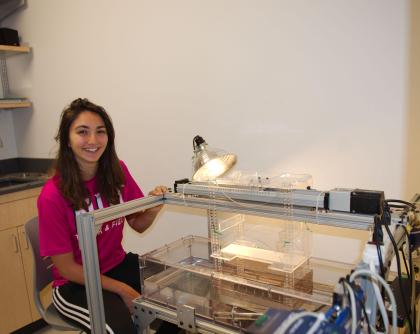
Students Search for Insights into the Brain and Behavior
Learning is very much a hands-on experience for Nicole Andanar, Hannah Gattuso, Yasmine Ghattas and David Liptsyn, NJIT undergraduates enrolled in Albert Dorman Honors College who are working with Associate Professor Eric Fortune, Department of Biological Sciences, to explore the unknowns of how the brain uses sensory information to influence behavior.

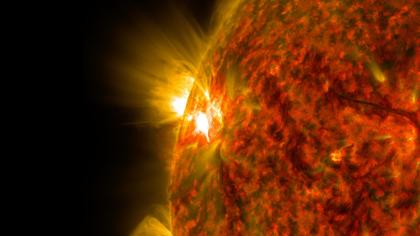
Putting Students Closer to Explosive Solar Events
NJIT has a long-established reputation as a leader in researching phenomena originating on the star closest to Earth — the Sun. NJIT’s optical telescope at Big Bear Solar Observatory and radio telescope array at Owens Valley, both in California, have greatly expanded our understanding of solar events that periodically impact our home planet, events such as solar flares and coronal mass ejections (CMEs) that can disrupt terrestrial communications and power infrastructure in addition to other effects.
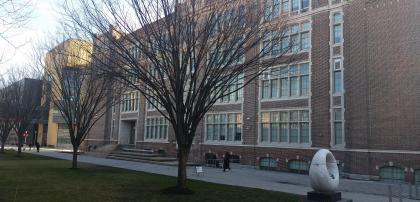
Helping to Make Written Words Matter at NJIT
Words have consequences. Whether spoken or written, the words we choose to use matter profoundly across the spectrum of our relationships with others. They matter from the very personal communication we share with those closest to us, to achieving success in school and the workplace, to engaging in social and political debate — hopefully debate that is civil and informed given the verbal tenor of our times.
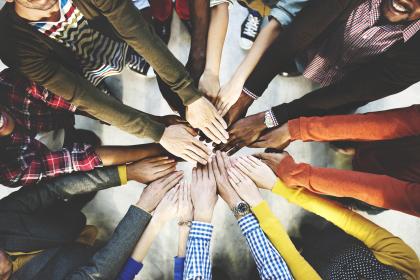
Is the Cooperative Economy Next in a Post-Consumer World?
For a significant part of the 20th century, the Manufacturing Economy generated unprecedented material prosperity in the United States. Then, as well-paying factory jobs migrated to corners of the world where labor is much less expensive, it was the Information Economy or the Service Economy that provided gainful employment and enabled the consumption underpinning our national and individual well-being.
Delving Deeper into the Circadian Rhythms of Life
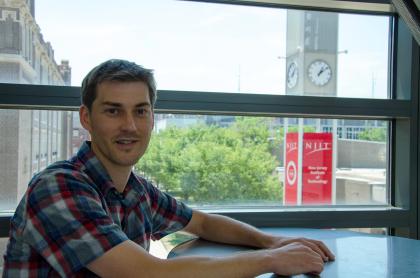
The circadian rhythms that harmonize our behavior with the daily cycle of light and dark, and with seasonal change, are among the most powerful physiological forces that we experience each day — forces that are experienced not only by other mammals, but also by many other living organisms.

Finding Valeria: A Ph.D. Story
Valeria Barra charted an unusual course from Siena, Italy to Newark, New Jersey and now onward for an internship program in Emeryville, Calif. at a one-time Steve Jobs startup you may have heard of - Pixar Animation Studios. Pixar has won eight Academy Awards for Best Animated Feature—“Inside Out,” “Brave,” “Finding Nemo,” “The Incredibles,” “Ratatouille,” “WALL-E,” “Up” and “Toy Story 3” have all taken home an Oscar.
An Explorer on the Frontier of Behavior
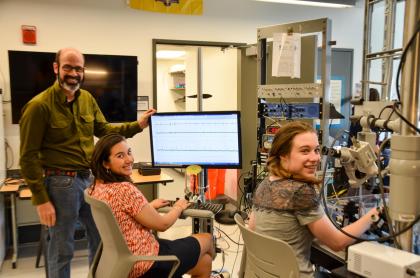
Associate Professor Eric Fortune, a member of the Department of Biological Sciences since 2012, is an explorer whose research is focused on finding answers to questions at the frontiers of human physiology and behavior. In his Central King Building laboratory, with the assistance of undergraduate and graduate students, Fortune is challenging the unknowns of how the brain uses sensory information to control behavior. It’s a search that has also taken him far from the NJIT campus, to wilderness locations in South America.
From Cells to Science and Society — Kevin Belfield is Engaged Across a Broad Spectrum of Research
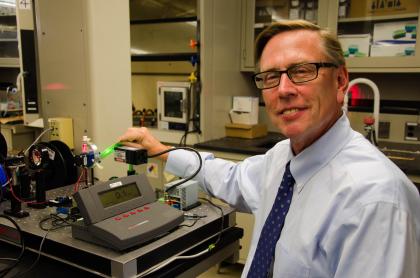
As a researcher, Kevin Belfield is working at the forefront of medical innovation to develop a minimally invasive imaging technique that could revolutionize how wound healing and the growth of cancerous tissue are monitored. A professor in the Department of Chemistry and Environmental Science, Belfield is also dean of the College of Science and Liberal Arts (CSLA), and in this role he is helping to build the success of programs that span a very broad spectrum of research and education at NJIT.
Coastal Perspectives — Studying Forces That Affect Life Where Land and Water Meet
Land lies in water; it is shadowed green.
Shadows, or are they shallows, at its edges
showing the line of long sea-weeded ledges
where weeds hang to the simple blue from green.
Or does the land lean down to lift the sea from under,
drawing it unperturbed around itself?
Along the fine tan sandy shelf
is the land tugging at the sea from under?
— From “The Map” by Elizabeth Bishop