All

Fake News, Cyberbullying, #MeToo: Law, Technology and Culture Director on Living in the Digital Age
Since 2017, NJIT students, faculty and administrators have gathered for “Talking Back to Hate,” a teach-in about ways to understand and overcome evolving challenges in the expanding digital media landscape, such as misinformation, cyberbullying, trolling and more.
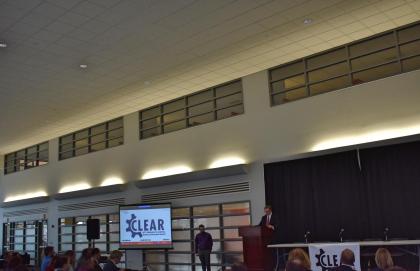
New Jersey's K-20 Education Collaborative Meets at First-Ever "Cradle to Career" Summit
In March, NJIT staged the first-ever “CLEAR: Cradle to Career” (C3 2018) Summit, aimed at “fostering a larger networked community of innovative and dedicated teachers, leaders, faculty researchers and students of all ages”.
The summit — co-hosted by NJIT’s statewide K-20 Collaborative for Leadership, Education, and Assessment Research (CLEAR) — brought together an expansive audience of NJIT students, faculty and staff; K-12 educators and leaders; and public and private organizations throughout the state.
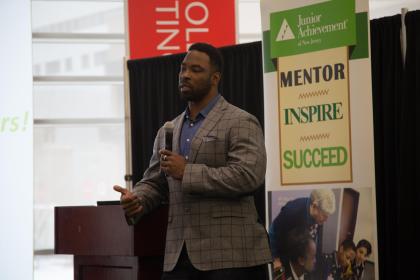
NFL Star Justin Tuck Visits NJIT, Inspires Young Students to Tackle College and Career Dreams
On April 3, Newark-area high school students and teachers arrived at NJIT in anticipation of meeting two-time Super Bowl champion and New York Giants Hall of Fame inductee, Justin Tuck.
Justin and Lauran Tuck, co-founders of the nonprofit Tuck’s R.U.S.H. for Literacy, appeared as special guest speakers at this year’s 2018 Junior Achievement (JA) Career Success® Workshop College Series to help promote career development among New Jersey’s high school learners.
A Spring Afternoon with Sophia and Friends
The first Friday afternoon of Spring 2018 brings an exciting concert to campus — acclaimed pianist Sophia Agranovich will be joined by two of her exceptional students, Mohammed Boubendir and Robert Argasinski. David Dubal, internationally known pianist, author, broadcaster and painter will introduce musical selections from composers such as Beethoven, Chopin and Liszt. The event is the first in the 2018-2019 Rauch Family Foundation Charitable Trust Concert Series at NJIT.
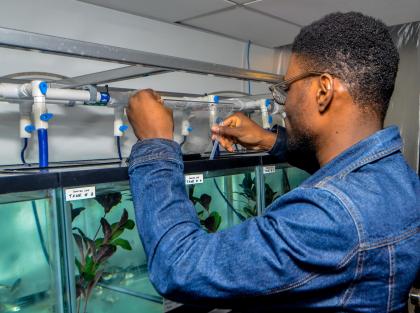
Undergraduate Ecosystems: Underwater with Blind Cavefishes
Neuroecology of Unusual Animals Laboratory
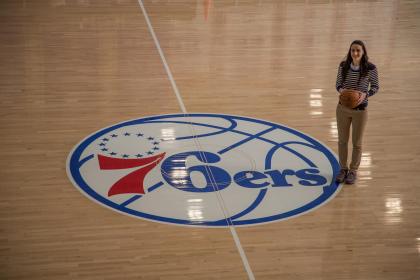
A Whole New Ball Game: Alumna Scores Job as Data Scientist for Philadelphia 76ers

NJIT alumni continue to prove that when armed with a degree from one of the nation’s leading public high-tech universities, trails are blazed and professional dreams really do come true.
Just ask alumna Ivana Seric ’17, who was able to turn her love of sports, math and science into a dream job with the NBA.
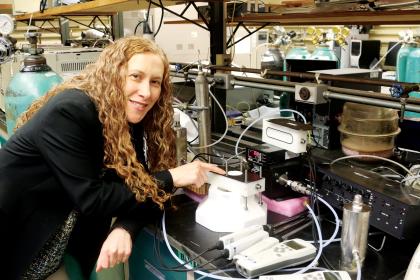
A Mathematician Takes Aim at Gunk
Some industrial processes seem to resist optimization. Filters impervious to the slings and arrows of accumulated “gunk” – the particles, minerals and organic buildup that foul water treatment facilities, nuclear power plants and even breweries – are prime among them.
And that’s where the mathematicians come in.
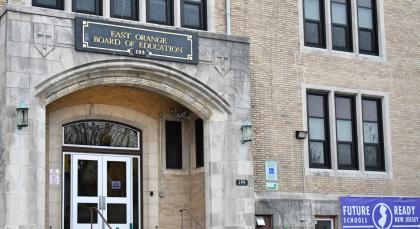
One Year In, East Orange Shines as 'Future Ready' Exemplar of Digital Learning
Paulette Salomon distinctly recalls April of 2016 as a critical point in her school district’s journey to provide the right digital learning resources and opportunities to the students of East Orange, New Jersey — a district where she has been an educator for 22 years, and has served as the educational technology supervisor to approximately 600 teachers and 10,000 students since 2010.
"Doing More with Less" Conference Explores Innovative Responses to Environmental Sustainability
The Murray Center for Women in Technology at New Jersey Institute of Technology (NJIT) will hold a one-day Women Designing the Future conference—“The Environment: Doing More with Less”—on Friday, March 23. Registration begins at 8:30 a.m. in the university’s Campus Center Ballrooms A and B.
NJIT Promotes Digital Readiness Across NJ Educational System
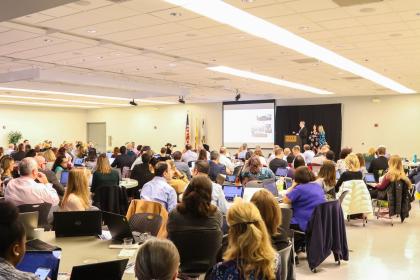
In February, more than 300 educators, superintendents, technology advisors and engaged citizens from districts throughout New Jersey convened at NJIT to promote digital education at the 2018 Future Ready Schools New Jersey (FRS-NJ) North Regional Certification Summit.