All
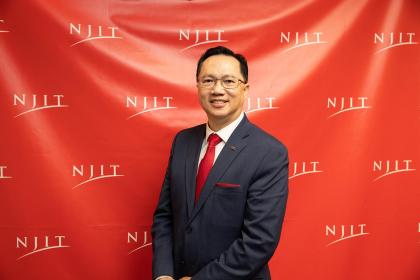
Teik C. Lim Begins Tenure as Ninth President of NJIT
July 1 marks the first day of Dr. Teik C. Lim’s appointment as president of New Jersey Institute of Technology.
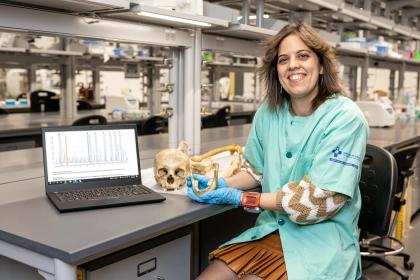
NJIT Forensic Anthropologist Investigates New Leads to Identify the Nameless
Ever since police ended the 40-year hunt for the Golden State Killer and identified Joseph DeAngelo by uploading crime scene DNA to a popular genealogy website in 2018, advances in DNA forensics have sparked an explosion in once-unsolvable criminal cold cases being resurrected and cracked after a generation. Yet, for the missing and unidentified, it is another story — often referred to as the “nation’s silent mass disaster.”
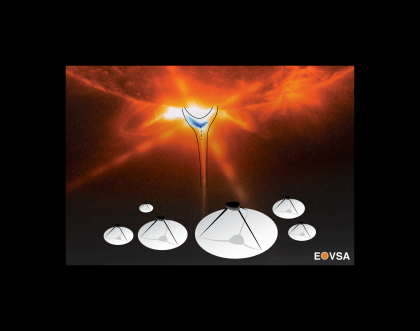
NJIT Researchers Unveil Particle Accelerator Region Inside a Solar Flare
Solar flares are among the most violent explosions in our solar system, but despite their immense energy — equivalent to a hundred billion atomic bombs detonating at once — physicists still haven’t been able to answer exactly how these sudden eruptions on the Sun are able to launch particles to Earth, nearly 93 million miles away, in under an hour.
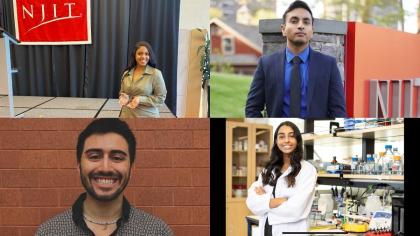
NJIT's Award-Winning Grads Reflect on Successes, Share Future Plans
Alongside the wave of excitement at Commencement 2022, NJIT’s College of Science and Liberal Arts recently decorated their star students at its annual awards ceremony.
Here, a diverse group of graduates who shared CSLA’s Outstanding Student Award look back on their NJIT journey and the successes they’ll take with them.
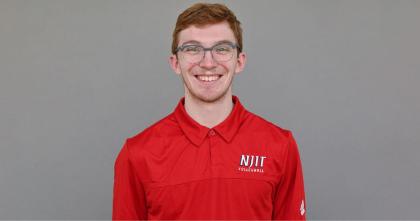
Eclectic NJIT Engineering Grad Will Andrews to Study International Development in Dublin
The bachelor’s that Donald “Will” Andrews earned at New Jersey Institute of Technology is in industrial engineering, but his heart is in international development.
The 2022 graduate’s interest in global issues traces back to high school, when he participated in the Model United Nations, and accelerated after his second year at NJIT, when he tackled a Humanity in Action Fellowship that examined democracy and pluralism in modern Germany in the context of the Holocaust.

NJIT Professors Prime Jada Evans for UCLA School of Law
Jada Evans had a plan when she arrived at New Jersey Institute of Technology in 2019 and achieved it – and then some – in just three years.
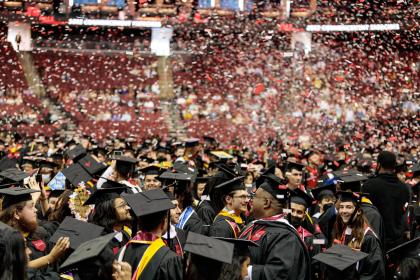
NJIT's Class of 2022 Urged to Seize the Opportunities Presented by Crises
Crisis presents opportunity, and given the pandemic, war in Ukraine, structural racism, climate change and questions around the world’s supply of energy, food and water, Rensselaer Polytechnic Institute President Shirley Ann Jackson called on the Class of 2022 at New Jersey Institute of Technology to take on such challenges with the goal of improving lives.
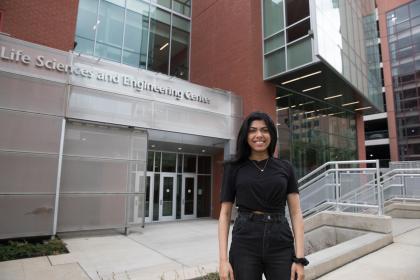
Senior Success: Sreya Sanyal Is Off to Become an NIH Researcher
Sreya Sanyal ’22 is right where she wants to be in the fight against cancer — at the cutting-edge of medical research. She’ll soon be using the breakthrough gene-editing technology CRISPR-Cas9, often described as “genetic scissors”, to study human disease as a post baccalaureate researcher with the National Institutes of Health (NIH) after graduation.
For Sanyal, whose parents met and graduated from medical school in India, her journey toward a career as a physician-scientist specializing in cancer biology has deep roots, beginning at the age of 10.
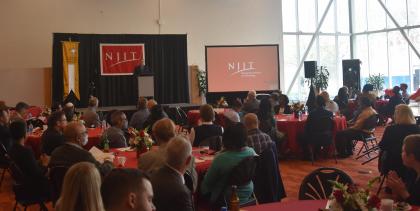
College of Science and Liberal Arts Celebrates 40 Years at 2022 Awards Ceremony
On May 4, celebratory glasses were raised at the signature year-end awards ceremony for NJIT’s College of Science and Liberal Arts (CSLA), where the incredible milestone of the college’s 40th anniversary served as backdrop to the festivities.
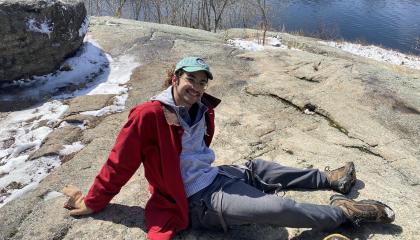
Biology Graduate Xavier Reyes Embarks on an Organic Farming Mission
For biology graduate Xavier Reyes, his decision to hang up his lab coat in exchange for overalls to become an organic farmer is the best way he can move the needle on sustainability.