Helen and john c hartmann department electrical and computer engineering
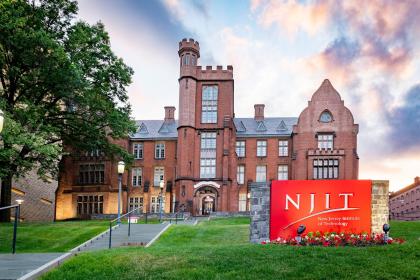
US News and World Report Ranks NJIT Online Programs Top 100 Nationally, Top 3 Statewide
Three of NJIT's online graduate programs placed among the top 100 in this year's U.S. News & World Report rankings of American universities, and in the top three for New Jersey institutions.

Dina Ayman, NJIT Alum and Professor, Named to Forbes 30 Under 30 in Enterprise Tech
Her 20s have been a busy time for Dina Ayman: earning two degrees at NJIT in the same year, working at Intel and Microsoft, teaching at her alma mater and starting a consultancy dedicated to diversity and inclusion.
Along the way, she achieved her dream of working at the intersection of engineering and technology, and became a role model for women interested in STEM. And now Forbes is recognizing all that, by naming her to its 2022 list of 30 Under 30 in Enterprise Technology.
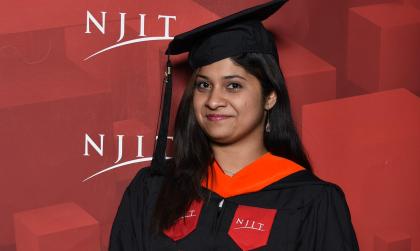
Ishani Chatterjee - ECE PhD Student of the Month - December 2021
Ishani Chatterjee successfully defended her dissertation defense on December 1, 2021. She worked under the guidance of Professor Mengchu Zhou, Distinguished Professor. Her research is in Natural Language Processing, Big Data, Optimization Models, and Data Analytics. Her research topic directly relates to the Sentiment Analysis of customer reviews focusing on online retail stores like Amazon. She has published papers in journals such as IEEE Transactions on Computational Social Systems, Entropy, etc., and a reviewer of technical papers for WF-IOT 2021, IEEE Access 2020.
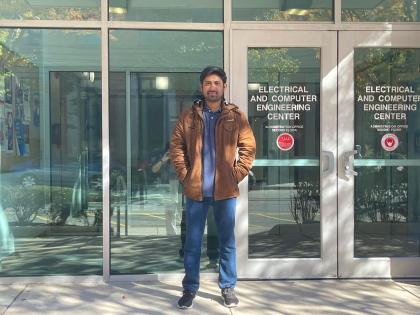
Mohammad Arif Hossain - ECE PhD Student of the Month - November 2021
Mohammad Arif Hossain is a Ph.D. candidate at the Helen and John C. Hartmann Department of Electrical and Computer Engineering of the New Jersey Institute of Technology (NJIT). He is currently working under the supervision of Distinguished Professor, Dr. Nirwan Ansari. His research areas include Cloud and Edge Computing, Distributed Machine Learning, Future Generation Wireless Networks, etc. Mr. Hossain has published several research articles in Q1 journals such as IEEE Transactions on Cloud Computing, Sensors, etc., and conferences.

Student Wins Scholarship for Helping Reduce Electron Leakage in Blue LEDs
Andressa Marangon, a senior electrical and computer engineering major at New Jersey Institute of Technology, won a $1,000 scholarship from the IEEE Electron Devices Society for her role in improving the brightness and power consumption of blue LEDs that technologically lag behind their red and green cousins.
That might not affect your iPhone or TV anytime soon, she said, but it's important for applications such as healthcare products and industrial machinery.

Ludvik Alkhoury - ECE PhD Student of the Month - October 2021
Ludvik Alkhoury is a Ph.D. candidate in the Helen and John C. Hartmann Department of Electrical and Computer Engineering of the New Jersey Institute of Technology (NJIT). Alkhoury works under the advisement of Professor Moshe Kam, Dean of Newark College of Engineering, in signal and image processing, detection and estimation, physiological signals and signs, and wearable sensors and devices. Alkhoury served as the president of the NJIT’s Graduate Student Association (GSA) for the academic year 2019-2020. He shares his experience.
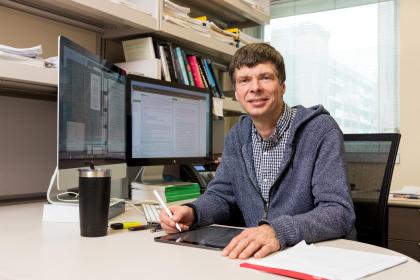
New Methods Can Protect Data Privacy Against Quantum Computing
NJIT Electrical and Computer Engineering Professor Joerg Kliewer is looking to help preserve privacy by busting conventional wisdom about the future of computer security, which states that today's data protection measures, especially in Internet-of-things devices, stand absolutely no chance against the hacking power that will soon be wielded by the new era of quantum computers.
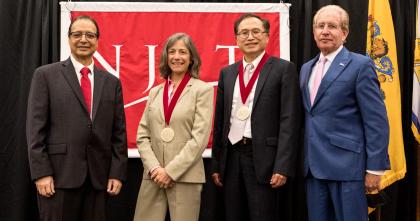
An Engineer and an Architectural Historian Win the 2021 Excellence in Research Awards
Nirwan Ansari, an electrical and computer engineer who is a pioneer in the field of communications networks, and Gabrielle Esperdy, an architectural historian and trailblazer in the digital humanities, are the winners of the Board of Overseers Excellence in Research award for 2021.
Atam Dhawan, senior vice provost for research, called the two awardees “exceptionally consequential researchers.”

NJIT's Dhawan Wins a Coveted IEEE Award for a Widely Used Cancer Detection Device
For a pioneering invention that enables doctors to use light to look beneath the outer layer of the skin to detect diseases such as early-stage skin cancers, NJIT’s Atam Dhawan was tapped this year to receive one of IEEE’s preeminent honors, the Engineering in Medicine and Biology (EMBS) William J. Morlock Award.
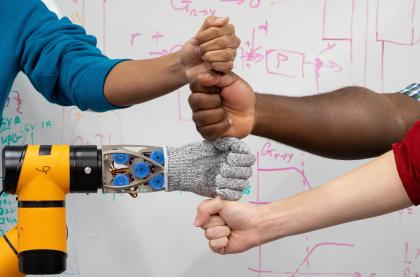
NJIT Expert Trains Robots to Use Their Hands, Earns NSF CAREER Grant
C-3PO walked upright and spoke six million languages, but never did much with his hands beside gesticulate on the odds of surviving space battles.
Such is the state of modern robotics and cyberintelligence, where a Boston Dynamics droid does backflips and Apple Siri maintains natural-language conversations, while precision manipulation of physical objects remains elusive, explained Cong Wang, associate professor of electrical and computer engineering at New Jersey Institute of Technology.