All
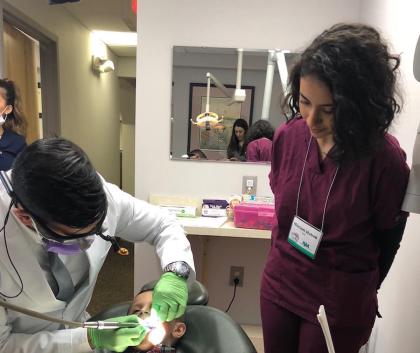
Teeth Time: Pre-dental Students Volunteer to "Give Kids a Smile"
They helped provide dental care to patients 12 years old and under, leaving behind many healthier mouths. On Feb. 1, pre-dental students from NJIT’s Albert Dorman Honors College volunteered their time to document and collect data as part of the New Jersey Dental Association’s (NJDA) annual Give Kids A Smile (GKAS) Day.
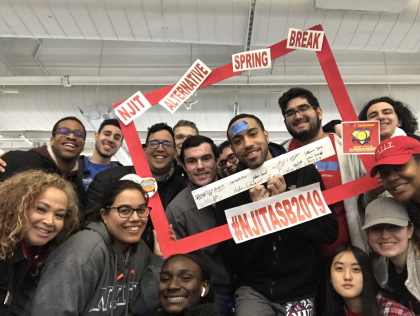
A Source of Service: Student Volunteers at NJIT
April 7-13 is National Volunteer Week, when volunteers nationwide are acknowledged for their service-oriented contributions. The NJIT community remains engaged in a range of giving-back activities, centrally coordinated by Career Development Services.
To help meet its civic and social responsibility goals, the university is a member of Campus Compact, a coalition “focused on teaching, research, and institutional action in service of the public good.”
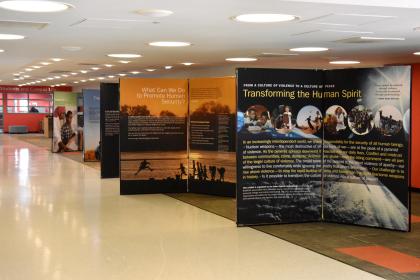
NJIT Hosts Traveling Exhibitions Exploring Nuclear War and Peace
On Friday, April 5, NJIT held the opening ceremony for the first of two internationally recognized peace exhibitions scheduled to be publicly displayed on campus this month, titled, "From a Culture of Violence to a Culture of Peace: Transforming the Human Spirit."
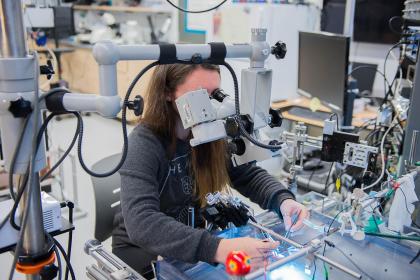
What's Hot and Cool in Tech? Come Find Out at NJIT's 7th Annual Innovation Day
NJIT Innovation Day, an invention-packed showcase of cutting-edge, student-led research, design and development across programs and disciplines, will take place Monday, April 8, at the Campus Center.
Around 70 student projects – from autonomous lawn care equipment, to lightweight solar arrays for solar vehicles, to a tornado water filtration bottle, to a platform that provides visual feedback on human balance control – will be on display. Broadly, the event will feature inventions that improve lives, novel business ideas, computer games and fundamental scientific research.

Watch: NJIT Mathematical Sciences Professor Releases Major League Baseball Predictions
Mathematical Sciences Professor and Associate Dean Bruce Bukiet has published his model’s projections of how the standings should look at the end of Major League Baseball’s regular season in 2019. For more than 20 years, Bukiet has applied mathematical models to compute the number of regular season games each Major League Baseball team should win. His mathematically derived projections have consistently compared well with those of so-called experts.
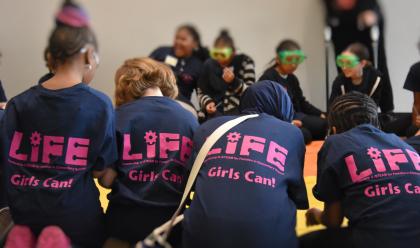
National Pi Day 2019: NJIT Welcomes New Jersey's Elementary School Girls to STEM LiFE
This month, the annual celebration for International Women’s Day came with a new campaign theme, “Balance for Better.” That message was in full voice last week at NJIT, as more than 200 young girls from New Jersey’s schools visited campus to learn about and showcase their abilities in all-things science, technology, engineering, arts and math (STEAM) for national Pi Day.
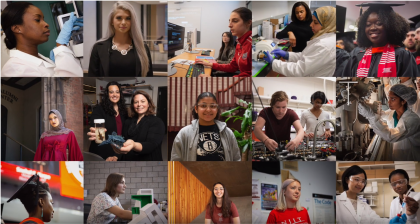
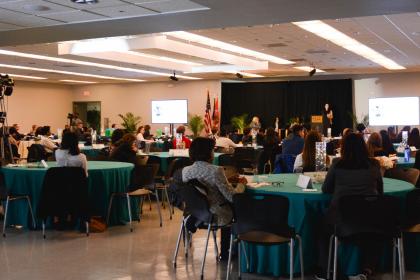
NJIT's Murray Center for Women in Technology Holds 5th Annual Women Designing the Future Conference
The Murray Center for Women in Technology at New Jersey Institute of Technology (NJIT) will hold its fifth annual Women Designing the Future conference — “Game Changers! Technological Innovations That Will Transform Our Lives”— Friday, March 29, from 9 a.m. to 3 p.m. in the university’s Campus Center Ballrooms A and B.
NJIT Officially Kicks Off "New Jersey STEM Month"
This month, NJIT officially commemorated the start of “New Jersey STEM Month” — a celebration supported by New Jersey Governor Phil Murphy to “highlight the Garden State’s strong presence and accomplishments in science, technology, engineering and math.”

Career Fair Draws Hundreds of Employers and Thousands of Jobseekers
It was a cold and windy Wednesday, but the winter weather didn’t stop the more than 2,200 students and alumni in search of internships, co-ops and full-time jobs from packing the Wellness and Events Center Feb. 13. There, 212 employers were recruiting for a range of positions — and doling out swag — at the Spring 2019 Career Fair, coordinated by NJIT’s Career Development Services.