Department physics
"Doing More with Less" Conference Explores Innovative Responses to Environmental Sustainability
The Murray Center for Women in Technology at New Jersey Institute of Technology (NJIT) will hold a one-day Women Designing the Future conference—“The Environment: Doing More with Less”—on Friday, March 23. Registration begins at 8:30 a.m. in the university’s Campus Center Ballrooms A and B.
Princeton Review Ranks NJIT Among Top 'Colleges That Pay You Back'
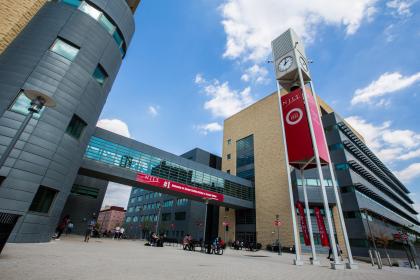
New Jersey Institute of Technology (NJIT) is one of the nation's best colleges for students seeking a superb education with great career preparation and at an affordable price according to The Princeton Review®.
Metro-Area Teachers Discover New Ways of 'Launching Students Into Physics'
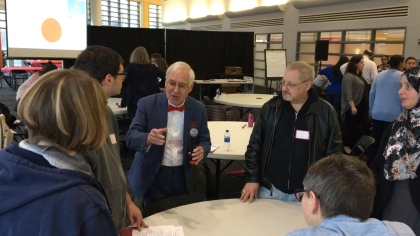
Physics teachers and STEM educators throughout the metropolitan area gathered at NJIT’s Campus Center Atrium this month as Gordon Thomas, professor of physics and NJIT “Excellence in Teaching” awardee, presented “Launching Students Into Physics” — a workshop aimed at helping pre-college teachers and communicators better engage students in all-things physics.

NJIT Technology and Society Forum Presents: Resolving Complex Fluid Flows
From large-scale weather or environmental disaster predictions and efficient design of vehicles and power generators, to understanding how bacteria propel themselves and how nutrients are delivered to different organs in our body at the cell level — researchers will need to find new ways of studying the complex flow of liquids, gases and plasmas that drive or characterize intricate climatic, transportation and biological systems.
Research that Ranges from Pipelines to Proteins
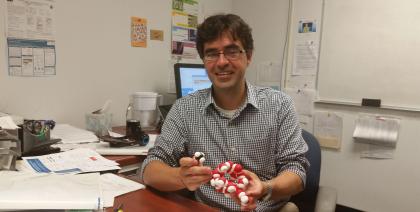
The research that Assistant Professor of Physics Cristiano Dias is pursuing has the potential to expand our knowledge of phenomena that can affect the creation of dangerous obstructions in undersea pipelines transporting natural gas and the formation of protein-based fibers in the brain related to diseases such as Alzheimer’s.
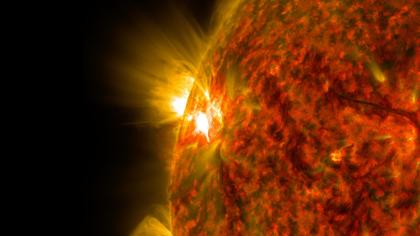
Putting Students Closer to Explosive Solar Events
NJIT has a long-established reputation as a leader in researching phenomena originating on the star closest to Earth — the Sun. NJIT’s optical telescope at Big Bear Solar Observatory and radio telescope array at Owens Valley, both in California, have greatly expanded our understanding of solar events that periodically impact our home planet, events such as solar flares and coronal mass ejections (CMEs) that can disrupt terrestrial communications and power infrastructure in addition to other effects.