“Providing Dorman Scholars with unique educational opportunities has always been our mission,” noted Professor Louis Hamilton, dean of NJIT’s Albert Dorman Honors College (ADHC). “And the scholars we admit to the college are highly capable and motivated young people who crave challenges and hands-on learning experiences.”
KARINA DSOUZA ’20
MAJOR: Biomedical Engineering
HOMETOWN: New Milford, N.J.
MARY McGUINNESS ’20
MAJOR: Chemistry
HOMETOWN: Spring Lake, N.J.
JENNIFER CALLAGHAN ’21
Major: Chemical Engineering
Hometown: Nutley, N.J.
The Spring 2018 Career Fair held this past February at NJIT’s new Wellness and Events Center (WEC) was alumna Whitney Randolph’s first time back on campus since she graduated from the university with a bachelor’s degree in biomedical engineering in 2017. The reason for her visit was not to look for a job, but rather to find job candidates, as a recruiter for her employer, Getinge. Randolph is a production engineer at the global medical technology company.
In a commencement speech that mixed humor and practicality, Student Senate President Mark Neubauer* described the road to success as navigable, if bumpy at times. As his classmates prepare to embark on it, he urged them to emulate the “traffic cones found on campus" and “be resilient.”
New Jersey Institute of Technology (NJIT) conferred 2,885 bachelor’s and doctoral degrees at the 102nd commencement ceremony May 15 at the Prudential Center in Newark.
Meet the 2018 Gonfalon Carriers
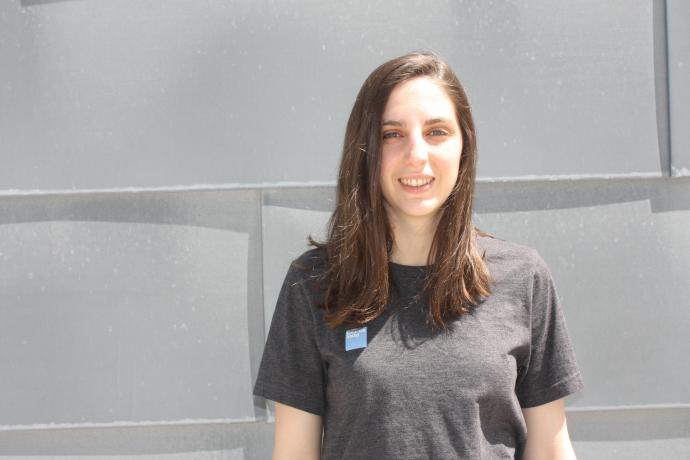
Julia Garcia
Gonfalon: Martin Tuchman School of Management (MTSM)
Major: Finance
Hometown: Madrid, Spain
MEDIA ADVISORY: New Jersey Institute of Technology (NJIT) to Confer More than 3,100 Degrees at 102nd Commencement Exercises May 15, May 17 and May 18, 2018
Engineering Educator Dr. Leah Hope Jamieson to Deliver 2018 Commencement Address and Receive Honorary Doctor of Science
With cherry blossoms at peak season, more than 200 members of the Newark College of Engineering (NCE) community gathered this week at Nanina’s in Branch Brook Park to pay tribute to their own – high-flying seniors setting off on careers, alumni who have already made their mark on the world, and professors, staff and friends of the university who inspire and support ambitious NJIT engineers year after year.
Success in a Snapshot: Jaasrini Vellore*, a biomedical engineering student who specializes in biomaterials, was honored at the 2018 NCE Salute to Excellence as the Madame Mau Outstanding Female Engineering Student. Although she’s a junior, Vellore’s accomplishments – from a 3.96 GPA, to a key role mentoring freshmen in her department, to research on a longstanding problem with hearing aids, to hospital internships – wowed the committee nonetheless.
