NJIT Infrastructure Forum Connects AI, Workforce and Resilience Challenges
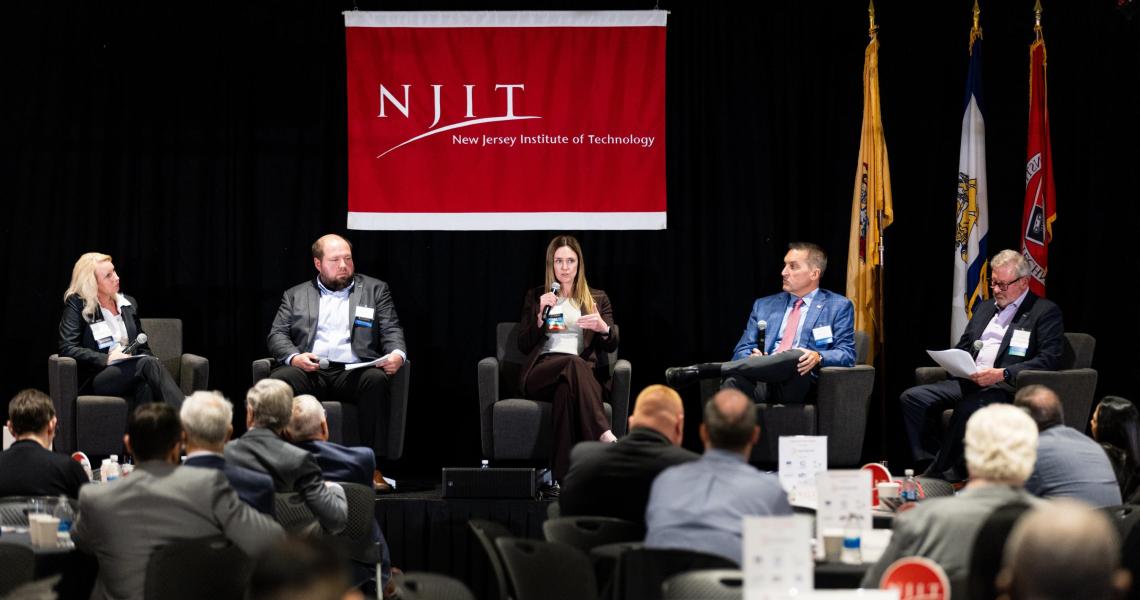
Artificial intelligence, cybersecurity, energy demand, transportation systems, water quality and workforce development are no longer separate conversations, but rather connected challenges where universities can help move ideas into practice, said leaders from academia, government and industry at New Jersey Institute of Technology’s Spring 2026 Infrastructure Forum.
The forum, a year in development, hosted more than 300 experts in their fields and enabled deep discussions in each subject with notable overlap between them. Discussions spanned three keynote addresses, two legislative perspectives and five expert panels. Patrick Natale ‘70, ‘75, executive director of the United Engineering Foundation and a member of the NJIT Foundation Board of Directors, served as the forum’s master of ceremonies.
NJIT President Teik C. Lim framed the forum as part of the university’s role as both a public polytechnic institution and a partner to the industries and agencies shaping the built environment.
“We strive to be a physical and intellectual focal point for innovative ideas, actions and people coming together. That is exactly what we’re doing today,” Lim said.
“By bringing all of you together to explore issues that deeply impact our economy, our welfare and our lives, we hope to align priorities, share advances and identify opportunities for new and for sustained collaboration across all sectors,” Lim added.
From Research to Real-World Deployment
Nick DeNichilo ’73, ’78 — co-vice chair of the NJIT Board of Trustees and former CEO of Mott MacDonald — framed the forum around a central question of how industry and universities can move faster together. He pointed to university research, capstone projects and workforce development as ways for companies to engage NJIT not only as a talent pool but as an equal partner in testing and applying new ideas.
John Pelesko ’97, NJIT’s provost, spoke and led a related panel on technological advances emerging from academia. Among the themes were the need for organizational innovation officers, the pressure to balance sustainability, building codes and profitability, and a new university course in emerging construction technologies.
That bridge between research and deployment surfaced throughout the day, especially in transportation. State Senator and civil engineer Paul Sarlo ’92, ’95 led a panel on transportation agencies, where Parth Oza, assistant commissioner with the New Jersey Department of Transportation, said New Jersey’s bridges average 58 years old and described how AI is already being used to improve pedestrian safety. Oza pointed to an AI-enabled intersection in Trenton that keeps a traffic light from turning green until sensors determine that a crosswalk is clear.
The example closely matched transportation research already underway at NJIT. In NJIT’s 2025 Research Magazine, Guiling (Grace) Wang, distinguished professor of computer science and associate dean for research, is highlighted for developing AI-based traffic signal systems designed to reduce waiting times while accounting for safety risks. Her colleague, Assistant Professor Hua Wei, focused on AI-enabled traffic signals. Joyoung Lee, associate professor of civil engineering, is working on how autonomous vehicles respond to such signals. Marcos Netto and Philip Pong are studying how electric cars impact the energy grid.
Rail infrastructure offered another example. As forum speakers discussed aging systems and the cost of maintenance, NJIT civil engineer Yun Bai’s research in the same magazine points to how routine operations could become part of the inspection process. Bai is developing sensor systems that can be placed on regular service trains to gather frequent data on track conditions, using vibration and acoustic signals with machine learning to identify rail defects and better understand how they form over time.
Rizwan Baig, chief engineer at the Port Authority of New York and New Jersey, said his agency is also embracing AI through an innovation hub deploying the technology across departments, including engineering. But he cautioned that engineers should treat AI as a “trusted copilot,” not a replacement for professional judgment.
“For engineers, AI is your trusted copilot,” Baig said. “It’s not something to take over your job. It’s not something that you just close your eyes and rely on and just sign off. So think about it as a junior engineer that is there to help you … We are fully embracing it.”
Preparing the Workforce Behind Modern Infrastructure
Several forum discussions returned to a shared concern: the infrastructure sector cannot modernize if its rules, business models and workforce pipelines remain static.
Clinton Calabrese, Deputy Speaker of the New Jersey General Assembly, and Andrew Zwicker, chairman of the New Jersey Senate Legislative Oversight Committee, offered government perspectives on that challenge. Both emphasized the need for bipartisan, common-sense reforms that allow agencies and companies to keep pace with technology while preserving the public-safety reasons regulations exist in the first place.
In a panel for architects and engineers, moderated by NJIT Board of Trustees member Gary Dahms, speakers discussed how firms are weighing innovation against budgets, billable hours and client expectations. Áine O’Dwyer ’08, CEO of Enovate Consulting, said billable hours can become an impediment to innovation, while also cautioning that AI and emerging technologies should be evaluated by their return on investment, not their trendiness. Kim Vierheilig ’99, ’00, an architect and member of the NJIT Board of Trustees, added that sustainability can remain a corporate priority alongside cost and performance pressures.
The construction field brought the workforce issue into sharper focus. In a panel led by NJIT’s Andrew Christ ’94, ’01, senior vice president of university operations, panelists including Ken Colao ’77, co-executive vice chair of the NJIT Foundation, and Brian Senyk ’08, chief engineer of Terminal Construction, said both new graduates and experienced workers must be ready to adapt as construction technologies, delivery methods and expectations change.
Efforts to directly address workforce upskilling have been gaining momentum. As CEO of T&M Associates, Dahm’s was first in line to take advantage of the NJIT’s industry-focused graduate degree enrollment program.
The same week as the forum, NJIT also took a concrete step toward expanding the infrastructure workforce pipeline. NJIT, Hudson County Community College and the New Jersey Administrative District Council of Bricklayers and Allied Craftworkers signed a Letter of Intent to develop an apprenticeship-to-degree pathway that would allow apprentice members to connect technical training and HCCC associate-degree credits to bachelor’s study at NJIT in Applied Engineering Technology or Construction Management.
The New Risks Facing Critical Systems
Maria Lehman, former president of the American Society of Civil Engineers, gave the forum a national frame through ASCE’s 2025 Report Card for America’s Infrastructure. The nonpartisan organization gave the country’s infrastructure an overall C grade across 14 categories. Ports earned the highest mark, a B, while stormwater and public transit each received a D.
Lehman said the report is trusted across political lines because engineers focus on evidence and plain language. Politicians on all sides trust the ASCE report because engineers speak in nouns and verbs, not adjectives and adverbs, she noted.
But the forum also made clear that the definition of infrastructure risk has expanded. Lucian Niemeyer, former assistant secretary of defense, warned that critical systems are increasingly exposed to cyber threats from state-sponsored actors, including attacks aimed at the networks that support water, transportation and energy systems. His remarks underscored that infrastructure resilience now depends not only on concrete, steel and maintenance schedules, but also on the security of the digital systems that operate behind them.
Water and energy pressures added another layer to that discussion. In a panel moderated by the director of operations for Ridgewood Water, Richard Calbi ’94, ’00, speakers discussed the spread of forever chemicals and plastics, the growing demand placed on water and electric systems, and the need for both near-term protections and long-term research solutions.
Calbi has been working with an NJIT-based startup, PFASolve, a company offering end-to-end remediation technologies – detection, capture and destruction – that are relatively inexpensive and sustainable. Panelists also urged attendees to think about household-level water protections while research, regulation and treatment technologies continue to advance.
The same week as the Infrastructure Forum, NJIT also hosted a CTR Workshop on Translational Research and Technology Innovations for PFAS Decontamination, bringing together state, industry, academic and community leaders to discuss PFAS advocacy, detection, monitoring, treatment, regulation, commercialization and public communication. The agenda included NJIT leaders and researchers, New Jersey Innovation Institute representatives, state and municipal officials, utilities, industry experts and academic partners.
NJIT’s has broadened this conversation with sustainability-focused engineering conversations through efforts such as its Engineers for Sustainability seminar series.
The panel also pointed to the fast-growing infrastructure demands created by data centers, which require major supplies of electricity and water at the same time communities are trying to modernize aging systems. A single megawatt of power is enough for 800 homes, but even a small data center can require 400 megawatts per month, said Jason Kalwa ’08, senior director for construction and maintenance at PSE&G.
Yet it was at the day’s start that the need for American infrastructure improvements hit hardest. Natale, the emcee, announced that Lehman — who presented the infrastructure report card, grading the railroad sector second-best of all categories with a B-minus — was arriving late due to an Amtrak delay.