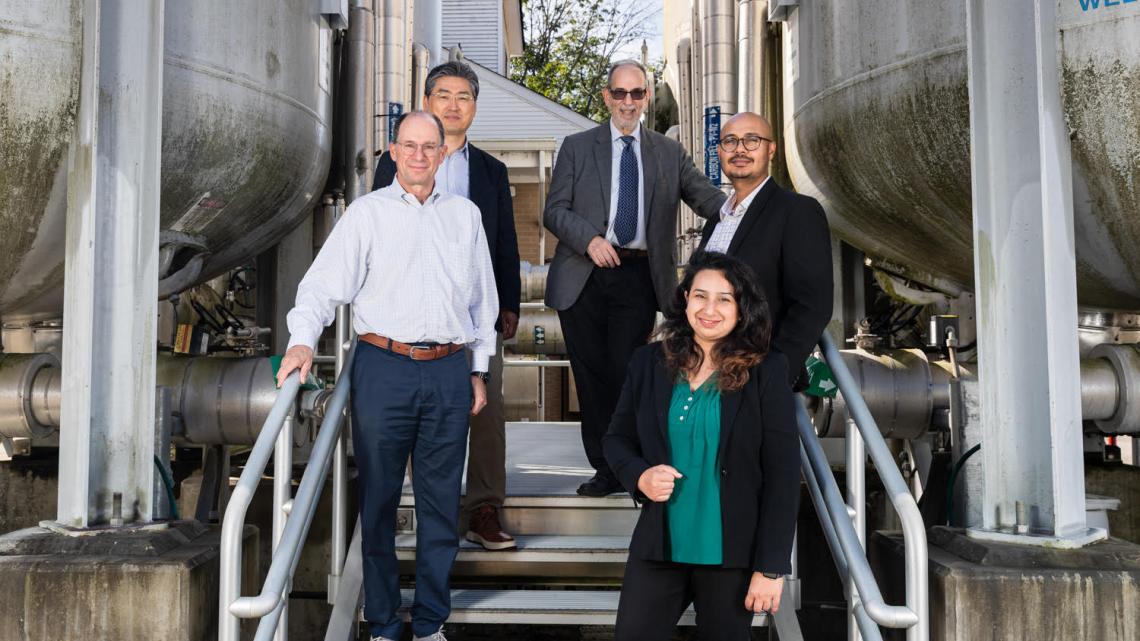
Richard Calbi, director of Ridgewood Water, was astonished to discover the extent of PFAS contamination in New Jersey drinking water when the state adopted pollution standards for the industrial chemicals in 2020.
“The first thing we did was determine if we were affected and found them in every one of our 52 groundwater wells. We couldn’t find water to buy that didn’t have PFAS in it. We had to reimagine and rebuild our entire system to accommodate new filters,” Calbi said.
Charmi Chande, a former postdoctoral researcher in chemical engineering at NJIT, heard similarly harrowing accounts from other system operators she interviewed as part of a National Science Foundation-funded I-Corps team.
“As technology developers, we asked them about pain points in the remediation process,” she recounted. “What nearly everyone said in more than 100 interviews was that they needed solutions now – kits that would allow them to expeditiously test the water at their own facilities rather than sending it out to labs and waiting for results to come back.”
Shortly after, Chande and three NJIT researchers co-founded PFASolve, a company offering end-to-end remediation technologies – detection, capture and destruction – that are relatively inexpensive and sustainable. They are conducting pilot tests at regional facilities, including Ridgewood Water, as a step toward commercialization. Calbi is one of their advisors.
PFASolve is one of several startups and partnerships nurtured and funded by NJIT’s Center for Translational Research since its launch in 2024. The center serves as a hub for commercialization training and development on campus for faculty and students, but also as a meeting place to generate ideas and formulate new approaches for addressing unmet needs in areas ranging from health care, to sustainable energy and environmental remediation, to data privacy.
The CTR is funded in part by a nearly $7 million grant from the National Science Foundation (NSF) to advance translational research. Awarded by the agency’s Directorate for Technology, Innovation, and Partnerships (TIP), the grant accelerates the development of promising prototypes and enables market validation and other commercialization activities.
“We have a responsibility to drive innovation from the campus to market,” said Atam Dhawan, senior vice provost for research. “I am pleased to report that two years after we received this critical funding from NSF, which we augmented with NJIT’s strategic investment funds, we can point to measurable successes: three startup companies, two translational projects with industry partners, and a number of other promising technologies in various stages of development.”
The NSF funding significantly bolsters NJIT’s Technology Innovation Translation Acceleration (TITA) program, which drills down on the potential commercial benefits of university research at earlier stages of the translation and market validation process and provides funding of $75,000 to $175,000. Inventors must have external partners.
Over the past three years, TITA and CTR have funded more than 50 projects. Another program, Collaborative Early Research Translation, provides grants of $25,000 to help inventors to establish external partnerships and secure intellectual property.
Through workshops, symposia and demonstration events, NJIT draws external collaborators, advisors and investors, as well as people in the community with their own thoughts about what’s needed. Center-funded inventors are currently working with more than 40 industry partners.
Somenath Mitra, distinguished professor of chemistry and environmental science, received $150,000 to develop nanotechnology that will enhance the solubility, bioavailability and effectiveness of pharmaceutical drugs by improving their water solubility without altering their crystal structure.
Murat Guvendiren, an associate professor of chemical and materials engineering, is also working with MTF Biologics and others to develop a minimally invasive, self-curable bone grafting material that conforms to defects, resists washout, and provides immediate mechanical stability.
OppyAI Inc., a spin-off from the lab of Hai Phan, an associate professor of data science, won $75,000 in TITA funding to launch Neural Crypto, a novel end-to-end encrypted communication protocol between humans and AI at scale.
Arjun Venkatesan, an associate professor of civil and environmental engineering, recently secured $100,000 in the CTR's Innovation Pitch Competition to translate a technology that destroys PFAS molecules under ambient conditions by breaking their strong carbon-fluorine bonds.
Additionally, NJIT’s New Jersey Innovation Institute, in partnership with the university and the New Jersey Economic Development Authority, recently announced the launch of another PFAS detection company, PureTrace Labs. Hao Chen, a professor of chemistry and environmental science and the company’s chief scientific officer, has developed a paper-spray mass spectrometry method that can rapidly detect PFAS in water, soil, packaging materials and textiles at very low levels.
“For too long, researchers conducted what was essentially freelance research, published it and put it on the shelf. There were few attempts to assess its commercial viability or market it,” Dhawan noted. “Bringing in investment from the outside is helping to change the culture. This resonates significantly with the younger generation of faculty. They understand the value of translation to market. They are agents of change.”
Both the CTR and NJIT’s Undergraduate Research and Innovation program draw hundreds of students each year into invention-focused labs, including through paid internships over the summer.
Chadley Gede, a junior majoring in mechanical engineering, has spent months testing and improving the performance of a portable sensor developed in the lab of Eon Soo Lee, an associate professor of mechanical engineering and PFASolve co-founder.
“The idea is to make it simpler and cheaper for homeowners and businesses to test their water. The conventional way – sending a sample to the lab – is reliable, but it can cost hundreds of dollars and take multiple days,” notes Gede. “It’s important to allow individual consumers to quickly judge the safety of their drinking water.”
