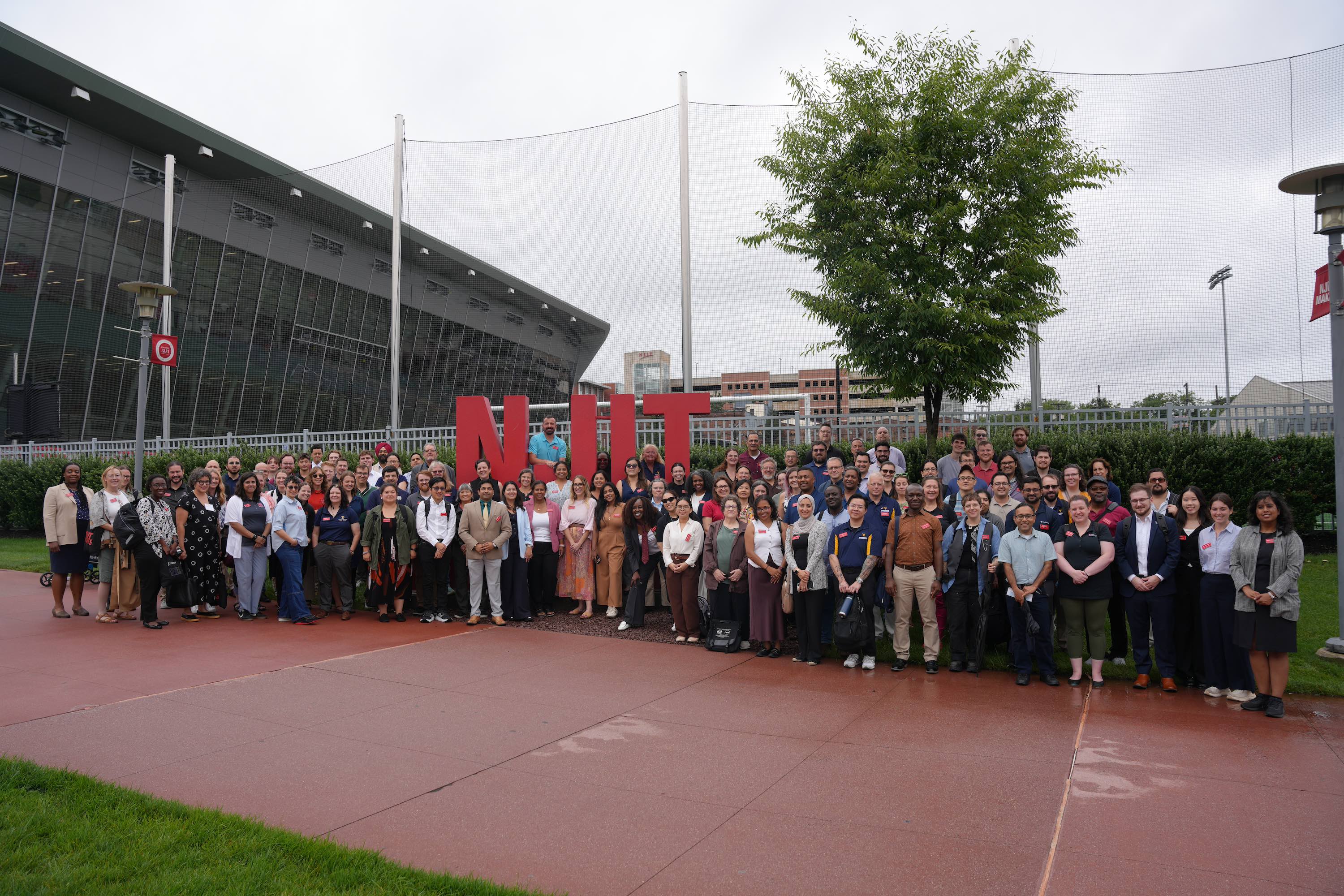
Engineering educators and students from institutions across the country gathered at New Jersey Institute of Technology for the 2026 First-Year Engineering Experience Conference, examining how universities can prepare beginning engineers for a profession — and an educational environment — being reshaped by artificial intelligence.
Hosted by NJIT’s Newark College of Engineering, the conference centered on the theme “AI Innovation, Integrity, & Informed Doubt.” Through workshops, panels, research papers and rapid-fire work-in-progress presentations, participants considered how AI is affecting instruction, assessment, academic integrity and the skills students will need in the workplace.
The program also reflected the wider scope of the first-year experience. Sessions addressed student belonging, neurodiversity, advising, major selection, transfer pathways, professional judgment, project-based learning and the transition from high school to college. Workshops invited participants to examine their own practices, including how to support neurodivergent students, give students greater autonomy in large courses and build coordinated advising teams around academic, personal and career needs.
Work-in-progress sessions gave faculty and student presenters five minutes or less to introduce emerging research, classroom experiments and programs still being evaluated. Presentations explored whether AI could support learning without replacing the work students must do to understand engineering concepts. One project tested a restricted AI teaching assistant in an introductory programming course. The chatbot could guide students step by step and create study materials, but it was prohibited from providing solution code. Early findings indicated that students still needed to invest substantial effort to learn the material, even with the additional resource.
Another study used an AI chatbot to ask students follow-up questions about their reasoning during a wind-energy project, creating an assessment resembling a written oral examination. Other researchers investigated how conversational history may change the accuracy and complexity of AI responses, and whether generative AI can help students turn broad design goals into measurable criteria and testing methods. Because much of the work was preliminary, presenters emphasized questions under investigation rather than settled conclusions.
NJIT presenters also shared work focused on the first-year student experience. A presentation on the Newark College of Engineering’s General Engineering program described a structured pathway offering academic preparation, targeted advising and alternative routes for students navigating early academic challenges or reconsidering their choice of engineering major. Other NJIT work examined student motivation in entrepreneurship education and whether brief, structured meetings with instructors could help students in large introductory courses feel a greater sense of clarity, connection and belonging.
AI as an Opinion, Not an Answer
The conference’s central questions were crystallized by keynote speaker Juan Gilbert, Ph.D., the Andrew Banks Family Preeminence Endowed Professor and chair of the Department of Computer and Information Science and Engineering at the University of Florida.
Image
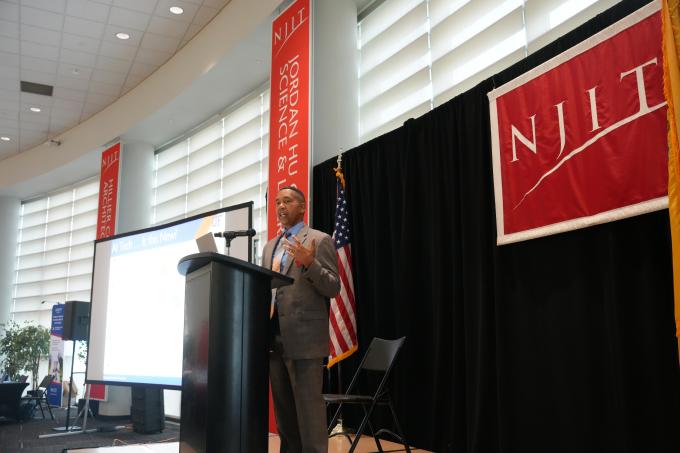
Gilbert acknowledged the anxiety generative AI has created among faculty, including concerns about cheating, the erosion of critical thinking and whether students will continue to develop foundational skills. He compared the moment to earlier technological changes involving typewriters, calculators and search engines, all of which required educators to reconsider assignments and teaching practices.
His message was not that educators should ignore the risks. Instead, he urged them to understand the technology and how students are already using it.
“Don’t fear it. Learn how to use it,” Gilbert said.
He encouraged faculty to submit their existing assignments to several AI systems, examine the responses and determine what portions of a problem AI can and cannot solve. Educators should also speak openly with students about how they prompt AI tools rather than assuming students use them in the same ways faculty members do.
Gilbert argued that AI creates an opportunity to move instruction toward judgment, verification and higher-level problem-solving. It can provide examples, explanations or pieces of a solution, he said, but it should function as an assistant rather than a substitute for either students’ reasoning or educators’ expertise.
He repeatedly cautioned against treating generated information as fact.
“AI is an opinion without a conscience,” Gilbert said.
For engineering educators, Gilbert said, the challenge is to incorporate AI while continuing to develop the creativity, ethical awareness and independent judgment required to address problems technology cannot solve on its own.
Building an AI-Ready University
“NJIT’s organizing team worked hard to create an environment that encourages meaningful conversations, new collaborations and memorable experiences during the conference,” said NJIT’s Ashish Borgaonkar, associate professor of engineering education and one of the event location chairs. “Our motivation was to showcase NJIT’s campus, state-of-the-art facilities, innovation in first-year engineering experience, and to enable attendees to explore the opportunities and challenges presented by artificial intelligence in engineering education.”
The conference concluded by bringing the national discussion into the NJIT context, with university leaders examining how an institution can move beyond isolated experiments and develop a broader approach to AI literacy, faculty innovation, academic integrity and student access.
We must consider our responsibility to foster integrity, critical thinking and informed skepticism.
NJIT faculty and staff presented the panel’s closing session, Building an AI-Ready University: Lessons from Institutional Innovation. The panelists were Nicole Bosca, director, Center for Educational Innovation and Excellence; Jamie Payton, dean, Ying Wu College of Computing; Samuel Lieber, director, School of Applied Engineering and Technology; Justine Krawiec, director of learning technologies; and moderator Ashish Borgaonkar.
Their topics included the balancing act of promoting innovation vs. academic integrity. Payton noted that even when students are against AI, it’s important to ensure they become informed.
“When you have a student who says ‘I don't want to use AI tools,’ great, come and learn about the AI foundational concepts so that you know how to channel that challenge, so that you know how to question even better, so that you know how certain tools are working, and so you can understand the principled stance on which you want to take,” she noted. “So it's not just about using tools in the classroom, but it's about educating students to understand things about how machine learning works, how we can embrace more open models and explainable AI approaches. What are some of the limitations? I know we've all heard about bias in AI. All of those topics are important. Understanding the foundational components of how AI works is critical to being an informed doubter.”
Payton added that students who arrive at NJIT already used to AI may misunderstand the university’s rigor — it’s important to teach them early that, unlike in the corporate world, where an individual worker’s goal is to produce competent results quickly, in the academic setting your goal is to learn how and why, not just to produce the output. Bosca made a related point — other cultures are more collaborative compared to individualistic American life, so international students may need extra explanation if accused of academic impropriety.
Lieber said that even though every university and some individual departments make their own decisions about AI use, it’s equally important to make those decisions by collaborating with industry and university accreditation bodies. Otherwise, what may seem like reasonable decisions now may have negative side effects later.
Krawiec, in responding to an audience question about costs of obtaining the latest professional iterations of artificial intelligence, observed that NJIT is unique as a top research university with a large percentage of students from underserved backgrounds — size doesn’t necessarily equate to funding, but NJIT owes it to the student body to keep them up-to-date. It’s similar to CAD software or CNC machines, Lieber added, in getting the right licenses when AI is just another tool.
