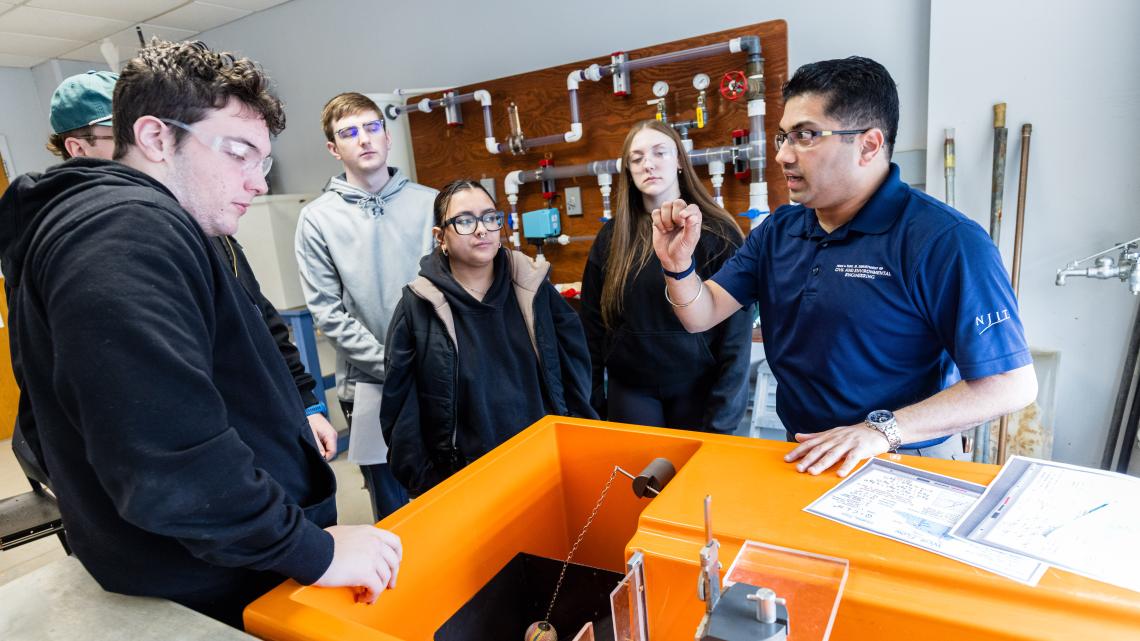
Ashish Borgaonkar, assistant professor of engineering education in the School of Applied Engineering Technology at New Jersey Institute of Technology and founding director of Newark College of Engineering’s Grand Challenges Scholars Program, has been selected for the 2026 ASEE National Outstanding Teaching Award. The award recognizes an engineering educator for excellence in outstanding classroom performance, contributions to the scholarship of teaching, and participation in ASEE section meetings and local activities.
For Borgaonkar, the recognition affirms a teaching philosophy that begins early in a student’s engineering education and is designed to last well beyond graduation.
In Fundamentals of Engineering Design, or FED101, Borgaonkar does not treat the first-year of engineering as a simple introduction to college coursework. He sees it as the start of a professional foundation — a place where students begin learning the habits, transferrable skills, judgment and responsibilities that will shape how they approach engineering problems throughout their careers.
“There are many things you need to know as an engineer, and if we wait too long to introduce students to such key concepts, then we are not really doing full justice to engineering education,” Borgaonkar said.
That includes engineering design, technical skills, ethics, inclusive design, societal impact and hands-on fabrication. In Borgaonkar’s courses, those ideas are not presented as separate requirements to check off later. They are embedded into the work of designing, building, testing and improving.
My passion is to provide opportunities to motivated students.
“When we introduce inclusive design, we don’t introduce it as a separate concept,” he said. “We introduce it as, when you are designing, you need to keep in mind these things, because then more people will be able to use the products your design.”
Borgaonkar serves as the course coordinator of FED101, which includes more than a dozen sections and reaches roughly 500 students each year. He personally teaches about five sections annually, while helping shape the curriculum delivered across the larger course. The interdisciplinary FED101 course engages students from multiple engineering disciplines and provides a foundation in engineering ethics, inclusive design, computerized drafting and hands-on training in NJIT’s Makerspace.
More than half of the course runs in the Makerspace, where students complete required training and learn to use tools such as 3D printing and laser cutting. The point, Borgaonkar said, is not only to teach students how to use equipment. It is to make those resources feel part and parcel of their engineering education.
“Now this becomes like a natural part of their environment,” he said. “When they are assigned a project, students are automatically thinking, ‘Oh, this part I can do in the Makerspace.’”
The course culminates in a team project that asks students to bring those pieces together. Students, for instance, have designed devices that use multiple sensors, integrate coding, collect data and fabricate parts to support the design. Because the course includes students from multiple majors, teams are encouraged to connect the project to their intended fields — environmental sensors for chemical engineering, infrastructure sensors for civil engineering, wearable sensors for biomedical engineering and other applications.
“Project-based learning, active learning, experiential learning — it’s a blend,” Borgaonkar said. “The final project is sort of like a platform for them to show off everything that they have learned in this course.”
His own history at NJIT helps shape that connection
That approach reflects the broader arc of Borgaonkar’s teaching and experience at NJIT. Borgaonkar was a doctoral student at NJIT, when he was presented with a last minute teaching opportunity: an adjunct professor unexpectedly became unavailable due to an emergency, and if no one could fill the role, the section would be removed. He felt a duty, with cautious confidence, to make sure the students were served.
His teaching portfolio includes numerous courses he has developed, co-developed or significantly redesigned. He has also coordinated multiple sections of core NCE courses and developed instructional materials, videos and hands-on learning modules to support consistent teaching across sections.
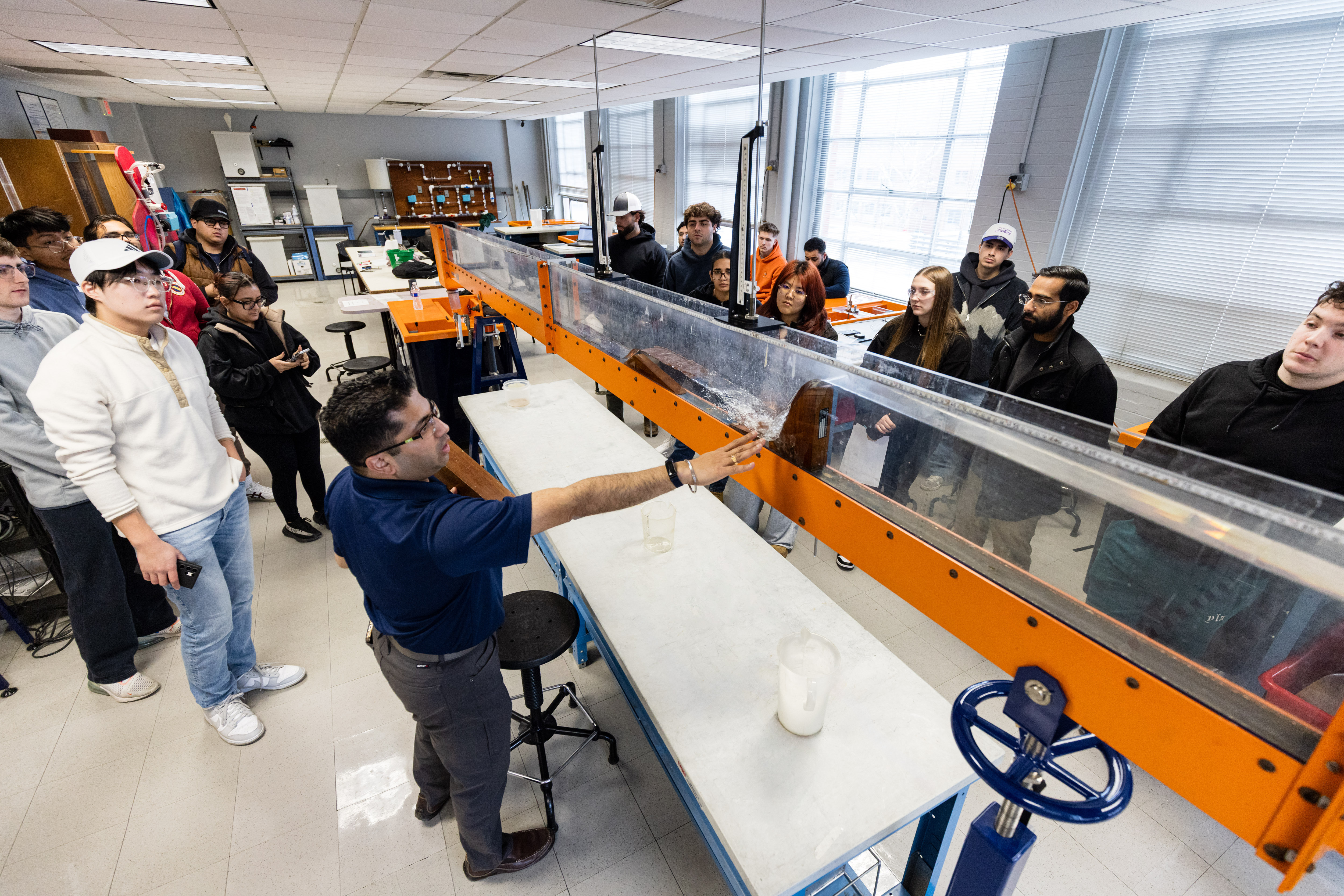
Student evaluations point to the same pattern: a professor who is organized, practical, demanding and deeply invested in whether students understand the material. In evaluation summaries, students repeatedly describe him as someone who explains complex concepts clearly, connects lessons to real-world engineering applications and cares about their success not only as students, but as future engineers.
Borgaonkar said that caring for students is not a technique. It is part of how he understands the role of a teacher.
When students come to him with a last-minute request or concern, he said, his first instinct is not frustration — it is to ask what can be done to help them succeed.
“This is not something you can pretend or just say once at the beginning of the class and then not show in your action,” he said. “This is more like part of your persona as an educator and facilitator of student learning experience.”
That focus on student opportunity also runs through Borgaonkar’s leadership of the NCE Grand Challenges Scholars Program. The program, endorsed by the National Academy of Engineering, asks students to go beyond standard coursework through experiences tied to research and creativity, multidisciplinary work, entrepreneurship, multicultural understanding and social consciousness.
Borgaonkar introduces the program in his classes and encourages students to think early about how they can distinguish themselves — not by rushing through requirements, but by finding opportunities that connect their interests with larger engineering challenges.
“My passion is to provide opportunities to motivated students,” he said. “This transcends through all of my teaching, whether first year, sophomore, junior, senior, and graduate, or the grants that I operate — all of them have some element of creating opportunities that otherwise would not exist.”
He also wants students to understand that engineering decisions carry consequences. The farther students advance, he said, the more people their work can affect.
“I want them to think about the impact of their actions, both positive and negative,” Borgaonkar said. “When they go out, do projects, become big-shot engineers, the higher they rise, the further their impact is going to reach.”
The national recognition follows a series of teaching honors for Borgaonkar, including the 2025 ASEE Mid-Atlantic Section Distinguished Teaching Award, the 2026 NCE Excellence in Teaching Award and NJIT’s 2024 Nexus Award for Excellence in Lower Division Undergraduate Instruction. His materials also note his contributions to ASEE conferences, engineering education scholarship and externally funded academic enrichment and workforce-development initiatives.
Borgaonkar said the ASEE honor has renewed his commitment not only to teaching, but to helping others adopt meaningful practices in their own classrooms.
“This recognition means a great deal to me, but I do not see it as mine alone. It reflects the support system at NJIT — from Dean Moshe Kam and my department chairperson and colleagues to the provost, the president, instructional teams and campus partners — that makes it possible to innovate in the classroom and create meaningful opportunities for students.”
For Borgaonkar, that is the larger purpose of the work: to help engineering students build the foundation they will carry into the profession — technical fluency, ethical judgment, confidence with tools, comfort with complexity and an understanding that every engineering decision can matter.
“The higher they rise, the further their impact is going to reach,” he said. “If they keep all of this learning with them and make sure each project is well thought out, well rounded, inclusive and considers engineering ethics, then we will have better projects, better products and better engineers.”
The recognition is a culmination of what has helped Borgaonkar stand out in his teaching and administration: saying “yes.” With new courses, new initiatives, innovative publications and presenting his work and findings, Borgaonkar has taken challenges and turned them into opportunities and programs that have benefitted engineering education at NJIT and beyond.
