All
NJIT Hosts Game Development Marathon for Global Game Jam
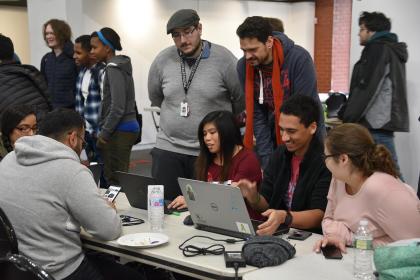
Nearly 100 budding game designers pulled all-nighters at NJIT for the Eleventh Annual Global Game Jam (GGJ) in what has become a much anticipated event for both design and information technology students.
Using Artificial Intelligence to Match Candidates to Jobs
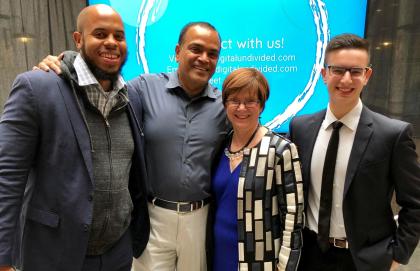
Milad Mirghahari came up with his idea the way many entrepreneurs do, by trying to solve a real-world problem he faced daily.
The difference in Mirghahari’s case is he was only 15 years old. Mirghahari’s family operated two Subway franchises and in his words — they were failing.
The main problem — they could not find good talent. They lacked ambitious, committed employees who wanted to succeed. After peppering his mom with questions long enough, she told him, “you think you can fix it — do it."
The Department of Informatics Welcomes Three New Faculty Members
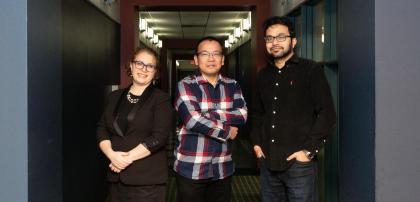
Three professors joined the Department of Informatics at the Ying Wu College of Computing (YWCC) this Fall.
Check out the Q&A below to learn a little more about Aritra Dasgupta, Margarita Vinnikov and Xinyue Ye, who hail from institutions across the country.
Assistant Professor Aritra Dasgupta
NJIT Unveils New Jersey's First Cyberpsychology Program
This year, NJIT’s College of Science and Liberal Arts has announced it will offer students a unique baccalaureate degree option in the emerging field of cyberpsychology. The new program — exploring the dynamics between modern technology and human psychology — is the first of its kind in New Jersey, and is the first academic program in the behavioral sciences to be offered at NJIT.
HackNJIT Attracts Students from Across the Country
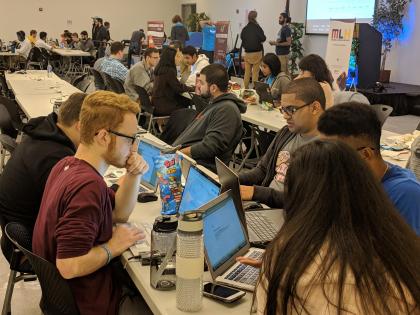
More than 250 college students recently descended on NJIT for a 24-hour hackathon.
The event challenged students to develop a software solution addressing some interesting applications of their choice, in a fast-paced, collaborative, yet competitive environment lasting a mere 24 hours.
Computing Dean Elected to National Academy of Inventors
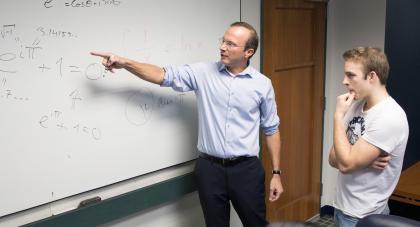
At NJIT, Craig Gotsman is best known as dean of Ying Wu College of Computing. Within the scientific community, he is better known as the inventor of a number of cutting-edge software technologies for manipulating 3D geometric data, enabling their use in a variety of applications. Many of these technologies have been patented and commercialized, some through startup companies, which Gotsman founded — spinoffs of his academic research. In recognition of these achievements, Gotsman has been named a Fellow of the U.S. National Academy of Inventors (NAI) for 2018.
Computer Science Professor's Startup Attracts Millions in Investment From Industry Leaders
A startup company co-founded by a NJIT Ying Wu College of Computing (YWCC) professor recently received a substantial investment from a startup foundry supported by industry giants including Microsoft and AT&T.
NJIT's Game Development Program Preps Students for Careers in Diverse Fields
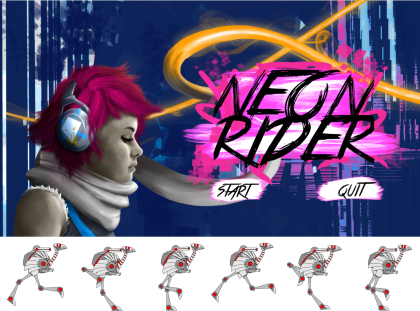
Housed within the School of Art + Design and Ying Wu College of Computing (YWCC), NJIT’s game development program blends digital design and information technology curriculums to offer students access to faculty and resources that cross disciplinary boundaries and cultivate innovation and creativity.

NJIT Advances Research, Commerce and Security Through Global Partnerships
New Jersey Institute of Technology (NJIT) has reached out to giants in the field of cryptography nearly 7,000 miles away to advance blockchain, an evolving digital security technology designed to enable enterprises both large and small to expand transactions across borders, supply chains and diverse stakeholder groups.

NJIT Launches A Potent Research Hub: The Institute for Space Weather Sciences
Both on land and in space, Earth’s technology-centered civilization is increasingly vulnerable to the powerful bursts of electromagnetic radiation, energetic charged particles and magnetized plasma known as space weather. As the complexity of engineered systems increases, as new technologies are invented and deployed, and as humans venture ever further beyond Earth’s surface, both human-built systems and humans themselves become more susceptible to the effects of the planet’s space environment.