All
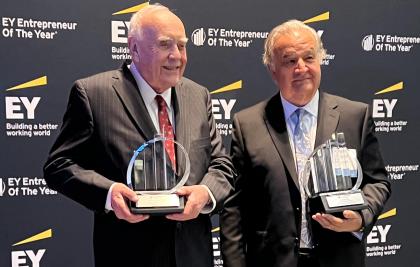
NJIT Alumni Honored with Entrepreneur of the Year New Jersey Awards
Two alumni from New Jersey Institute of Technology (NJIT), William Mascharka '64 and Carlos P. Oliver '77, have been named Entrepreneur of the Year 2024 New Jersey Award winners. This prestigious award, presented by Ernst & Young LLP (EY US), recognizes their exceptional entrepreneurial spirit and leadership in high-growth companies.
Engineers Unveil Survival Mechanisms of a Singularly Durable Life Form, the Spore
Bacterial spores are some of nature’s most adept survivors. Subject to extreme environments – blazing and freezing temperatures, drought and even the vacuum of space – they coat themselves in a thick husk and lie dormant until conditions improve.
In studying the way these single-cell organisms respond to an environmental change – an uptick in humidity, Gennady Gor, an associate professor of chemical and materials engineering at New Jersey Institute of Technology, noticed anomalous behaviors.
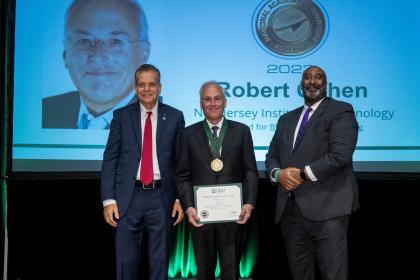
NJIT Alum and Trustee Chair Robert Cohen Inducted as Fellow to the National Academy of Inventors
Robert Cohen, a three-time alumnus, chair of NJIT's Board of Trustees and President of Digital, Robotics, and Enabling Technologies at Stryker, has been inducted as a Fellow of the National Academy of Inventors (NAI). This prestigious honor recognizes Cohen’s prolific, innovative and groundbreaking contributions to the medtech field and academia.

Sunblock for Solar Panels: NJIT Startup Merges Data, Material Science
Materium Technologies, a startup company with deep NJIT roots, is bringing data science innovations into the slowly evolving field of solar energy panels.
Startups are always a gamble, but the Materium team has a good hand, with two pair of Highlanders — recent alumni Sheldon Fereira (M.S. ‘23) and Scott Daniel (M.S. ‘24), advised by Professor Nuggehalli Ravindra and Adjunct Instructor Michael Jaffe. Their collective scientific expertise spans the worlds of artificial intelligence, applied physics, biomedical engineering, and semiconductors.
US News & World Report Ranks 2 NJIT Graduate Programs in Top 100 Nationally
The latest graduate studies rankings from U.S. News & World Report continue to boost the national standing of New Jersey Institute of Technology in the fields of engineering and computer science, with both programs ranking in the top 100.
NJIT’s Newark College of Engineering (NCE) ranks No. 80 on the publication’s list of the Best Engineering Schools in the U.S. — the ninth consecutive year that NCE has made the top 100.
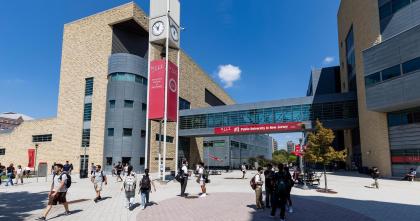
NJIT Earns Top Rating in Money's List of the Best Colleges in America
New Jersey Institute of Technology (NJIT) earned the top rating in Money’s 2024 analysis of the Best Colleges in America.
With five stars, NJIT tied Princeton University as the highest-rated university in New Jersey and matched STEM schools like MIT, Georgia Institute of Technology and California Institute of Technology.

AI-Powered Exoskeleton Enhances Human Locomotion, Helps Restores Mobility
A team of researchers have demonstrated a new method that leverages AI and computer simulations to train robotic exoskeletons that can help users save energy while walking, running, and climbing stairs. Described in a study published in Nature, the novel method rapidly develops exoskeleton controllers to assist locomotion without relying on lengthy human-involved experiments.
Moreover, the method can apply to a wide variety of assistive devices beyond the hip exoskeleton demonstrated in this research.
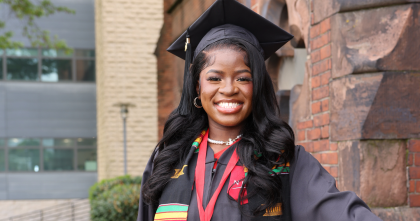
Internships, Mentoring and Networking Leads an NJIT Grad to Honeywell
As Fimimolaoluwa Are prepares to start working at Honeywell after earning a bachelor’s in chemical engineering, she feels grateful for all the support and experiences she had at New Jersey Institute of Technology.
“Chemical engineer I” is her title at Honeywell, where she’ll undergo a year of training before joining the company’s Field Operating Service team. Reflecting on how she got there, she credits mentors, internships, networking and the embrace of a welcoming community.

Internships, Lab Work and Volleyball: How a Grad Developed Skills at NJIT
Carson Williams is returning to his native Texas after earning a master’s in engineering management at New Jersey Institute of Technology, a year after he earned a bachelor’s in mechanical engineering there.
He feels thoroughly prepared for his associate account representative role at Daikin Applied, an HVAC systems manufacturer in Austin. Why? Because he developed a broad range of skills in a series of experiences on and off campus, both as a grad student and undergraduate.
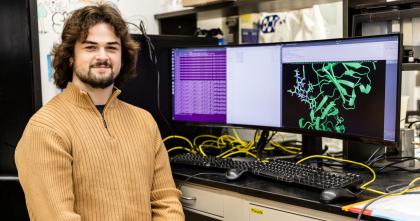
Owen West Wins Goldwater Prize for His Role in Studying Self-Assembling Peptides
His lifelong passion for baseball led Owen West, a rising junior from Point Pleasant Beach majoring in biomedical engineering, to dive into pharmaceutical research and become one of two NJIT winners of the prestigious Goldwater Scholarship for 2024.