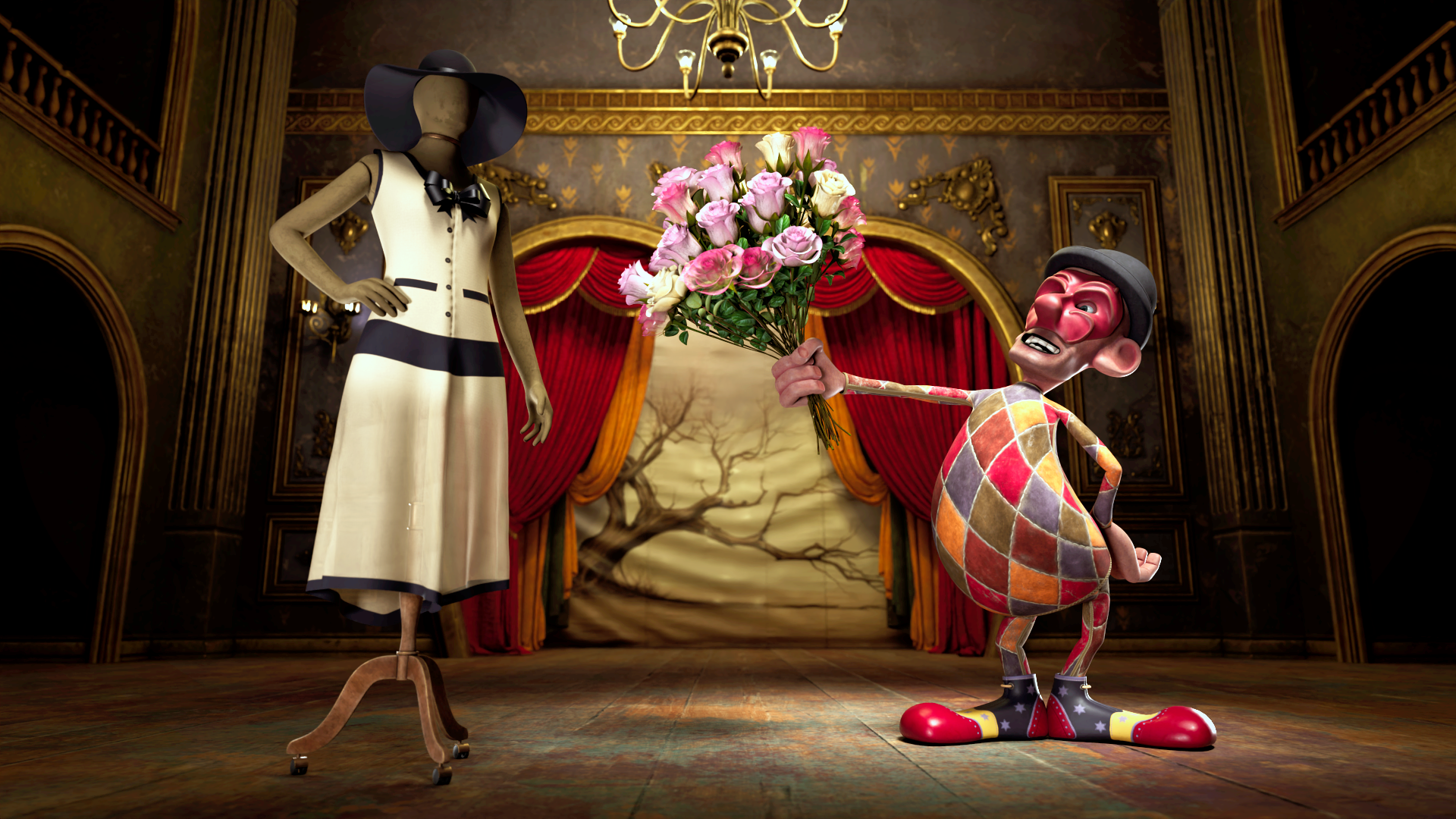
Richard Thompson, associate professor in the Hillier College of Architecture and Design, once performed on Broadway. For his latest role, the stage was a motion-capture space where NJIT students recorded his movements, which were then transferred to a 3D clown.
That performance helped bring King Karno to life. The animated short is now traveling the film festival circuit, with an Aug. 20 screening scheduled at the Chichester International Film Festival in England and another upcoming appearance at the Port Townsend Film Festival in Washington, which is recognized by MovieMaker Magazine as one of the 25 Coolest Film Festivals.
Thompson will be attending and participating in both of these events, as well as future festivals in Austin, Buffalo, and Syracuse. This summer, he was invited to be the keynote speaker at the Jersey Shore Festival, where King Karno also won an award. Earlier screenings have brought various accolades, including the WIFI Film Festival, where the film garnered five nominations, winning two awards for Best Animated Short Film and Best Direction from over 2,400 submitted films.
For Thompson, a 3D artist in NJIT’s School of Art and Design, the film is also an extension of the classroom. The emerging technologies used to create it have become part of his courses, while students, in turn, have contributed directly to the project.
“It’s a continuous feedback loop,” Thompson said. “I see something new at a conference, let’s say. I assess its value to our students – particularly in terms of providing access at a fraction of the cost. I then integrate it the very next semester into my class – where I also share some of my acting and clowning knowledge. The student then learns the very latest industry workflows and has the potential to produce something themselves that might be seen at a film festival.”
A clown built from history
King Karno grew from Thompson’s interest in the historical connection between clowning traditions and character animation. Its title honors Fred Karno, a British pantomime producer who discovered Charlie Chaplin and Stan Laurel.
The character combines several influences: a Harlequin-inspired costume and mask, a bowler hat reminiscent of Chaplin and Laurel, and the oversized clown shoes that often define the modern clown. The film follows the protagonist as he falls in love with a mannequin, telling its story through movement rather than dialogue.
“Can you tell your story completely through visuals?” Thompson asks. “Visuals are always the most powerful way. They are also universal, requiring no translation. It’s more fun for the viewer than being told specifically what they’re supposed to think or feel through dialogue, or worse yet, a voice-over.”
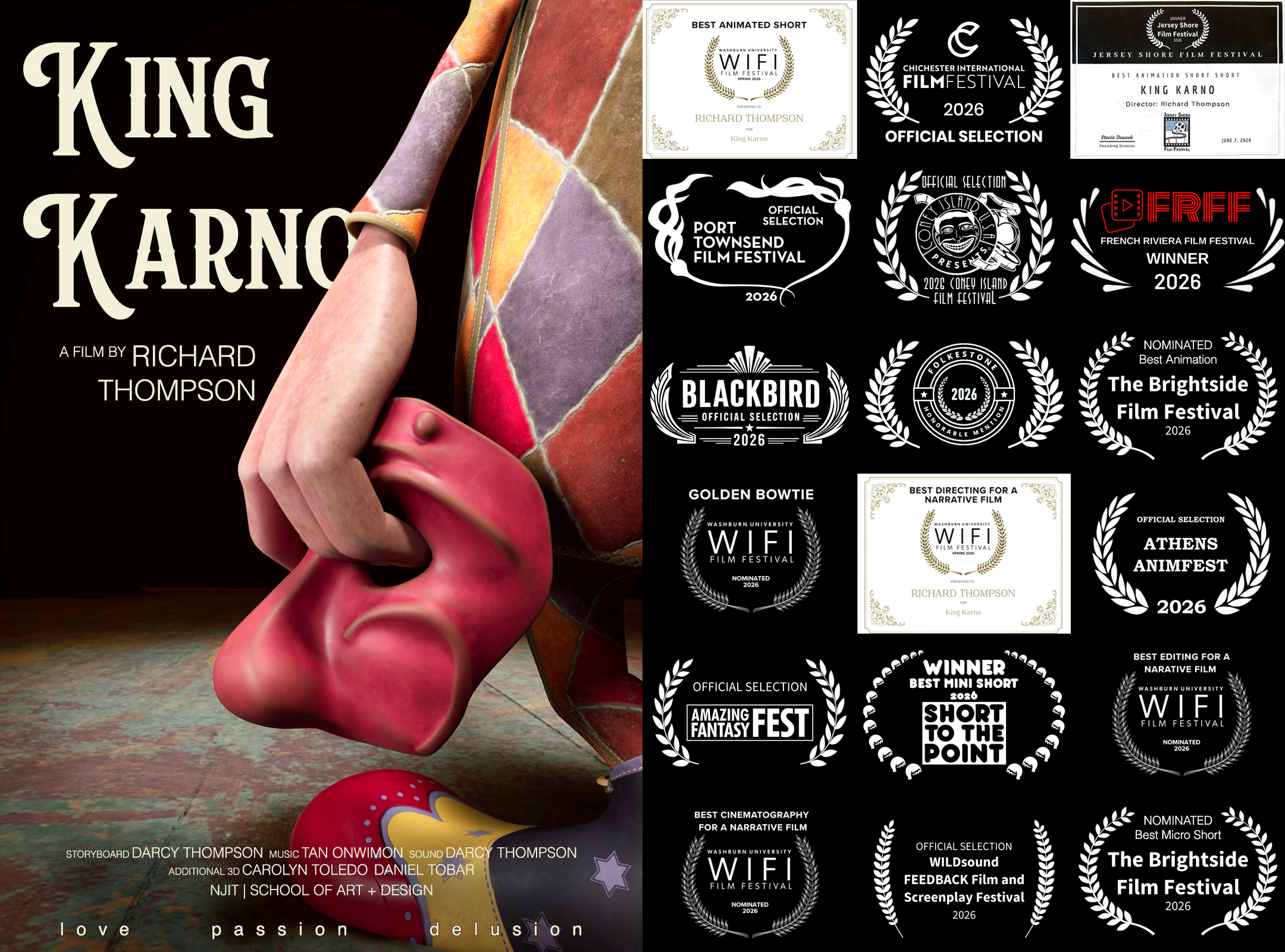
Thompson’s first career gave him a foundation for that challenge. He spent 17 years as a professional actor, appearing on and off Broadway before transitioning into 3D animation. His understanding of timing, physical performance, and what an actor can communicate without speaking now informs both his films and his teaching.
“I have all these past roots,” he said. “I never thought I would use them in a new career, but I am, I definitely am, and all the time.”
The film also reflects the economy of design Thompson teaches his students. Its action unfolds in a single environment, reducing the need to build multiple sets. The character’s mask limits facial movement, placing greater responsibility on the body to communicate emotion.
From film experiment to NJIT classroom
To capture that movement, Thompson turned to Autodesk Flow Studio, an AI-driven motion-capture platform. Unlike generative AI, the technology uses machine learning to recognize and record human movement. An animator must still clean the data and adapt it to a digital character.
“The students still performed their animation,” Thompson said. “It’s still technically complex and challenging to do.”
Thompson piloted the technology with NJIT students in the spring of 2025. A traditional motion-capture system requires specialized suits, trackers, and a lengthy calibration process. With Flow Studio, Thompson’s class captured more than 30 students in a single afternoon, allowing each one to experience the complete workflow.
The response helped inspire Digital Clowns, an elective that attracted an overflow of 19 students. They designed original clown characters and performed movements for them using both AI- and LiDAR-driven motion capture. Thompson also introduced the technology in Acting Fundamentals for Animators, a course the program is working to make available to students earlier in their studies.
That evolution is driven partly by the students themselves.
“You’re constantly evaluating whether it was successful,” Thompson said. “You get feedback from the students, and I ask for it.”
After students said they needed more time to prepare their motion-capture performances, Thompson began reconsidering the course schedule. He has also helped restructure the digital design curriculum, so students master 3D topology, texturing, rigging, and animation earlier. Over 6,000 custom screen-recorded tutorials support that instruction across several courses.
The results are in the work of the many talented students in the program. One such student, Giovanni Crocco, used Flow Studio to produce an animation in only his second year. This work has appeared at film festivals, and Autodesk selected him as a Design and Make Ambassador.
Students also contributed to King Karno. Through an Undergraduate Research and Innovation fellowship, Carolyn Toledo and Daniel Tobar explored the motion-capture technology, recorded Thompson’s performance, and helped retarget the movement data. Toledo also contributed texture work to the film. Both received production credits.
Their involvement captures Thompson’s approach: students do not simply study emerging tools. They help test them, improve the process, and produce work that reaches audiences beyond NJIT.
As generative AI changes the creative industries, Thompson wants students to concentrate on qualities technology still struggles to reproduce.
“Focus on design originality. Focus on storytelling,” he tells them. “But most importantly, focus on empathy.”
For Thompson, that empathy can mean moving an audience to tears or making someone laugh at a silent clown chasing an impossible romance.
