Carolyn Toledo did not come to NJIT with years of digital design experience already behind her. What she did bring was a lifelong love of art, a curiosity about technology and a growing sense that the future of creativity would demand both.
“So all throughout high school, I was really into art. I was big into studio art. So a lot of hands-on stuff – painting, drawing and sculpture,” said Toledo, a senior in NJIT’s Hillier College of Architecture and Design (HCAD). “But then by the time graduation came along … I decided that I wanted to make a career out of it, but I wanted to do something more modern, a little more relevant to how the arts in general is going on in this day and age.”
That mindset led her to digital design at Hillier College, in the School of Art + Design, where she found a program that allowed her to bridge visual art and technology in ways that felt both practical and exciting. Drawn by interests in movies, video games and digital media, Toledo said she saw NJIT as a place where she could build something new from the ground up.
“I always had an interest in movies, video games, that kind of stuff,” she said. “So I decided to bridge my interest in technology with my interest in arts.”
Finding her footing in digital design
Toledo said one of the biggest strengths of the digital design program was that it did not expect students to have everything figured out from the start. She entered as someone who had never worked much in digital art, and quickly found that the foundation year helped her make the transition without feeling overwhelmed.
“I was totally new to it,” said Toledo. “So freshman year, that foundation year was a good way to segue into digital design.”
From there, she began to discover just how broad the field could be. Over time, she was exposed not only to 3D design and animation, but also to user interface and user experience design (UI/UX), areas she had not even known much about when she first arrived on campus.
“I came here not even knowing what UI/UX is,” she said. “It wasn’t even until the later half of my sophomore year that I figured out what it was.”
That sense of discovery became central to her NJIT experience. Rather than being confined to one track, Toledo said HCAD’s digital design program gave students the room to explore different interests while also helping them identify their own strengths. That flexibility allowed her to develop her skills in entertainment-focused design, immersive media and more people-centered applications of digital design, especially in areas that can educate, guide or support others.
Designing with everyone in mind
As her work evolved, so did her design philosophy. Through coursework, studio collaboration and her UI/UX minor, Toledo said she began thinking more deeply about accessibility and usability — not simply whether something looked good, but whether it actually worked for the people using it.
That perspective became especially clear in her internship at the Morris Museum in Morristown, where she worked in a role that balanced graphic design and marketing. There, she said, she found herself applying lessons from the School of Art + Design directly to real audiences, including older museum goers who rely on clear text, legible layouts and thoughtful visual choices.
“Something that I keep in mind is the text size and how big the images are. I think I do attribute a lot of that idea of designing for everyone [to] a lot of the classes I took here,” she said.
That idea — design for everyone — has become the clearest throughline in her work.
“I would say the mark that I hope to leave on everything I do is that it’s universal in some way,” she said. “Nothing is designed just for one demographic, that it should be understandable, accessible to everyone.”
Researching AI as a creative tool
Another major part of Toledo’s journey came through summer research, when she explored how AI-driven motion capture could support the creative process in digital design. Rather than viewing AI as something that replaces artists, she described it as a tool that can remove technical barriers and free up more time for imagination, experimentation and storytelling.
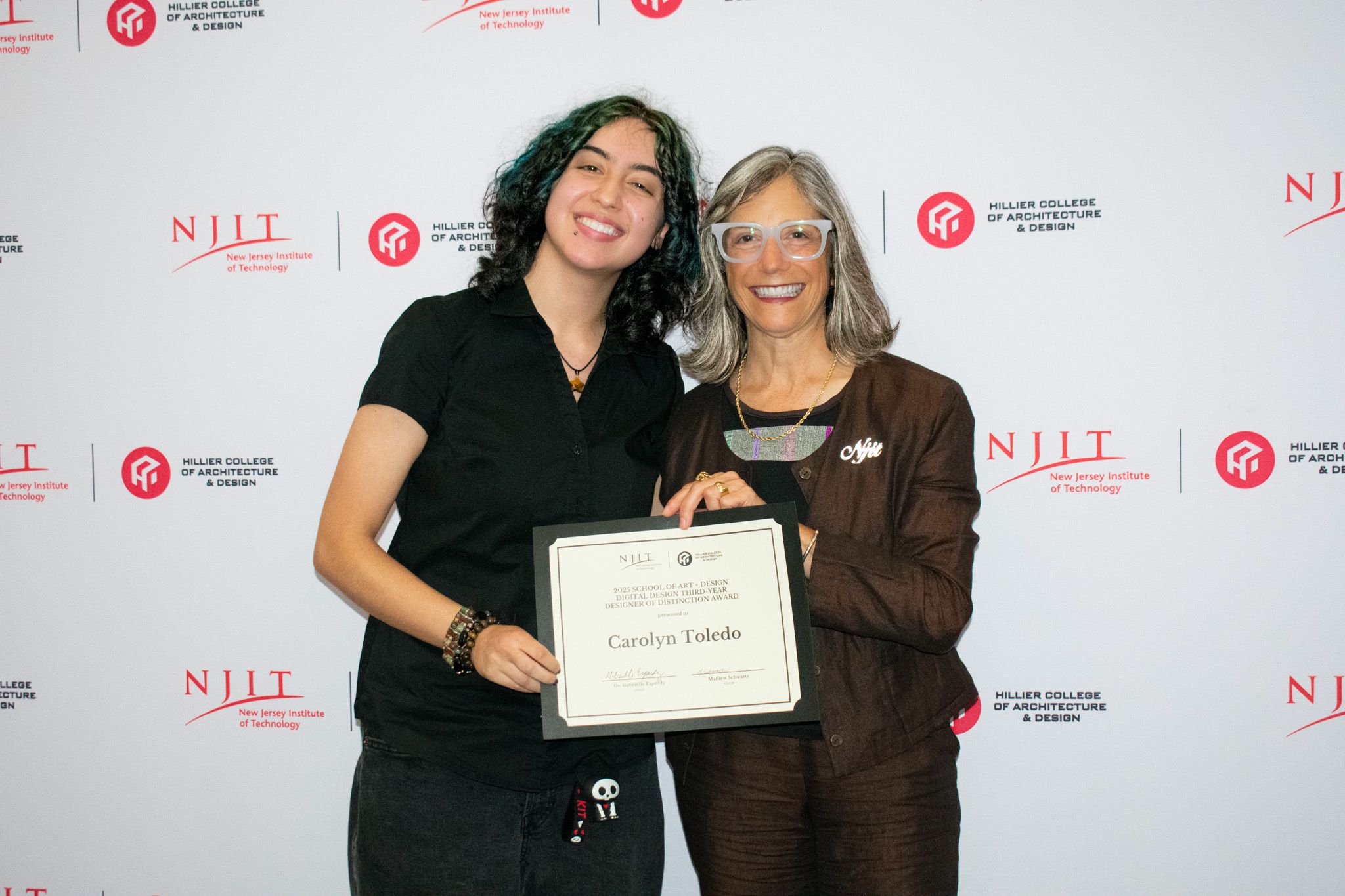
Carolyn Toledo with Dean Gabrielle Esperdy after receiving the Designer of Distinction award during her third year at NJIT.
“It wasn’t strictly a focus on AI,” said Toledo. “So instead of using AI to make something for us, It was a focus on how using a specific AI tool can facilitate us in our creative process.”
Her project centered on an AI motion-capture system that could take ordinary video footage and translate bodily movement into data for a computer-generated model, without the expensive suits and equipment traditionally associated with motion capture. The experience showed her how emerging technologies can expand what is possible for artists, especially in educational environments where access and cost matter.
She said that process — using technology to support, rather than replace, creativity — is exactly the kind of future she wants to be part of.
A community that made room for her
Just as important as the academic side of her NJIT experience has been the personal one. Growing up in Hillsborough, New Jersey, Toledo said she did not often have the chance to connect with others who shared her Ecuadorian background. At NJIT, and in Newark more broadly, that changed.
“I’m Ecuadorian. No one in my town comes from that same country,” she said. “So coming here, there’s a bigger Ecuadorian population.”
She said NJIT’s diversity helped make campus feel more open, more connected and more reflective of the wider world. It also gave her a stronger sense of belonging, not only through shared cultural background, but through the many ways students learn from one another across disciplines and experiences.
“It was refreshing,” said Toledo. “It helped make these spaces feel more like a community.”
That sense of community has extended into Newark’s arts scene as well, where Toledo has become involved with local creative activity, from murals to film festivals. She said she hopes to remain in the area after graduation, continuing to build a career in a place that has already become part of her creative identity.
A senior success story still taking shape
Now preparing for what comes next, Toledo says she is still energized by how many possibilities digital design has opened for her. Animation, exhibit design, UI/UX, motion capture and community-centered creative work all remain part of the picture. For her, that breadth is not a distraction — it is the point. The School of Art + Design gave her the freedom to explore, the support to improve, and the confidence to trust that her voice as a designer could keep evolving.
“I feel like I have a lot of experience in all those areas where I can really just pursue anything,” she said. “That’s a thing that I love about this major — we’re exposed to so many things.”
And through all of it, she has held onto the same principle: that the best design is not only inventive, but inclusive — that reaches beyond one audience and makes space for everyone.
