Bloomberg Radio Broadcast at NJIT Spotlights University Expertise on PFAS ‘Forever Chemicals’
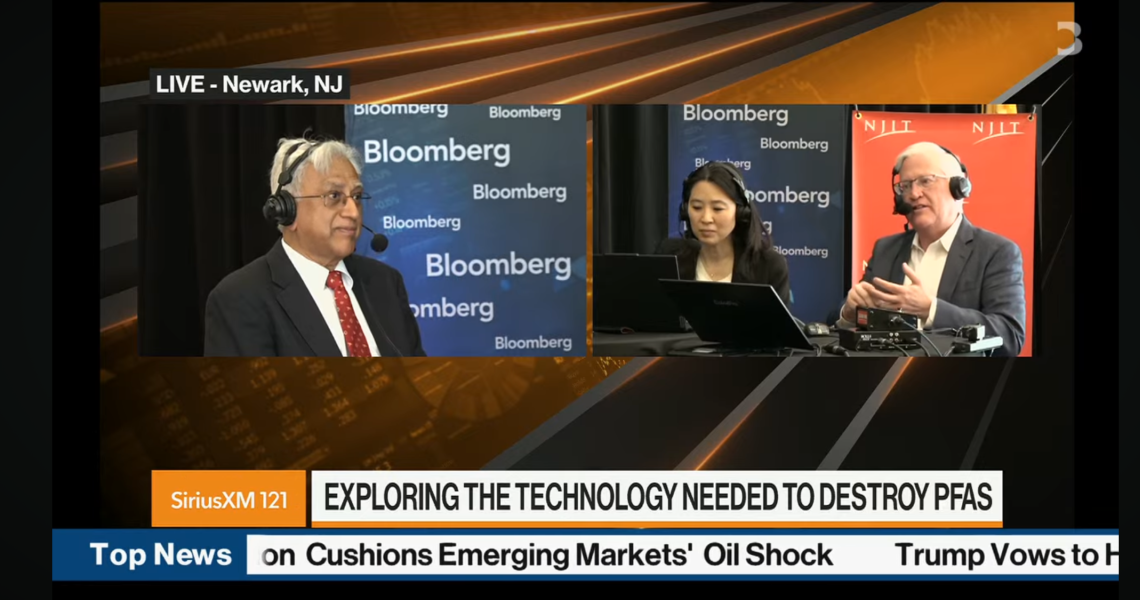
A live Bloomberg Radio broadcast from NJIT put the university’s environmental research into a much wider public conversation, as hosts Scarlet Fu and Paul Sweeney brought their weekday “Bloomberg Intelligence” program to campus and mixed NJIT faculty and researchers into the show’s regular coverage.
The focus of the day was PFAS, the family of synthetic compounds often called “forever chemicals” because they are built to resist breakdown. Used for decades in products designed to repel heat, water, oil and stains, PFAS have become a growing concern because they persist in the environment and can accumulate in water, soil and living organisms.
What made NJIT a fitting setting for that conversation was the range of work already underway here. The researchers featured on the broadcast reflected a broad response to PFAS, from rapid detection and water treatment to destruction technologies and commercialization pathways.
Cassie Hallberg, CEO of PureTrace Labs, spoke to the need for faster, more accessible PFAS testing across sectors ranging from industry and municipalities to agriculture and households. Her appearance helped show how NJIT research can move beyond the lab and into application: PureTrace was launched in NJIT’s New Jersey Innovation Institute to commercialize PFAS detection technology developed by Professor Hao Chen’s research. That technology builds on paper-spray mass spectrometry methods.
Associate Professor Arjun Venkatesan brought a remediation perspective. His work in emerging contaminants, including efforts with PFASolve and municipal-scale research partnerships, reflects the reality that PFAS is not a one-solution problem. With thousands of PFAS compounds in circulation, effective remediation requires a mix of approaches across detection, capture and destruction — a “trace to erase” mindset..
Professor Jay Meegoda highlighted the destruction side of the challenge. In a project funded by the U.S. Department of Defense, his work on PFAS remediation has focused on a sonoreactor that uses ultrasound and nanobubbles to break down PFAS molecules, with argon gas helping improve efficiency reducing the energy required. That work was featured in NJIT’s 2025 Research Magazine where Meegoda described the push for greener, lower-energy remediation technologies.
In Assistant Professor William Pennock’s interview, he added to the treatment-process perspective. His research in drinking water treatment — including coagulation, flocculation, sedimentation and filtration — highlighted how new PFAS strategies can fit into existing infrastructure. His research (with Venkatesan here) shows how that work connects fundamental treatment processes with practical implementation.
Distinguished Professor Wunmi Sadik’s appearance linked detection and destruction efforts. Her PFAS-related work leading the BioSMART Center includes rapid detection methods, as well as degradation-focused research and broader environmental chemistry. On air, she also pointed to the value of point-of-use solutions that could address contamination closer to where people encounter it, like in-home filtration.
Distinguished Professor Michel Boufadel rounded out the conversation with a broader environmental systems view. As director of NJIT’s Center for Natural Resources, his work helps extend the PFAS discussion beyond drinking water alone. That includes recent research on electrokinetic remediation in soils.
Taken together, the broadcast offered a useful snapshot of how NJIT is approaching one of the most persistent environmental problems now facing communities, utilities and industry. Rather than treating PFAS as a narrow specialty, the program showed the strength of a research bench that stretches from chemistry and environmental engineering to applied treatment systems and commercialization.