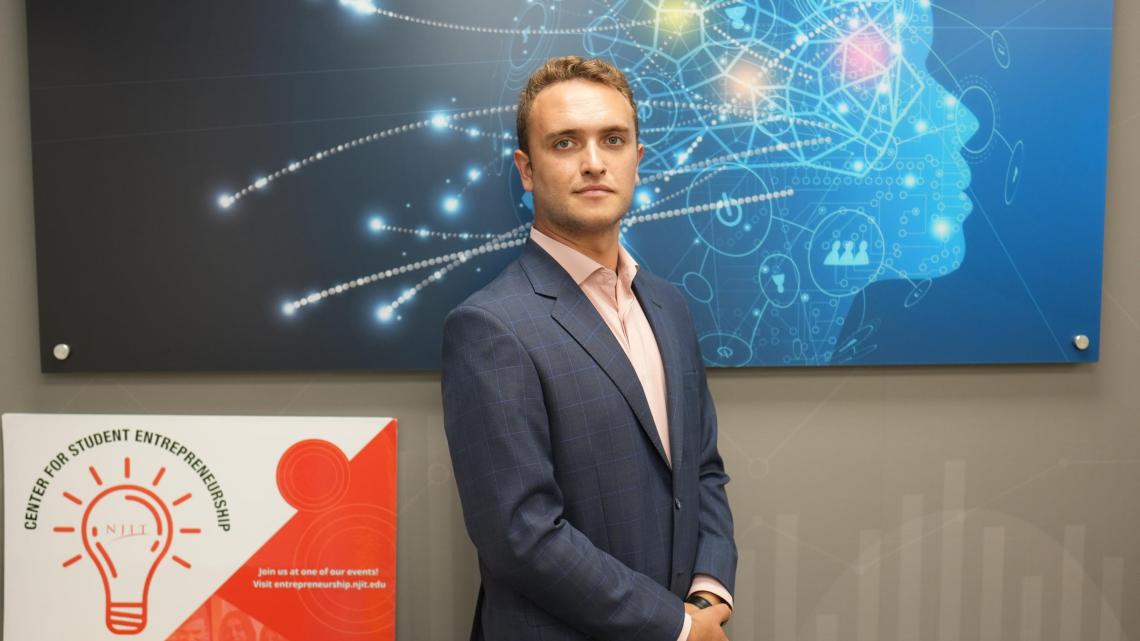
When Sepehr Rahimi came to NJIT to study cell and gene therapy, he was looking for more than classroom knowledge. He wanted to work where science met real-world application.
He found that connection quickly. An NJIT experience shaped by industry led him to an internship at BioCentriq, then to a full-time role as the organization grew and evolved into MADE Scientific.
Along the way, Rahimi began to see a problem that had little to do with science itself. In biotech, promising therapies can be slowed not only by discovery, but by the operational weight surrounding them: the documentation, coordination and regulatory preparation required to move toward clinical trials. Highly-trained experts, he realized, were often spending enormous amounts of time managing processes instead of developing cures.
That realization became the basis for Chorah Labs, the startup Rahimi co-founded in 2025 after his stint with MADE Scientific. The company is building regulatory infrastructure for biotech teams preparing for clinical trials, with a platform designed to reduce the time, cost and administrative burden of submissions while keeping expert review and accountability at the center.
Now Rahimi is building that company as NJIT’s first Global Entrepreneur in Residence, part of a first-in-New-Jersey model with implications that reach well beyond one founder.
For Rahimi, the role arrived at a decisive moment. After stepping out to launch Chorah Labs, he needed a viable way to continue building the company in the United States.
“As an international founder, that is not a secondary benefit,” Rahimi said of the GEIR pathway. “It is the enabling factor. Without it, I would not have been able to continue building the company here.”
That pressure point is central to why NJIT moved to establish the program.
Where founders and students meet
Kathy Naasz, executive director of NJIT’s Center for Student Entrepreneurship, said the idea came into focus at an unusually fitting moment. Provost John Pelesko had forwarded her a notice of funding opportunity from the Office of the Secretary of Higher Education. Around the same time, she was on a train to a conference in Boston where two universities were presenting on the Global Entrepreneur in Residence model — a little-known term at the time. New Jersey’s decision to fund a pilot gave NJIT an opening.
Entrepreneurship centers often bring in Entrepreneurs in Residence to mentor students and share what they have learned from building companies. The Global Entrepreneur in Residence model extends that concept to international founders. Through a university-based role, they can mentor students while pursuing a more flexible H-1B pathway outside the annual cap cycle.
At NJIT, though, the story is not only about founder support. It is also about what students get to see.
Naasz said one of the model’s biggest strengths is that it gives students access to a stage of entrepreneurship they would rarely witness this closely. Early-stage founders are usually consumed by competing demands, from product development to fundraising to the kinds of tough questions investors ask. Through the GEIR role, students are able to learn alongside that process as it unfolds.
Rahimi has become part of that learning environment in practical ways. He participates in weekly Open Entrepreneurship Hours, follows up one-on-one with student entrepreneurs and stays engaged with the center as Chorah Labs continues to take shape.
“I hope students take away that building something is not out of reach,” Rahimi said. “It is iterative and challenging, but it is something they can engage with early and meaningfully.”
Naasz said that exchange has already become visible across NJIT’s entrepreneurship ecosystem. Chorah Labs was accepted into the NJ AI Hub Accelerator. Ying Wu College of Computing capstone students worked on a project for the company. Rahimi also participated as a client in Professor Cesar Bandera’s Tech Venture Support Program, bringing the day-to-day needs of an active founder into spaces where students are learning how ventures actually move forward.
An especially distinctive piece of NJIT’s approach is its use of Peer EIRs — student entrepreneurs who work alongside the GEIR and gain firsthand exposure to accelerators, conferences and the work required to move a company toward launch. For Naasz, that kind of proximity creates what she described as “a special moment for learning.”
Building here, not somewhere else
The larger significance of the program is not hard to see in Rahimi’s own path.
NJIT helped launch him into New Jersey’s biotech sector. His work in cell and gene therapy helped him identify a structural problem worth solving. The GEIR program then gave him a way to keep building that solution here, in a state where the university is trying to strengthen the links among research, entrepreneurship and industry.
That is the logic behind the first-in-New-Jersey distinction. The program is not simply about placing one founder on campus. It is about testing whether a university can help keep entrepreneurial talent in the state long enough for companies, jobs and student opportunities to grow around it.
A second GEIR, Sheldon Fereira, is now set to join the program, giving NJIT the chance to deepen that model and broaden what it can look like in practice. Fereira, who earned master’s degrees from NJIT in applied physics and data science, is co-founder of Materium Technologies, a startup developing advanced protective coatings for electronics and semiconductor devices. His role at NJIT will also include supporting students in STEM and entrepreneurship by helping track student venture progress, Center for Student Entrepreneurship program performance and wider entrepreneurial ecosystem metrics.
Naasz said that in both of NJIT’s GEIR cases, the founders were nearing the point where they would have had to leave the United States within weeks, even as they were developing technologies with the potential to help people and the planet. The program gave them a way to stay and keep innovating here.
For now, Rahimi’s story offers an early measure of what the model can do. A founder who once came to NJIT as a graduate student is now building a biotech company here, while students watch that work up close — not after the fact, but in real time. With Fereira and Materium adding a second example, NJIT is beginning to show how that same pathway can extend across different fields, founders and forms of student engagement.
