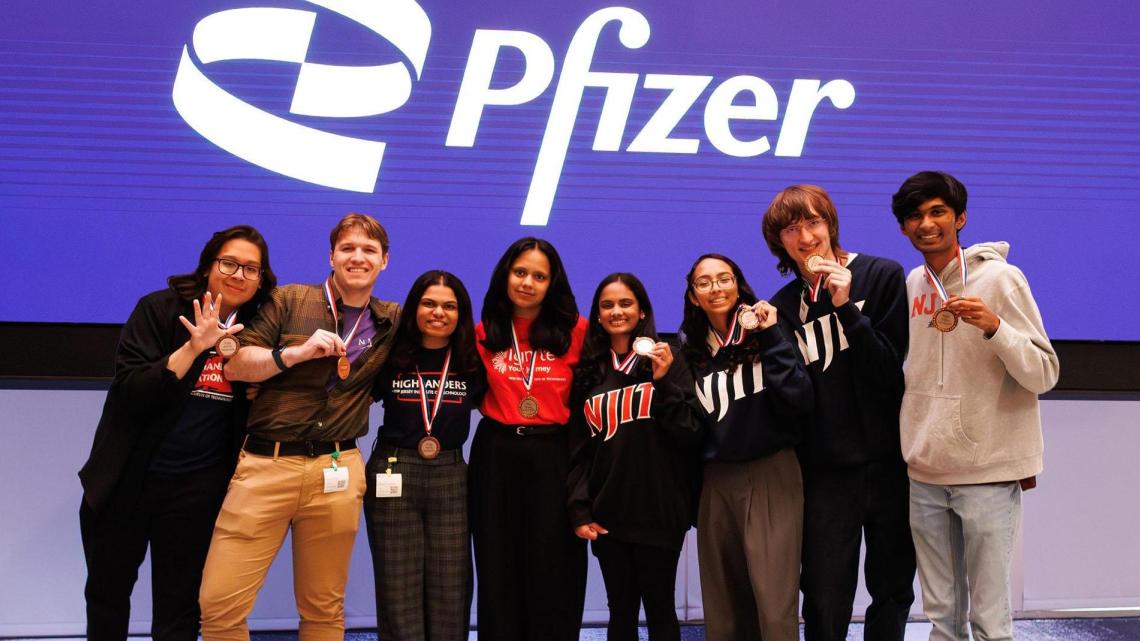
Rougly half of patients do not take psychotropic drugs as prescribed, especially those in underserved communities, according to A:Care. To address this, a team of eight Ying Wu College of Computing undergraduate students created "Sidekick," a mental-health side-effect tracker that earned third place at the 2025 Pfizer Digital Hackathon.
The app aids in making side effect tracking simple, reliable and accessible, with a goal of reducing medication dropout, improving adherence, empowering patients and promoting equity in health outcomes for all communities.
The team cites many reasons for why patients may discontinue medication, including doubts in effectiveness, initial side effect periods, stigma about being on medication and not treating their symptoms to expectations, among others.
Sidekick’s initial build connects with wearables for symptom logging and alerts for changes in mood, sleep and physiological patterns. Additional smart alerts are pushed to patients and health care providers to flag risks and set dosage reminders.
The objective, according to project manager Michelle Zambrano (computer science), is to assess symptoms through structured analysis while considering patient experiences. One of her own team members provided first-hand experience on how the device may have helped to avoid premature changes to their own regimen.
“Our team member shared a personal anecdote about having a recent ‘bad day,’ but reported that the previous week was more positive. The bad day was ‘very bad,’ but the prior data confirmed that there were far more good days over a few extreme exceptions. [They] made a data-driven decision with their doctor to continue the same medication and re-evaluate at a later time,” she said.
As one of eight teams from New Jersey schools, three of which were from NJIT (and the only one to score a win), Zambrano feels that their third-place award came due to “passion, sheer excitement and a drive to make comparative app designs better.”
Their preparation and technical fluency in how they handled detailed questions stood out to judges as much as their empathy for users.
“We also won because we were able to accurately answer every possible curve ball question they asked us about liabilities, safeguards, cybersecurity and privacy,” she added.
Sidekick provides non-identifying medication data that is accessible to the server, encrypted patient and provider information and secure reporting between parties.
The competition began with presenting to Pfizer executives over Zoom, which was followed by a live pitch deck and demo session at the New York headquarters.
Zambrano sees the opportunity as mutually beneficial: Students get real-world experience in bringing an idea to innovation and Pfizer is able to measure how participants can potentially fit into its organizational culture.
“I’m applying for the Pfizer digital rotation program now!” she exclaimed.
Congratulations to the other team members:
- Haripriya Kemisetti (data science) – Backend Developer
- Aditya Baradi (data science) – Full-Stack Developer
- Joshuan Barba (computer science) – Business Intelligence
- Alexey Mishin (computer science) – Backend Developer
- Shreyal Sharma (computer science) – Full-Stack Developer
- Jane Kalla (computer science) – Full-Stack Developer
- Alex Wesolowski (computer science) – Business Intelligence
