A one-day design sprint at NJIT challenged students to think like engineers, designers and problem-solvers for a wider range of users.
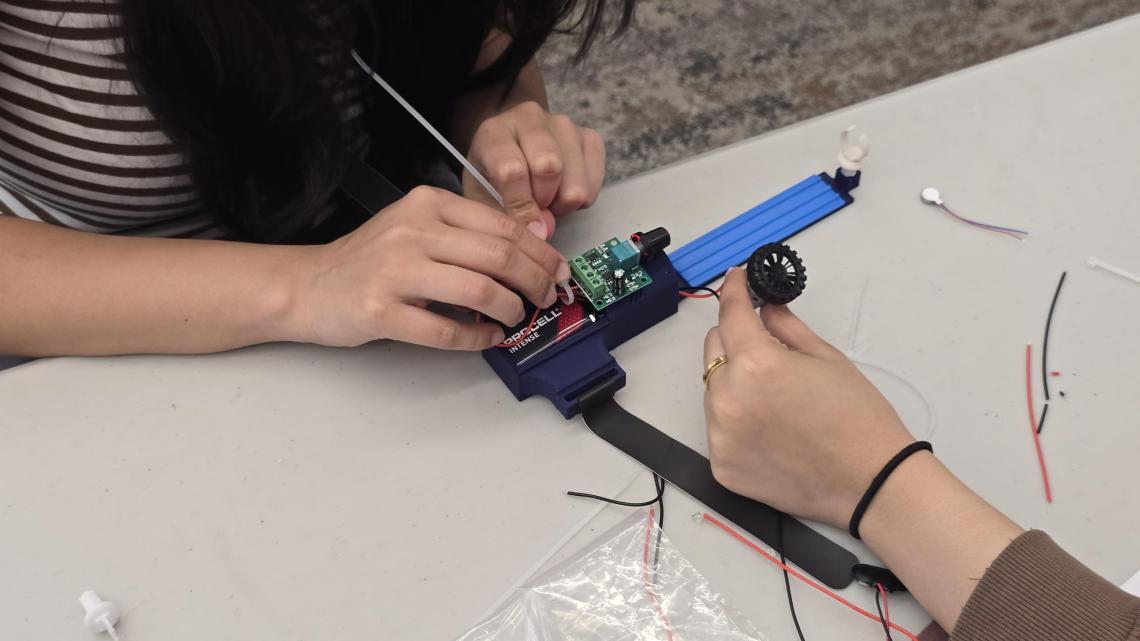
At CADence: An Additive Design Jam, held April 18 in the NJIT Makerspace, six teams spent the day designing and prototyping assistive technology concepts aimed at improving everyday accessibility. Working in medical, transportation and community tracks, students used CAD software, 3D printing and electrical components to build modular devices intended to respond to real-world challenges.
The event was organized by students Adeola Adeoye-Davids, a third-year biomedical engineering major, and Iniobong Ofonime, a third-year mechanical engineering major and Honors College student, and advised by Elisa Kallioniemi, assistant professor in the Department of Biomedical Engineering and director of NJIT’s Brain Stimulation Lab.
The student organizers were motivated in part by what they described as a broader gap in engineering education: they cited a TeachAccess Review finding that less than 3% of engineering and computing technology course descriptions reference accessibility or people with disabilities.
That gap gave CADence a clear purpose. Rather than treating accessibility as a side consideration, the event asked students to design with it at the center.
“It takes real courage for undergraduates to organize something this ambitious,” Kallioniemi said. “Adeola and Iniobong didn’t wait for the faculty to create this opportunity. They saw a gap in engineering education. Most students graduate without ever thinking deeply about accessible design. They saw that and built something to fill it. That’s leadership.” She added that “the maturity and thoughtfulness of the student work at CADence was genuinely impressive.”
NJIT President Teik Lim opened the event by stressing that technical skill alone does not define a strong engineer.
“What differentiates you is having what I call the power skills,” Lim told participants. “And that is what you’re using today — teamwork, communication and the most important one is empathy.”
Students began with a base component and then received track-specific prompts that pushed them to adapt that structure into a functional assistive device.
- In the medical track, teams were asked to create a modular attachment for people with Parkinson’s disease or essential tremors — a “Stability Core” that could hold a toothbrush, feeding utensil or similar tool while using a vibration motor to help counter tremor and improve precision.
- In the transportation track, teams designed a frame-mounted “Haptic Dashboard Component” for vehicles such as electric wheelchairs, delivery bikes or campus shuttles, using tactile pulses to communicate alerts such as battery life, speed limits or proximity warnings.
- In the community track, teams created a “Haptic Signpost” that could mount to a handrail or door frame and help people with visual or sensory impairments navigate large indoor spaces through surface texture and vibration cues.
Using SolidWorks, Autodesk Fusion and other CAD tools, teams moved from concept to prototype over the course of the day, printing, testing and revising their work before presenting two-minute pitches to judges from Johnson & Johnson, FemTherapeutics, Mack Trucks and Barker Architecture Office/Pratt Institute. Projects were judged on functional integration, ergonomics and accessibility, technical execution, innovation and creativity, and design documentation.
That industry presence mattered. If the organizers were responding to a lack of accessibility-focused design education, the judges helped underline why that work has relevance beyond campus.
“I think [experiential learning] is very, very important,” said Allan Peprah, senior transportation analyst at Johnson & Johnson. “A lot of things that you learn in college, like just in the classrooms, it may not click instantly with the job you’re doing. But if you had experiential learnings or experience doing those projects with a team, I feel like that translates the most.” Peprah added that the combination of teamwork, communication and problem-solving “goes a long way” for students preparing for internships and future roles.
The first-place team, Super CAD, came from the transportation track and included mechanical engineering majors Benjamin Cruz, Lucas Rainha and Sebastian Mercado. Second place went to Team Stingray — Monisha Khatri, a biomedical engineering technology major, Jiya Patel, a computer science major, and Kashvi Shah, a biology major — while Team Octopus, made up of biomedical engineering major Negar Namdar and mechanical engineering majors Leila Donyaparast Livari and Mohammadali Rashidioun, earned both third place and the Most Creative award.
For Lucas Rainha, the format itself was part of what made the event work.
“Overall, I really liked the whole idea of this event being like a mini Hackathon with a 7-hour time limit and the only form of manufacturing being limited to 3D printing,” Rainha said. “It definitely makes it really approachable to people who don’t know microcontrollers or electronics.”
Jiya Patel said her team’s work in the medical track was shaped by a personal connection.
“Parkinson’s is a very frustrating, progressive neurodegenerative disorder that mainly affects movement,” Patel said. “I witnessed this firsthand with my high school history teacher, who struggled with these tremors. At times, even writing the date on the whiteboard was a challenge. This inspired us to design a device that is as accessible as possible and can be used comfortably in real-world scenarios.”
By the end of the day, CADence had produced winners, prototypes and a stack of judge feedback. But the bigger takeaway may have been the framing behind it: asking students to design not just for function, but for people — and to treat accessibility not as a niche concern, but as part of good engineering practice. The organizers said they also gave teams their prototypes, extra materials and detailed scoring notes after the event so students could continue developing their ideas.
If you missed the opportunity to participate, look out for the announcement next year when CADence returns.
