For Naketa “KET-A” Williams ’26, artificial intelligence is not just about what systems like ChatGPT can do — it is about whose stories, languages and values they carry.
That idea will soon take Williams to Jamaica as a Fulbright recipient, where she will join a national initiative advancing culturally grounded AI development.
Williams will spend the next year working with the Jamaica Artificial Intelligence Association (JAIA) and researchers at the University of the West Indies to develop IRIS — Indigenous, Responsible, Intelligent Systems — the first sovereign large language model in the Caribbean.
In April, Williams learned she was among roughly 1,800 U.S. students selected for Fulbright awards for the 2026–2027 academic year. The Fulbright U.S. Student Program supports international research and cultural exchange.
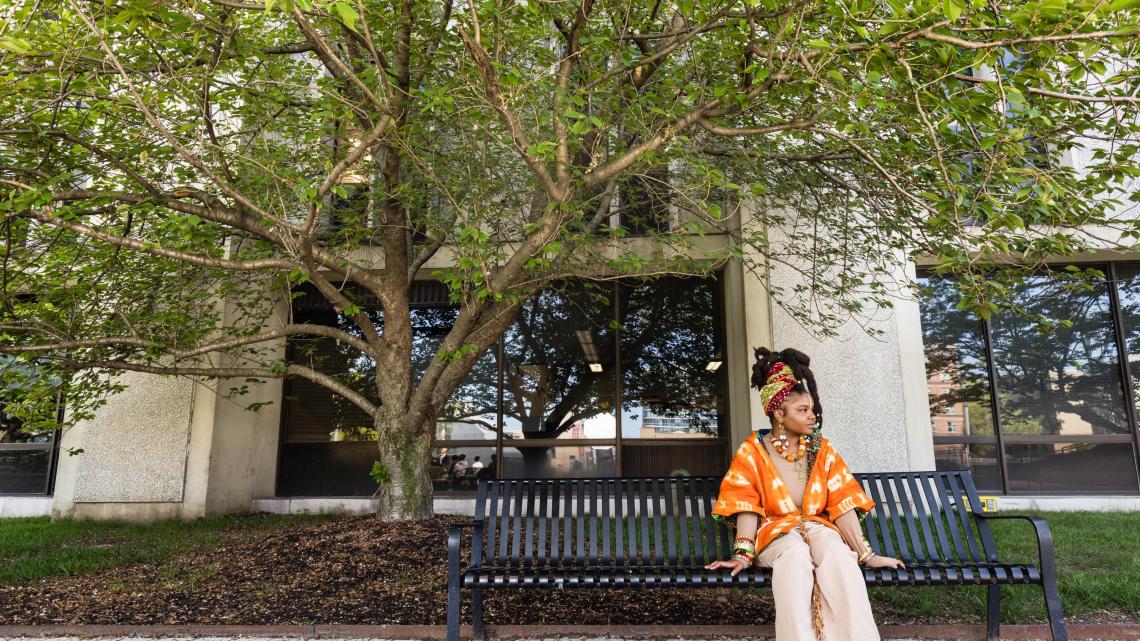
She received the news at one of her favorite places on campus.
“There’s a tree near the WEC that I always go to and call my ‘Wishing Tree,’” said Williams, a McNair scholar who is part of NJIT's Educational Opportunity Program (EOP). “When I got the Fulbright email, I actually hugged the tree. I was just elated.”
For Williams, whose roots are in Jamaica, the project is both intellectual and personal.
“It all starts with my love for my country,” she said. “I want Jamaica to be in the best position as the world is changing.”
A cyberpsychology major, Williams said her experiences with many mainstream generative AI systems led her to a larger question: What happens when the technologies shaping daily life are built on foundations that do not fully represent the people using them?
“I speak Jamaican Patois,” she said. “And when you get comfortable, your native tongue comes out. Sometimes I would use Patois in conversation, and it didn’t really pick up my nuances.”
“When AI systems are trained primarily on global datasets, they can miss the soul of a culture,” Williams added. “That affects whether people recognize themselves in the responses.”
IRIS was launched in 2024 as part of Jamaica’s national AI initiative. Built using Jamaican linguistic, cultural and historical resources, the system represents a growing movement toward locally governed — or sovereign — AI rooted in cultural specificity and public trust.
With the current AI landscape largely shaped by major technology firms, Williams said initiatives like IRIS offer an alternative model — one in which communities help define how intelligence systems are developed.
“For me, sovereign AI means building systems that understand people in the fullness of who they are,” Williams said. “It’s not just about language — it’s about values, context and lived experience.”
That collaborative dimension is central to Williams’ work ahead. While the project’s engineers continue refining the model, she will focus on the human side of development — studying how communities evaluate the system’s cultural authenticity and develop trust in its responses.
Working alongside Gunjan Mansingh, professor of computer science at the University of the West Indies and an advisor with JAIA, Williams will lead workshops and community sessions where participants compare responses from IRIS and globally trained models like Claude and ChatGPT.
Williams said the goal is to determine whether the system feels culturally legitimate to the people it is designed to serve — a quality that cannot be measured by benchmarks alone.
“The community isn’t just testing IRIS,” she said. “They’re helping build it.”
Williams said the locally developed model allows community feedback to reach the development team directly, shaping how the system is refined over time and strengthening its role in cultural preservation.
She pointed to Jamaica’s Maroon communities as an example, noting that some smaller languages on the island risk fading without sustained preservation — something she sees IRIS helping to address.
“Being able to embed that kind of knowledge into systems like IRIS means it doesn’t just disappear,” she said. “It can actually be taught and carried forward.”
If successful, Williams believes the project could help reshape broader conversations around artificial intelligence, particularly for regions where languages and lived experiences are often underrepresented in mainstream systems.
“I don’t want AI safety research to focus on a narrow idea of who ‘the human’ is,” she said. “Everyone should see themselves reflected in the systems they use.”
“I want people to feel hopeful when they think about AI,” she added. “Cultural perspectives aren’t just something to study. They can be built into the technology.”
As she nears commencement later this month, Williams hopes her NJIT journey will resonate with students who may not see themselves in traditional definitions of academic success.
“You don’t have to be an honors student to be great,” Williams said. “All the resources are at NJIT for you to take advantage of.”
