
What if catching a bus were as easy as calling an Uber, without the steep fare or the long walk to a stop?
NJIT biologist Simon Garnier thinks an unlikely organism could help make that possible — slime mold.
The brainless, single-celled organism has an unusual ability to move nutrients through tubes inside its body, rerouting the flow as conditions change.
Garnier's team is drawing on that ability to develop Fluid Fleets, an on-demand transit system in which buses adjust their routes as passengers request rides.
“We want to bring the convenience of Uber with the efficiency and affordability of public transportation,” Garnier said. “Instead of paying $40 for an Uber, imagine paying $4 for the same convenience. We think slime mold can help get us there.”
Unlike most single cells, Physarum polycephalum can spread across a tabletop as one enormous cell. As it searches for food, it stretches out a branching network of tubes that carry nutrients throughout its body.
Image

Above: Time-lapse footage shows a slime mold cell exploring its surroundings and extending a branching network toward a block of nutrient-rich agar. The 30-second video captures approximately 12 hours of activity. Credit: Simon Garnier/NJIT.
In 2010, researchers even showed that slime mold could form networks resembling Tokyo's rail system. But Garnier and his colleagues focused not on the network's shape, but on how material moves through it.
“For it to be able to move and grow that fast, essentially it is a problem of transport,” Garnier explained. “How do you move and transport your nutrients, your nuclei, your mitochondria, your entire biomass from a point in the environment where it's not necessarily the best place to be to a point where it's better?”
At NJIT's Swarm Lab, Garnier and collaborators adapted that transport mechanism into an algorithm called RAPID — Robust Adaptive Pathfinding for Interconnected Devices. Contributors include NJIT doctoral students, University of Scranton mathematician Jason Graham, NJIT mechanical engineering professor Petras Swissler and former undergraduate Lindsay Burke ’26.
Rather than calculating routes across an entire network, RAPID uses information from neighboring locations to determine where to go next, adjusting as conditions change.
“The main inspiration from slime mold is that there's no centralized decision-making,” said Maxfield Comstock, an NJIT researcher at the Swarm Lab who develops the project's software and simulations. “There's no brain at the center deciding where material should move.”
“It seems like the algorithm is doing something really clever, like solving some really challenging problem,” he added. “But it actually isn't. It's just avoiding a challenging problem.”
In Fluid Fleets, those neighboring points become street intersections, and the material being transported becomes passengers.
Garnier says riders would request a trip through an app, and the system would assign a bus to pick them up, perhaps at a nearby corner. Transfers could be arranged automatically, without passengers planning their journeys.
“The bus knows you're aboard, and at each intersection, it listens to which direction wants you most,” Garnier said. “It does that for everyone on the bus, dropping people off along the way. And if traffic slows one bus down, the others can adjust their routes to avoid it.”
But could buses making those decisions on the fly actually outperform conventional routes?
To find out, the team put Fluid Fleets to the test in computer simulations of Newark, Rutherford and Wayne.
Over a 100-minute simulation, Fluid Fleets transported approximately 56% more passengers in Newark, 78% more in Rutherford and 128% more in Wayne than conventional fixed-route buses.
Passengers also spent far less time walking to catch a bus — roughly one to three minutes, compared with about 20 minutes on conventional routes. Those simulations didn’t account for traffic, but newer tests that do have shown similar trends, Comstock said.
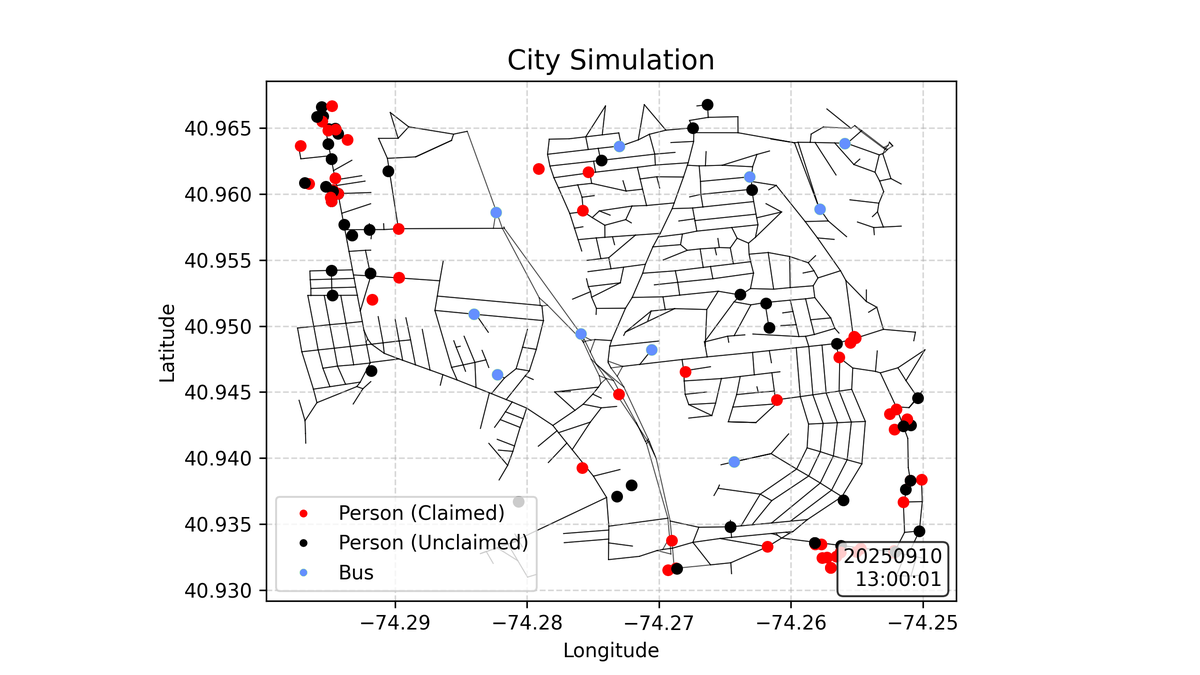
Fluid Fleets in action: A simulation of Wayne, New Jersey, shows how NJIT's proposed on-demand transit system would serve passengers. Blue dots represent buses, red dots show passengers assigned to a bus, and black dots indicate those still awaiting assignment. Credit: Burke et al., A Swarm Approach to Public Transit Using On-demand Routing in a Slime-Mold-Inspired Framework (2026).
“We expected bigger improvements in less populated areas, where people may have to walk 20 or 30 minutes just to reach a bus stop,” Garnier said. “But we didn't expect the system to perform so well even in dense areas like Newark.”
“Every time we try it on something, I feel like we must have cheated somewhere,” he added. “It can't be that good all the time.”
The team also sees opportunities to improve accessibility. Passengers with mobility limitations could request pickups at their locations, while those willing to walk farther might receive discounted fares.
Despite promising simulations, Garnier said the next hurdle is proving Fluid Fleets affordable to operate.
Backed by a $25,000 NJIT Collaborative Early Research Translation grant, the team plans to partner with Pennsylvania's Monroe County Transit Authority to examine the system's operating expenses.
“If our system delivers twice as many passengers but costs three times as much in fuel, no transit agency is going to adopt it,” Garnier said.
“MCTA serves these pockets of densely populated communities separated by areas where very few people live,” he added. “That's a real challenge for public transportation, but they're interested in finding new solutions. They were also among the first adopters of tap-to-pay fares, so they're clearly open to innovation.”
NJIT undergraduates will develop simulations using transit data and examine costs and regulatory constraints, including drivers, fuel, maintenance and restrictions on where different-sized buses can travel.
Within five years, Garnier hopes to persuade a transit agency to test Fluid Fleets on the road.
“My dream is to be able to go to work by public transportation and never have to use my car again,” Garnier said. “You finish your coffee. You push a button. You walk outside, the bus is waiting for you ... and then you just listen to your podcast or read your book.”
