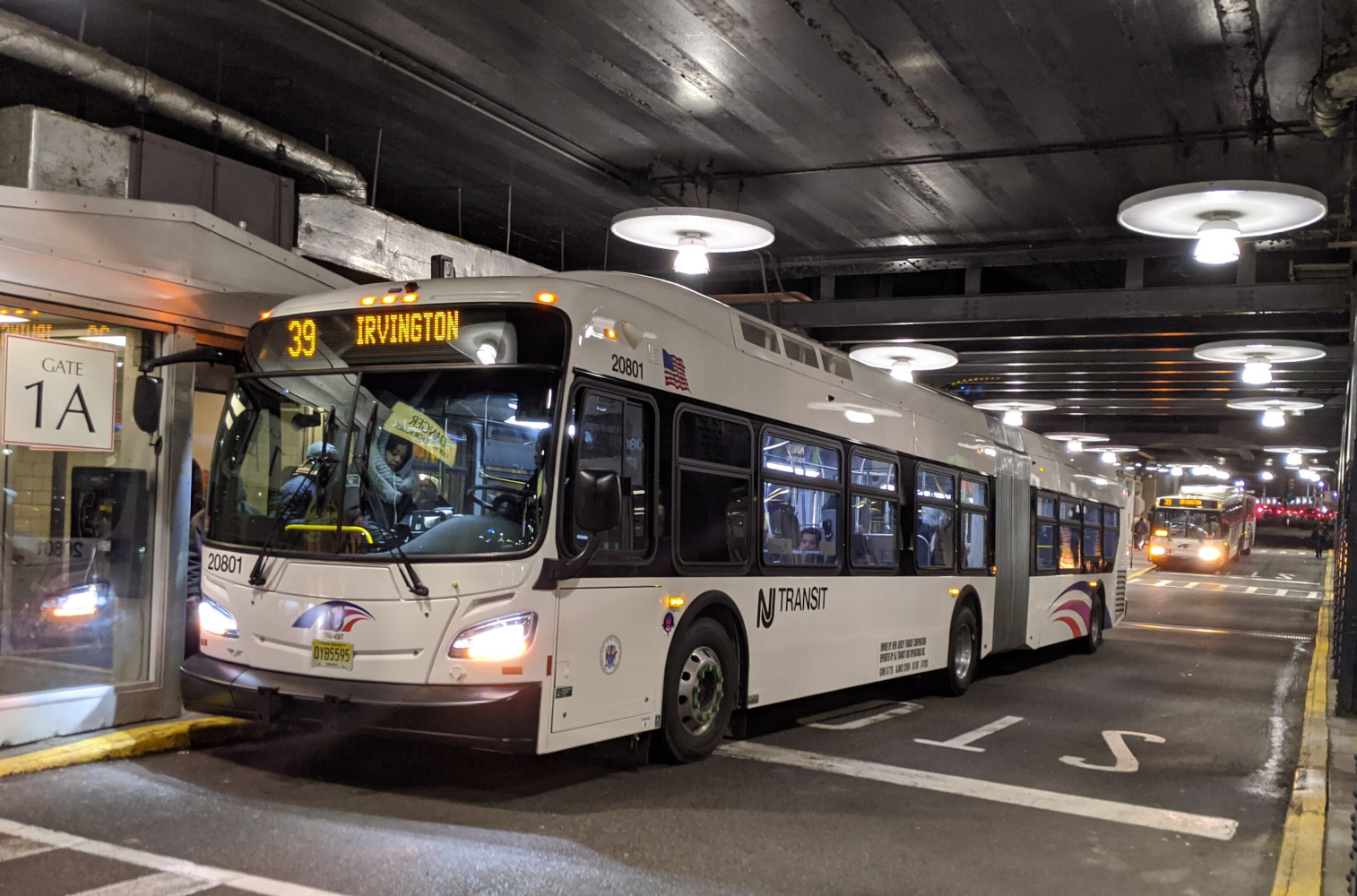
Commuters may get to work faster and rely less on bus schedules if transit agencies embrace Lindsay Burke’s undergraduate research at New Jersey Institute of Technology.
Burke, who graduated in May with a B.S. in computer science and was in the Albert Dorman Honors College, was first author on A Swarm Approach to Public Transit Using On-demand Routing in a Slime-Mold-Inspired Framework for the Distributed Autonomous Robotic Systems conference in Tokyo this fall.
In her research, Burke and colleagues found that a bus route is more efficient when it navigates based on where the most people are waiting, instead of driving to defined stops whether anyone is there or not.
The method uses their algorithm called RAPID — Robust Adaptive Pathfinding for Interconnected Devices. The algorithm, running locally on each bus, grades nearby locations based on how many people are waiting to board or disembark. Locations with the highest values become the next stops.
Riders traveling from or to less-dense areas aren’t abandoned. Each time a nearby bus skips their location, their value grows in the algorithm until it overmatches denser populated locations and signals a bus to stop there.
For suburban, urban and semi-rural scenarios, they looked at data from New Jersey Transit. “We show that our approach increases passenger delivery rates relative to a fixed-network approach by 28%, 49% and 101%, respectively, and results in over 75% reduction in walking time in all cases,” the paper states.
Whether such improvements would be seen in northern New Jersey is an open question. Burke noted the massive X-factor in the research: traffic. She said the team is working on accounting for rush-hour traffic jams and hopes to elaborate in a future paper. She also said larger-scale simulations would be needed before putting the plan into action, since laboratory simulations only considered a 2-kilometer radius. In addition, the team hopes to partner with the Monroe County (Pennsylvania) Transit Authority for a pilot study.
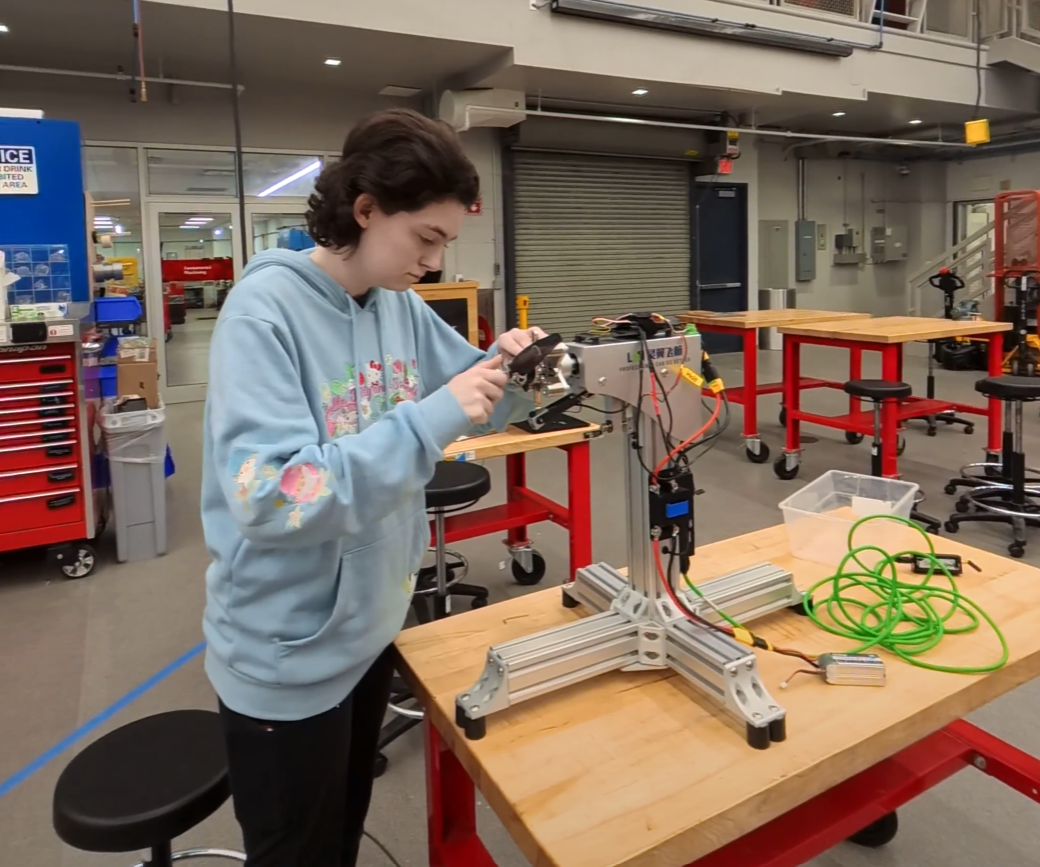
Burke working on a Flylanders thrust testing stand in the NJIT Makerspace
Burke worked primarily under mechanical engineering Assistant Prof. Petras Swissler, who laid out the unintuitive connection between slime mold and bus routes. Other faculty have studied how robots can learn from ant behavior, such as biology Prof. Simon Garnier, while Swissler and peers have looked at framing cities as cells. Slime mold logic, he noted, is well-documented in physical networks — including his own work on disaster recovery robots — because of its uncanny ability to keep moving in all directions until it finds food and then transfer the nutrients wherever necessary. “From there, framing transit systems in the context of transport mechanisms in slime molds was a pretty simple jump,” he explained. Garnier served as a research adviser, he added.
Burke said she hopes that other NJIT student researchers continue investigating this subject. “I didn't really know anything about coding coming into college,” she said. However, “Through all my research experience at NJIT, I realized there's still a lot of foundational work that needs to be done in the field of robotics.”
Her next move is doctoral studies at the University of Michigan, where she’ll study optimized control algorithms for robots that act collectively, along with emergent behavior which refers to complex behaviors that arise from simple, local interactions. Despite being a computer science major, this move goes back to her roots, as she discovered her affinity for hardware on her childhood school’s Lego robotics team in Vernon Township along with her brother -- they were two of the family's quadruplets. Later, at NJIT, she led the electronics and propulsion team for the university’s Flylanders radio-controlled airplane club, while also minoring in drones and robotics.
Her upcoming time at Michigan is funded by the U.S. Department of Energy; she declined a similar offer from the Department of Defense. The scholarship comes with internship opportunities, which she’ll begin in summer 2027. She hopes to intern at Lawrence Livermore National Laboratory, because of their relevant expertise in large-scale drone swarms.
“I consider myself very fortunate that Lindsay decided to pursue research under my mentorship, as she provided significant and meaningful contributions across the several projects we worked on together,” Swissler added. “Throughout this time she has shown an unparalleled zeal for learning that I am sure will lead her to great success as she pursues her Ph.D. at Michigan.”
