NJIT Ph.D. Researcher Wins NASA FINESST Award to Probe Mysteries of ‘White-Light’ Solar Flares
In 1859, astronomer Richard Carrington witnessed a sudden flash from the Sun. The flare was followed by an extreme geomagnetic storm that produced auroras at unusually low latitudes and disrupted telegraph systems around the world.
The event later became known as the Carrington Event — the first recorded observation of a white-light solar flare.
More than 160 years later, scientists are still trying to understand exactly how these eruptions on Earth’s nearest star transport energy into the lower layers of the Sun’s atmosphere, producing visible white-light emission and, in some events, seismic disturbances known as sunquakes that ripple across the solar surface.
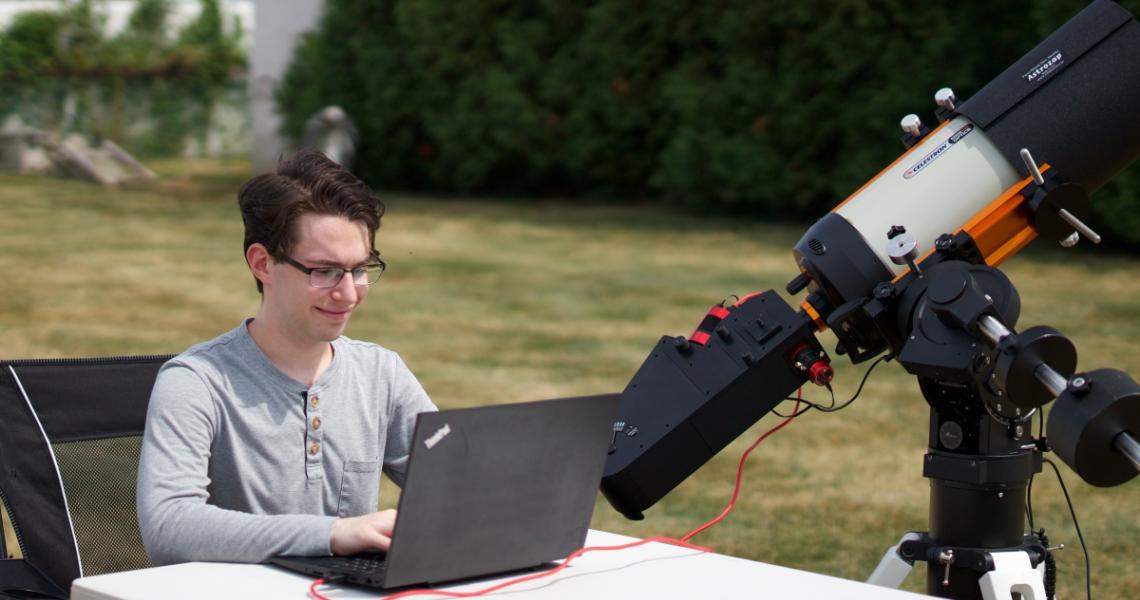
Samuel Granovsky, a doctoral researcher at NJIT’s Center for Computational Heliophysics, is now exploring these events with a Future Investigators in NASA Earth and Space Science and Technology (FINESST) fellowship, which provides $150,000 over three years.
“White-light flares vary in size and frequency,” Granovsky said. “While Carrington-class events are roughly once-in-a-century, strong X-class flares can occur multiple times a month during the peak of the Sun’s 11-year cycle, which may disrupt satellites and ground electrical equipment. It’s important to better understand the underlying physics behind these events.”
Like other solar flares, Granovsky says white-light flares are often triggered when twisted magnetic fields in the Sun’s corona suddenly snap and reconfigure.
“You have the magnetic field being twisted at certain regions,” he said. “When it gets overly stressed, it snaps into a different position, and that snapping accelerates particles.”
For decades, scientists have thought high-energy electrons carried most of that energy downward, depositing much of that energy within the chromosphere — a layer above the Sun’s visible surface — particularly its upper and middle layers.
But observations from NASA’s Solar Dynamics Observatory and other instruments suggest flare energy may penetrate much deeper.
“During certain white-light flares, we observe not only visible brightening across the solar surface, but also seismic waves known as sunquakes and unusual changes in the solar spectrum,” Granovsky said. “In some cases, normally dark absorption lines briefly brighten or even flip into emission, which suggests intense heating in the lower atmosphere and may indicate energy deposition extending toward the photosphere.”
A focus of his NASA-supported research is the Sept. 6, 2017 X-class solar flare, which produced multiple line reversals across a sunspot region — a clear example of strong energy deposition in the Sun’s lower atmosphere.
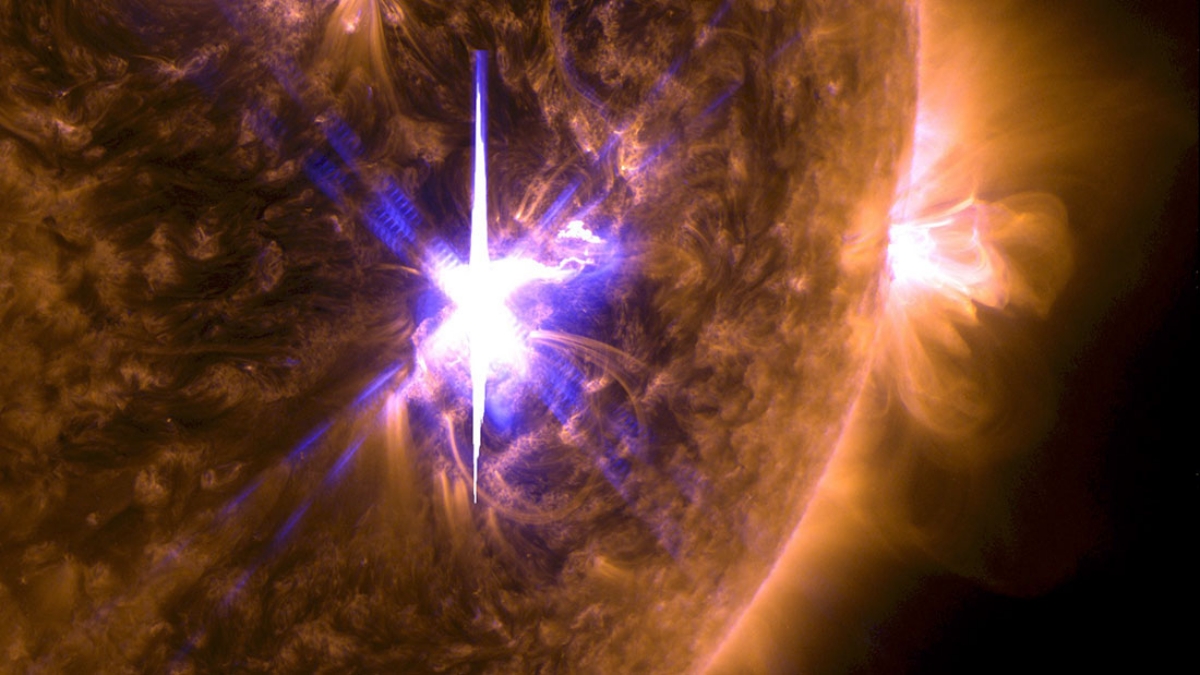
Above: Close-up view of the Sept. 6, 2017 X9.3-class solar flare — one of the strongest on record — as it erupts from a sunspot region on the Sun's surface. Granovsky is using this event to study how white-light flare energy penetrates deeper into the solar atmosphere than previously understood. Credit: NASA/GSFC/SDO
“Those signals help trace how energy is deposited in deeper atmospheric layers and the solar response beneath the visible surface,” said Granovsky, who is conducting his work under the mentorship of Distinguished Professor of Physics Alexander Kosovichev.
Granovsky says heavier particles — particularly protons — are one possible explanation for how flare energy may reach such deep atmospheric layers. Because protons are roughly 2,000 times heavier than electrons, they can penetrate further before depositing their energy.
However, they are also much harder to detect directly.
“Electron beams can explain the visible brightening we see in white-light flares, but they don’t fully account for deeper atmospheric impacts,” he said. “Protons are one possibility. We can infer electrons through hard X-ray emission, whereas diagnostics of accelerated protons are generally more limited and often rely on gamma-ray signatures that are not available for every event.”
Granovsky aims to determine whether lower-atmosphere signatures — including line reversals, shock responses and localized heating — can help identify the role of proton beams in white-light flares.
To investigate, Granovsky is combining observational analysis with numerical modeling to track how particle beams move through and heat different layers of the solar atmosphere.
His work draws on data from multiple instruments, including NASA’s Solar Dynamics Observatory, the Interface Region Imaging Spectrograph (IRIS), and GOES X-ray satellites.
The research extends beyond the one-dimensional flare models long used in solar physics.
Instead, in collaboration with the NASA scientist, Irina Kitiashvili, Granovsky is using StellarBox — a three-dimensional radiative magnetohydrodynamics code developed at NASA’s Ames Research Center — to reconstruct how flare energy propagates through the Sun’s atmosphere.
“Most models treat flares in one dimension, where energy moves straight up and down,” he said. “But in reality, energy also spreads sideways, and three-dimensional modeling more accurately captures that behavior.”
His simulations, performed at the NASA Advanced Supercomputing Center incorporate radiation, plasma physics and magnetic fields to reproduce how the solar atmosphere responds during white-light flare events.
“In some of our simulations, we see very large shock waves propagating outward at extremely high speeds,” Granovsky said. “In the corona, they can reach 700 to 800 kilometers per second, comparable to speeds observed in large solar disturbances.”
Granovsky says those simulations reveal a far more dynamic atmospheric response than one-dimensional models are capable of showing. They also generate synthetic observations — virtual telescope data that can be directly compared with real measurements — helping researchers test whether proton-driven flare models better reproduce the deep-atmosphere signatures observed during white-light flares.
The work may also improve understanding of space weather events that can affect Earth.
“Part of it is building a more complete picture of how these flares work,” he said. “Improved understanding of flare physics could eventually contribute to better forecasting of large solar eruptions and their impacts on Earth.”
“We’re among a relatively small number of groups modeling these flares in three dimensions,” he added. “I think that will have a major impact on how these events are studied going forward.”