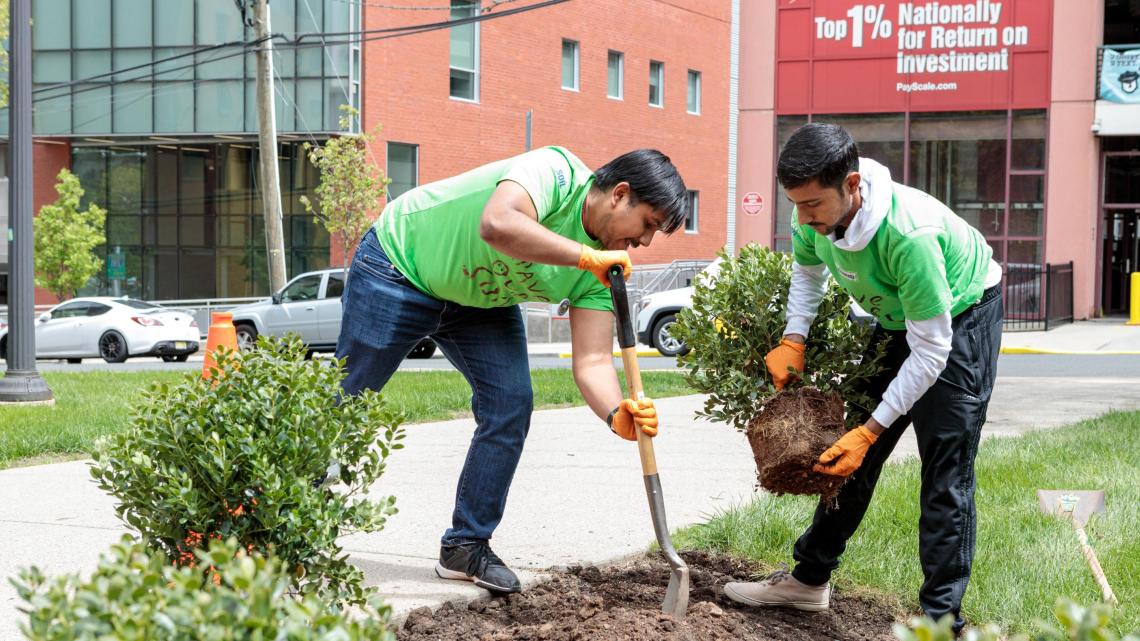
New Jersey Institute of Technology is advancing its commitment to sustainability with the launch of a new Peer-to-Peer Sustainability Engagement Program led by the Office of Sustainability.
Supported by a New Jersey Department of Environmental Protection (NJDEP) grant titled “Decarbonizing New Jersey Higher Education Institutions by Enhancing Recycling Activities,” the initiative brings NJIT together with four other New Jersey public universities to strengthen sustainable behaviors and reduce waste across campus.
Set to launch this Spring, the program focuses on one of the most critical components of environmental progress: changing everyday behavior.
Sustainability is a core pillar of NJIT’s 2030 Strategic Plan, which emphasizes responsible resource management, community engagement and operational excellence.
While NJIT has made steady progress through investments in recycling infrastructure, energy efficiency improvements and academic sustainability initiatives, there remains an opportunity to further strengthen consistency and engagement across campus. Recycling practices and participation levels can vary by location, and sustainability efforts are not always visible in daily routines. This program builds on existing successes by empowering students, faculty and staff to champion sustainability within the spaces where they live and work.
“This grant allows NJIT to showcase our culture of stewardship of our resources to the wider community,” said Prabhakar Shrestha, assistant director of sustainability at NJIT. “Sustainability is not only our core mission of our university but also the ethos that binds us together.”
Research consistently shows that peer-to-peer engagement is one of the most effective ways to influence behavior in decentralized environments like university campuses. By embedding sustainability champions throughout academic buildings, administrative offices and residence halls, NJIT is taking a people-centered approach that complements its existing infrastructure and policies. The result is a program designed not only to improve environmental outcomes, but also to strengthen campus culture and shared accountability.
The Peer-to-Peer Sustainability Engagement Program is built around two complementary leadership models: Green Teams and EcoHighlanders.
Green Teams are composed of faculty and staff volunteers located in academic and administrative buildings across campus. These teams serve as local sustainability champions, promoting correct recycling practices, helping reduce contamination and coordinating building-level initiatives. By increasing visibility and consistency in sustainability messaging, Green Teams help reinforce environmentally responsible habits in workplace settings.
EcoHighlanders are student sustainability leaders embedded within NJIT’s residence halls. Serving as peer educators, they host events, lead outreach efforts and encourage fellow students to adopt environmentally responsible behaviors in their daily routines. Because EcoHighlanders engage students where they live, they play a critical role in shaping social norms and increasing participation in sustainability efforts. Each EcoHighlander receives a scholarship in recognition of their leadership and commitment, reinforcing NJIT’s investment in student-driven change.
The program follows a structured, multi-phase implementation model. Recruitment for Green Teams and EcoHighlanders took place in late 2025, followed by a comprehensive training session early this year.
Participants will receive instruction in recycling guidelines, peer education strategies, behavior-change models and effective communication. Throughout the semester, EcoHighlanders will dedicate time each week to educational outreach, events, and engagement activities, while Green Teams will coordinate sustainability efforts within their respective buildings. The program will conclude with an end-of-year celebration highlighting successful projects and recognizing residence halls and office spaces that demonstrate strong environmental leadership.
To ensure accountability and measurable impact, the Office of Sustainability will evaluate progress using surveys, waste audits, utility data, and participant feedback. This comprehensive assessment approach allows NJIT to track improvements in recycling accuracy, resource conservation, and environmental literacy while identifying opportunities to refine and expand the program in future years.
By addressing knowledge gaps, reducing recycling contamination, and increasing participation, the Peer-to-Peer Sustainability Engagement Program is expected to strengthen NJIT’s environmental standards in tangible ways. The initiative directly supports NJIT’s 2030 Strategic Plan and aligns with NJDEP sustainability priorities, reinforcing the university’s role as a responsible environmental steward.
The program represents a shift toward sustainability as a shared responsibility. By empowering Green Teams and EcoHighlanders, NJIT is fostering a culture where environmental stewardship is visible, valued, and sustained — helping build a greener campus for the NJIT community today and into the future.
Training for the selected student team members will be hosted at the end of January. Faculty and staff interested in joining a Green Team may complete the interest form here.
