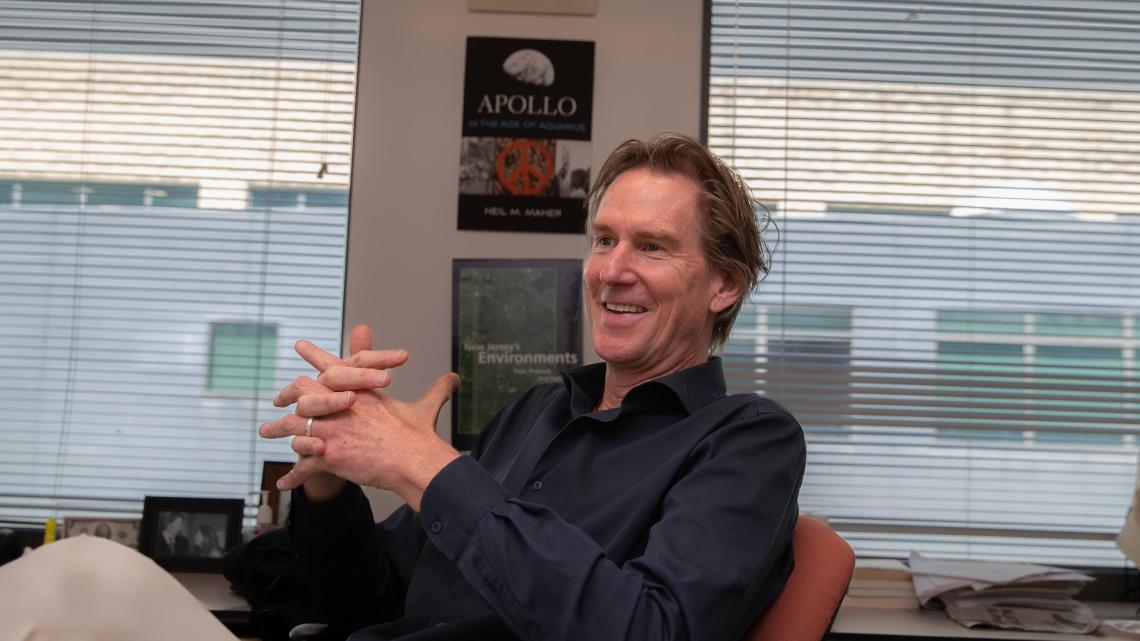
New Jersey Institute of Technology (NJIT) historian and master teacher Neil Maher has been named a 2026 Andrew Carnegie Fellow, becoming the first faculty member in university history to receive the national honor.
Selected from more than 380 nominees nationwide, Maher is one of only 24 scholars chosen for the fellowship this year, which awards up to $200,000 to support original research in the humanities and social sciences.
This year’s fellowship theme focuses on scholarship examining political division and civic cohesion in American life.
“It’s a genuine surprise and an honor,” Maher said. “I’ve been at NJIT and in Newark for 25 years and have seen both grow. It’s especially meaningful to have the opportunity through this fellowship to tell an important part of the city’s history.”
The fellowship will support Maher’s ongoing research and forthcoming book project, tentatively titled Unequal Natures: Building Consensus Across a Segregated City.
The work explores the rise of Newark’s environmental justice movement in the decades following World War II, tracing how residents confronted pollution, unsafe housing and public health crises — and, over time, built coalitions across deep social divides.
“Everyone knows about the unrest in Newark during the summer of 1967,” Maher said. “But what’s often overlooked is how environmental problems were part of that story, and how people eventually came together across lines of difference to address them.”
Maher’s project builds on years of research, including work begun during his 2022 fellowship at the Dorothy and Lewis B. Cullman Center for Scholars and Writers at the New York Public Library. Alongside archival study, he has conducted oral histories with generations of Newark residents and activists and worked extensively in local collections, including those at the Newark Public Library.
Maher says the narrative spans from Newark’s industrial “Birmingham of America” era to today’s clean water movement, following residents across neighborhoods in all five of the city’s wards and highlighting how activists from racially and ethnically diverse communities gradually found common cause around environmental rights.
“The city of Newark has one of the strongest environmental justice movements in the country today,” Maher said. “The question is how a city so divided in the 1960s came together to fight for clean air, water and housing. This project traces the people and the connections that made that possible.”
A key chapter in that history, Maher suggests, was New Jersey’s plan to build garbage incinerators across the state in the 1970s.
While officials initially proposed a facility in every county, only two were initially constructed in the early 1990s — in Newark and Camden — two of the most socioeconomically disadvantaged cities in the state. This decision intensified local opposition in Newark.
Over time, conflicts over waste siting in places like Newark’s Ironbound neighborhood in the East Ward intersected with activism in the Central Ward around housing and health conditions. What began as separate struggles evolved into a broader, interconnected movement.
“These weren’t isolated fights,” Maher said. “They became linked.”
Though the project has been years in the making, Maher said it originally grew out of his undergraduate and graduate seminars on environmental inequality, in which students undertake research, often on their own communities, where pollution caused local residents to fight back.
“I saw how much history was right here in New Jersey,” he said. “So, my students helped spark my own interest in environmental pollution here in Newark.”
Maher’s scholarship and environmental focus extend beyond the classroom through ongoing collaboration with local community partners, including the Newark Water Coalition (NWC).
Supported by a university-funded CRISP grant, Maher, faculty from NJIT’s Department of Data Science, and NWC are currently collaborating on an AI-based app that will allow Newark residents to access and share scientific data about their drinking water.
“The idea for the app came from the Newark Water Coalition,” explained Maher. “They’ve been undertaking their own community water testing for years, so we’re really learning from them and NJIT is supporting their efforts.”
Maher began his research on Newark four years ago and hopes the finished book will reach a broad audience, particularly in Newark itself.
“My goal is to write something not just for academic audiences, but perhaps more importantly for Newark residents,” he said. “I’ve learned so much from the community, and I want this to be their book as well.”
Maher is the author of Nature’s New Deal, which received the Charles A. Weyerhaeuser Book Award, and Apollo in the Age of Aquarius, named a Choice Outstanding Academic Title and a Smithsonian Best Book. His earlier work examined conservation policy during the New Deal and the cultural politics of the 1960s space race.
Carnegie Corporation of New York was established by Andrew Carnegie in 1911 to promote the advancement and diffusion of knowledge and understanding.
When founded in 2015, the Andrew Carnegie Fellows Program funded a range of research in the humanities and social sciences. Starting with the 2024 Class, Carnegie changed the focus as part of a three- year commitment to understanding political polarization. In total, the fellows program has funded over 320 fellows, representing more than $60 million in grants.
The 2026 fellows were officially announced May 5. See the full list here.
