Newark Mayor’s and Bloom Scholars Empower High School Students Through Research
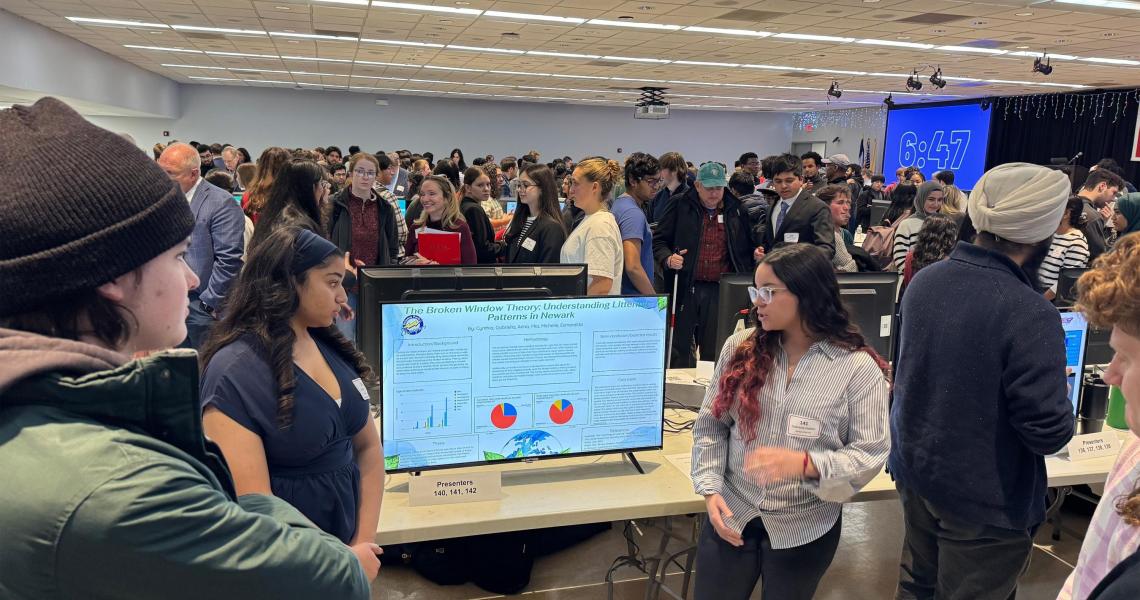
During the recent Honors Interdisciplinary Research Forum, high school students from Newark’s Science Park High School worked alongside students from NJIT's Albert Dorman Honors College as part of a service project, which allowed them to present their research on the effects of litter and street pollution in Newark.
The Honors College students, comprising Newark Mayor’s Scholars and Dr. Joel Bloom Presidential Scholars, took their expertise and showed the students the steps required for research, with a focus on sustainability and community service.
As a Newark Mayor’s Scholar, sophomore Temitope “Temi” Ikujuni took a lot of interest in keeping his hometown clean. “When we spoke with residents, many said it felt like a foundational issue, that people simply didn’t care. That pushed me to think differently.”
Hearing residents describe littering as a “foundational issue” made Ikujuni reconsider whether cleanups alone could make a lasting difference. If the goal was to address the cause — not just the symptom — he felt the work had to start earlier. As a Newark native and Science Park High School graduate, he knew how much his own foundation had been shaped in those years. That led him back to his alma mater, where he hoped to introduce students to research writing and real-world problem solving — skills he said he wished he had encountered earlier.
Once he found that connection with his high school, Ikujuni felt that educating the younger generation was the way to go, and that they would become the ones to offer solutions to an issue that Newark residents felt was foundational.
He shared his idea with fellow Newark Mayor’s Scholar peers and mentors, whose guidance helped transform it into a structured miniature research curriculum for full implementation.
At the high school, he received help from his former science teacher, Phoebe Gruetter. “Temi was very helpful in getting everything together,” she said. “He was very motivated, and I'm glad that he was on our team because he really showed great leadership and got our students together, introducing them to research for the first time, and putting them on the spot to do this presentation.”
That connection between Temi and the students was noticeable, as he proudly took pictures of them in front of their research posters in a college setting at the Honors Interdisciplinary Research Forum.
“Getting to be in this setting and be around other college-age students and see the presentations that they're doing and presenting for other students, I think it’s a really motivating factor,” said Gruetter.
Ikujuni described that for the first four weeks, students collected trash once a week and treated it as primary research. They compared the data, analyzed patterns, and realized something powerful, the cleanups alone weren’t solving the issue. That’s when they started asking deeper questions about why the littering happens.
One group noticed people were throwing trash into flower pots because there weren’t enough accessible trash cans. Another group explored the broken window theory — that when an area already looks dirty, people are more likely to add to it. And a third group argued that there simply isn’t enough litter education in schools.
“They said, ‘We go through school and we don’t really learn about this. You know it’s a moral thing, but there’s no real push,’” said Ikujuni. “That stuck with me because I love education, and I truly believe awareness is where change begins.”
One of the students that appreciated this opportunity to learn more about his surroundings and sustainability was junior Caleb Dawkins.
Dawkins, who wants to be an electrical engineer, learned a lot while working alongside Ikujuni. “We wouldn't have gotten to where we were without him, to be honest, because it did take a lot of his help. We all played a great part, but he played one of the best parts on the team.”
He hopes the research will extend beyond the study phase and lead to actionable projects at the city level. The next step is to implement their action research plans, using data-driven strategies to reduce litter across the city. Findings will be shared with city leadership to help inform and strengthen local litter reduction efforts.
“Get some trash cans around. Just get stuff happening with the litter because it’s a real problem that most people won’t really notice. Most people notice it when you see the trash all piled up in one place,” described Dawkins. “But when it's all scattered all over the place, it doesn't look like anything to you. You accumulate everything all in one spot. I think we really do need this problem to be addressed.
“It’s a human thing. On this planet, you don’t just live in your house or with your friends, you live on this planet.”
Ikujuni highlighted the help from university lecturer Emily Tancredi-Brice Agbenyega, “She’s incredibly hands-on with sustainability and community engagement, and she believed in what we were trying to build from the beginning.”
“It was inspiring to see the Newark Mayor's Scholars accompany Science Park students in the process of identifying the root causes of littering and designing action research projects to explore possible solutions,” said Tancredi-Brice Agbenyega. “Each of the NMS and Bloom scholars applied their working knowledge of research design to assist the high school students in each step of the process.
“It was a great example of community-engaged learning in action, and a demonstration of ADHC’s commitment to service.”
Although he had to take extra time out of his busy schedule in order to meet and motivate high schoolers, Ikujuni is proud of all the work accomplished so far.
“We want them to finish their research papers and eventually present their proposals to the mayor, so their ideas can receive funding,” he said. “Being a Mayor’s Scholar has been an experience I’ll always carry with me.”