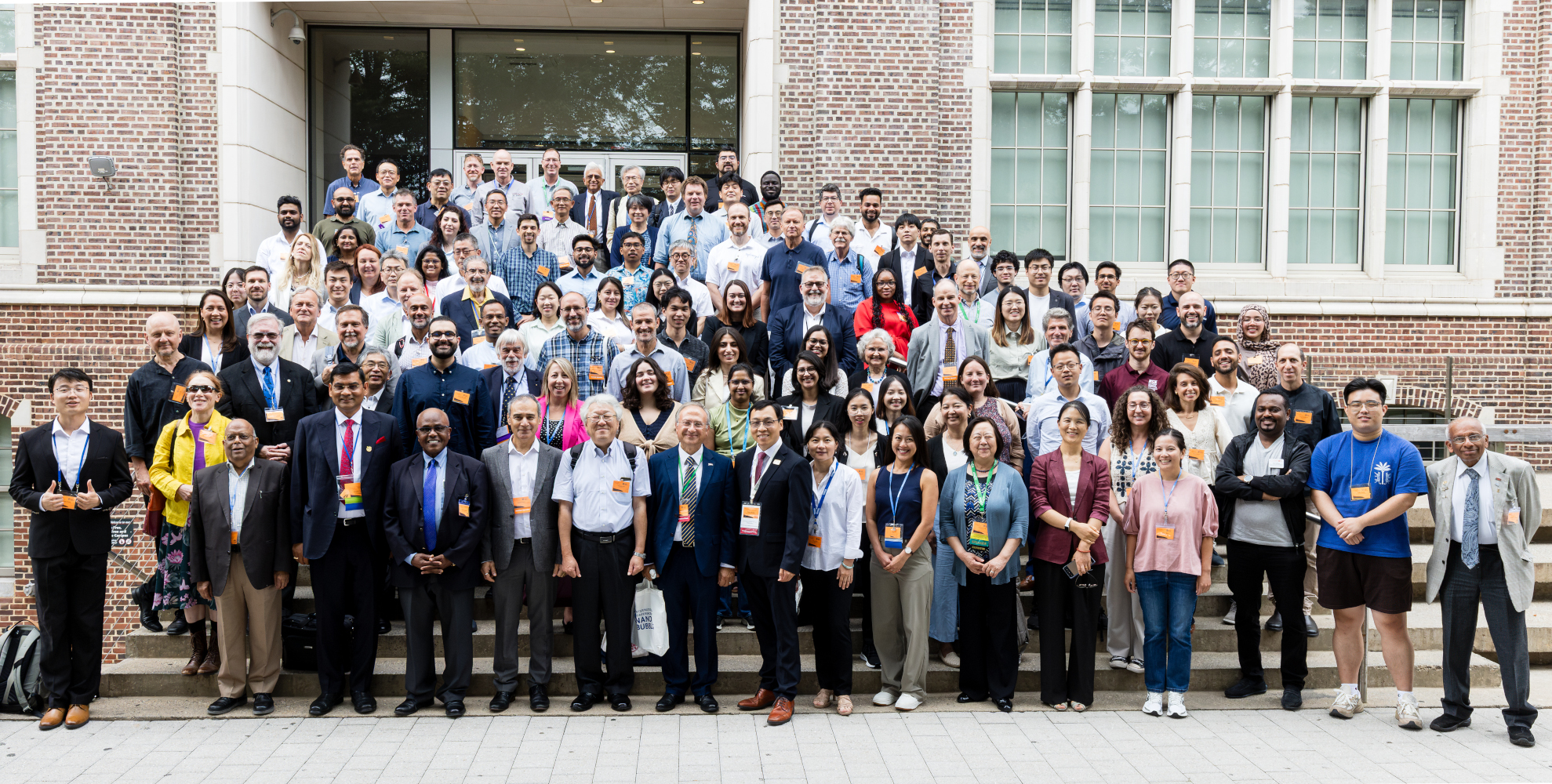
New Jersey Institute of Technology hosted the International Conference on Nanobubbles, bringing together scientists, engineers, entrepreneurs and their customers to consider a technology so small that billions could fit inside a grain of sand.
The tiny bubbles are typically used in air, soil and water as a delivery vehicle for chemicals or gases that perform functions such as aeration, cleaning and disinfection, explained conference chairman Wen Zhang, an NJIT professor of civil and environmental engineering.
Discussions ranged from research to commercialization to applications, among 140 people representing 70 organizations and 17 countries. Applications are already widespread, in diverse fields like agriculture, biomedicine, cleaning products, energy, fisheries, food, industrial processing and water treatment, Zhang noted.
Zhang’s own expertise includes using material science and nanobubbles to assist with agricultural applications and environmental treatment, which is related to processes used in cleaning the Lincoln Memorial Reflecting Pool after summer 2026 algae blooms.
“There is something that's incredibly fitting about a conference that's devoted to objects that are too small for us to see, but that's convenient to discuss the consequences that are incredibly visible to the world. Whether it's clean water, sustainable agriculture, safer food, or better health treatments, that's the terms on which the work that you're all doing is going to finally be judged,” NJIT Interim President John Pelesko stated in opening remarks.
In a panel discussion on Critical and Unanswered Questions on Nanobubbles, attendees addressed vital topics such as bubble stability, economic viability and sources of observed scientific benefits. The panel was moderated by NJIT’s Jay Meegoda, conference co-chair and distinguished professor of civil and environmental engineering. Meegoda also led a session on Mysteries of Nanobubbles. He observed two mysteries encountered by his team while performing environmental clean-up experiments of the nearby Passaic River — bubbles that exist but theoretically shouldn’t due to extreme pressures, and bubbles that behave differently depending on how they’re created in the laboratory. Electrical charges and ozone interactions are some of the responsible factors, he said.
Other speakers from NJIT included faculty members Linda Cummings and Lou Kondie. NJIT researchers and graduate student speakers were Thu Le, Samarpan Majumder, Duwage Perera, Sowmya Atukari, Jiahe Zhang, Yining Zhang and Guangyu Zhu.
Sessions by Kent Semmen, a water chemist at Florida’s Walt Disney World, and Yuhong Jiang, CEO of Pure NanoTech, were additional highlights at the conference. Semmen showed how Disney is piloting nanobubbles to clean aquariums in the EPCOT and Animal Kingdom theme parks. It’s faster than traditional methods and it’s good for the animals, he said. Disney has not yet used nanobubble technology in its salt water bodies — Semmen said that direction is possible but more testing is needed before they can proceed. Meanwhile, Jiang said Pure NanoTech commercializes patents developed by Wen Zhang’s team. The startup is based in Parsippany and has customers in agriculture, pharmaceutical and wastewater sectors. Several of their employees are NJIT alumni including the company’s top three scientists, Jiang said.
Jiang is also president of the North American Ultrafine Bubble Association, for which NJIT became one of seven founding organizations this summer. The association aims to foster responsible and sustainable growth of their industry by promoting best practices, encouraging collaboration, facilitating information sharing and supporting technology standardization.
Standardization details are decided by scientists and business leaders under International Standards Organization Technical Committee 281, Fine Bubble Technology. "Standards cover things like measurement methods for bubble size, concentration and stability, as well as application methods such as how to use the technology for aeration and oil remediation,” Zhang stated. “ISO already offers a lot of standards and many other pending or ongoing ones under development.”
All prior editions of the nanobubbles conference were held overseas. “This conference, to me, really reflects the values that define the New Jersey Institute of Technology: innovation, collaboration across the disciplines, global engagement and a steady insistence that research should answer the problems that people actually have,” Pelesko added. “I believe this conference exemplifies all of those things, and that's really why I'm incredibly proud that we're able to host.”
