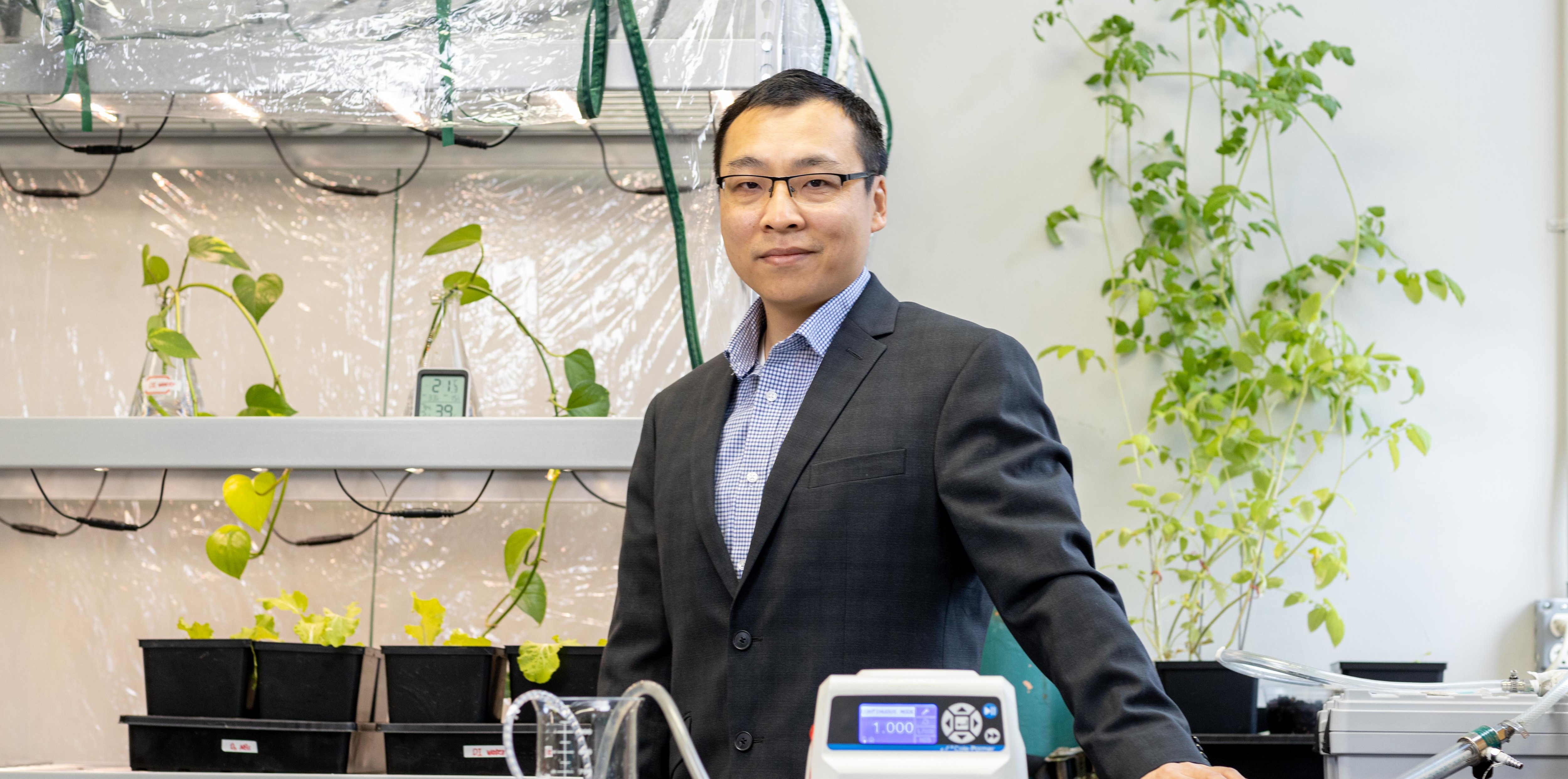
One of the most powerful environmental cleaning technologies in recent years is too small to see with the naked eye. Nanobubbles — tiny gaseous bubbles with diameters of around 100 nanometers — can clean up a range of harmful pollutants in water, from oil spills to algae.
Wen Zhang, a New Jersey Institute of Technology professor of civil and environmental engineering, knows a thing or two about nanobubbles. He is the principal investigator of NJIT's AI-Enabled Advanced Materials and Systems for Environment and Agriculture Laboratory , and has led efforts using nanobubbles to mitigate harmful algal blooms. Zhang's patented nanobubble technology is used by PureNanoTech, an NJIT-supported startup company providing nanobubble generation systems for research and industrial purposes.
Nanobubbles were recently in the news as a potential solution to an algae problem in Washington, D.C., when the U.S. Department of the Interior announced that they were using "high-tech nanobubbler ozone technology" to tackle an algae bloom in the Lincoln Memorial Reflecting Pool. Algae growth spiked there after the completion of a $16 million renovation, fueled by warm weather and fed by nutrients in the water.
While Zhang was not involved in the Reflecting Pool cleanup, he shares insights addressing the technology's capabilities and how nanobubbles might perform in a project of this scope.
What exactly is nanobubble technology? How does it work, and why might it be effective for cleaning up algae?
Nanobubble technology means injecting extremely small gas bubbles into water, typically using gases such as air, oxygen or ozone. In water treatment, the main value is not just "tiny bubbles," but the fact that they can improve gas transfer, create a very large gas-water contact area, and stay suspended longer than ordinary bubbles. In practice, that can improve oxygen delivery, oxidation and contact between the treatment gas and algae-affected water. Nanobubble systems are already being studied and applied in water and wastewater treatment, aquaculture and related environmental uses.
For algae control, the effect depends strongly on the gas being used. Air or oxygen nanobubbles are generally a gentler ecological approach; they can increase dissolved oxygen and may stimulate heterotrophic bacteria and other aerobic processes that compete with algae for nutrients, so they can suppress blooms indirectly rather than simply "poisoning" algae. Ozone nanobubbles are much more aggressive. Ozone is an oxidant, so it can damage algae cells, reduce pathogens and improve water clarity faster. That is likely why the Interior Department described the Reflecting Pool treatment as "nanobubble ozone technology." But ozone can also affect non-target microbes, so it is better viewed as a fast cleanup tool than as a guaranteed long-term ecological fix.
How long has this tech been around, and what are some common uses?
The basic science of micro- and nanobubbles has been around for years, and the environmental and water-treatment literature has expanded a lot over roughly the last decade. In the last five to ten years, the technology has moved beyond lab studies into more visible pilot and field applications, especially for water quality improvement, aquaculture, wastewater treatment, disinfection and algae management. Reviews in recent years describe applications across water and wastewater treatment broadly, and aquaculture specifically.
For algae and water-quality work, ozone-nanobubble pilots have already been reported at sites such as Lake Okeechobee’s Port Mayaca Lock, Lake Newport in Ohio, and Constitution Gardens in Washington, D.C. NOAA summarized those pilots in 2020, and more recent U.S. pilot work has also reported bacteria reduction, odor control and clearer water in some settings. So this is not a brand-new concept, although performance still depends heavily on the specific water body, nutrient load, hydrology, and how the system is operated.
Is nanotechnology more effective or safer than other algae cleanup methods? Do its effects last longer?
I would not say it is automatically "better" than every other method; it is better to think of it as a different tool with different strengths. If the goal is a rapid visual cleanup, ozone nanobubbles can work faster than oxygen-only treatment because ozone directly damages algae and other contaminants. That is one reason it can improve clarity quickly. But like hydrogen peroxide, which is also being used at the Reflecting Pool, it may function mainly as a short-term corrective measure if the underlying nutrients and biomass are still in the system. Reuters’ coverage quoted an algal bloom expert saying peroxide is often a short-term treatment and that rebound is common; the same broad caution applies to ozone-based cleanup if nutrient drivers remain.
In my view, air/oxygen nanobubbles are usually the more sustainable strategy when the objective is long-term water-quality improvement, because they support oxygenation and biological competition against algae rather than simply knocking the bloom down chemically. Ozone nanobubbles are usually the faster but more costly strategy when the objective is immediate water clarification or emergency cleanup. The most durable solution, however, is still to remove the nutrient source and, ideally, remove algal biomass from the water. If you only kill algae in place, some of that biomass can break down and release nutrients back into the water, which means the bloom can return later. So nanobubbles can be very useful, but whether the effect lasts depends on whether the treatment is paired with nutrient control, circulation, solids removal or sustained operation.
How long might it take to clean up a pool the size of the Lincoln Memorial Reflecting Pool with nanobubble tech?
The Lincoln Memorial Reflecting Pool is very large but also shallow; public sources describe it as holding roughly 6.5 million gallons (25 million liters) and note that shallow, warm conditions make it naturally prone to algae growth. The current cleanup is also not using nanobubbles alone; news reports say the Park Service/Interior Department has deployed both hydrogen peroxide and nanobubble ozone technology, along with manual scraping and pumping.
As a rough expert estimate, for a shallow basin of that size, visible improvement in color and clarity could occur within about 24 to 48 hours if ozone nanobubble treatment is well distributed and paired with peroxide and physical cleanup. But that is the cosmetic/short-term answer. The longer-term answer is that keeping the water clear for more than a week or two depends on the nutrient supply, incoming water quality, temperature, and whether treatment continues after the first cleanup. If the system shifts to sustained air or oxygen nanobubble treatment with good circulation, the benefit can last much longer. If it is primarily an ozone "shock" treatment without nutrient control or biomass removal, algae can absolutely come back.
