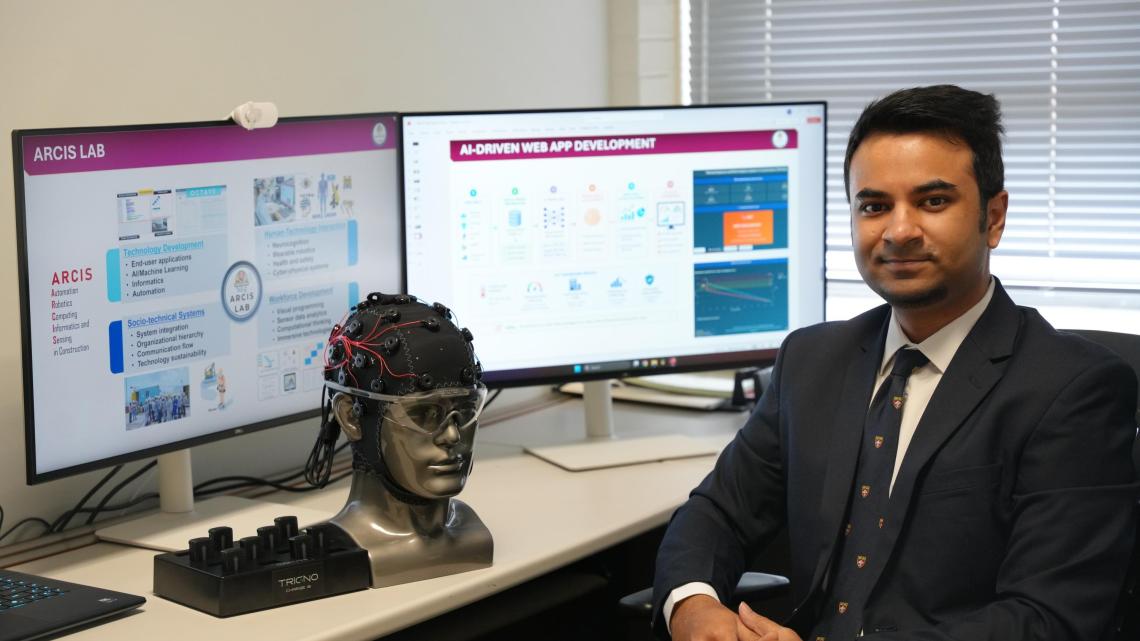
A Q&A with Mohammad Khalid, assistant professor of civil and environmental engineering
How would you summarize your research?
I focus on equipping the construction workforce with on-the-job data analytics and computational thinking. Designed for people without a background in computer science, my platforms would allow engineers to transform raw sensor data—such as readings from wearable devices, environmental monitors, equipment telematics and computer vision systems—into real-time safety and productivity insights that improve decision-making on construction sites. Additionally, I work on wearable robots to reduce physical strain and enhance mobility for construction workers; bio-behavioral sensors to track stress and fatigue to improve safety; and neurocognitive measures to help design training systems that adapt to workers’ mental workload in real time.
You say the construction industry is slow to adopt new technology. Why?
For one, construction is a complex and fragmented industry. Compared to manufacturing, where processes are controlled and repeatable, all construction projects differ. Each one has a new team, a new environment, new constraints and new resources, including equipment. One project might be on the ground level, but the next is 50 stories high. There is also a strong reliance on experience and traditional practices that the industry is hesitant to change. Cost and uncertainty play a big role; companies are cautious about integrating new technology that might disrupt the workflow and require training. They may not see an immediate return on investment. Another major factor is the gap between technology developers and end users. Often, this technology is designed without understanding how workers operate in the field. Software such as Autodesk is used by architects, designers and engineers and it’s one-size-fits-all. In construction, some workers are in the office, while others are out in the field.
How does the technology gap constrain the construction industry?
The challenges are quite significant – the industry continues to struggle with productivity, safety and workforce sustainability. Productivity growth in construction has lagged behind other sectors for decades, affecting project costs and timelines. Construction is also the most hazardous industry in part due to heat-related stress and fatigue. Workers are exposed to high temperatures and long shifts with extreme physical demands, and they experience reduced attention and longer reaction times as a result. This increases the likelihood of severe accidents, including fatalities. In 2024 more than 1000 construction workers died from work-related injuries in the U.S. alone. Because of the physical demands and the high stress, it makes it difficult to retain workers long-term.
How can data-analytics improve safety and productivity?
By leveraging real-time data, we can predict risks and prevent accidents by optimizing workflows and supporting workers, both physically and cognitively. There are several areas of technology that can have an immediate impact. Environmental monitoring can track heat, humidity and air quality to alert workers to heat stress and related occupational illnesses. Wearable sensors can help identify overexertion, and assistive robots can reduce the risk of injuries. Cognitive overload is another, very important issue that is often overlooked. Construction workers constantly process information and make decisions under pressure. They work with teams of workers to coordinate equipment, building materials and existing structures. All of these elements need to be orchestrated perfectly to make sure no one is hurt while they still deliver the project within the deadline. With the right sensing technology, we can measure their cognitive load.
How does your technology address these problems?
We’re using a cap with 32 electrodes that sense real-time brainwave signals from different parts of the brain that correspond with task-dependent behaviors in construction, from masonry, to roofing, to heavy lifting, to computer work. It can detect high stress, emotional instability, anxiety, frustration and distraction. We also have eye-tracking devices that can coordinate with brain signal sensors. They can detect eye-movement patterns and tell if someone is paying attention or not.
Another big opportunity is immersive environments. In them, we can assess cognitive workloads and visual attention that we don’t want to test in real life, where site workers are standing under a suspended payload, for example. We can simulate different kinds of construction work to see in each instance when and where the overload risk is getting high. Adaptive systems that process this data can alert a worker to take a five-minute break when they detect instances of distraction and cognitive overloads.
We can also train workers in immersive environments, including rookies managing their first payloads, for example, by allowing them to visualize crane movements. When they make mistakes, we can tell them how and what happened.
Exoskeletons reduce physical stress during demanding tasks, such as lifting and overhead work. We can make them more powerful by connecting them to other technologies. We can incorporate sensors with EEG and EMG capabilities and monitor environmental conditions such as heat and wind speed. Fed into a data analytics pipeline, this can provide real-time feedback. Instead of just assisting with movements, the exoskeleton can help us understand how a worker is performing, including how much physical strain they’re experiencing and how big a cognitive workload they’re facing, and let them know when an intervention is needed.
How will workers and supervisors act on this data?
The sensors give millions of numerical data, but the key is making the information actionable and easy for workers to understand. They don’t need numbers, but guidance. Instead of showing them complex metrics, our interface would provide simple feedback, such as alerts that the heat is rising, that that they are fatigued or putting excessive stress on their body and need to take a break. It might also prompt them to adjust their posture, to rotate tasks or to use assistive equipment. This data can also help with planning. Supervisors can adjust schedules, redistribute the workload and identify high-risk conditions before they lead to incidences.
Over time, this technology can support training by helping workers recognize patterns in their own performance so that they can make decisions independently. The goal is to integrate these insights seamlessly into the daily workforce, where acting on data becomes a natural part of how the work gets done.
