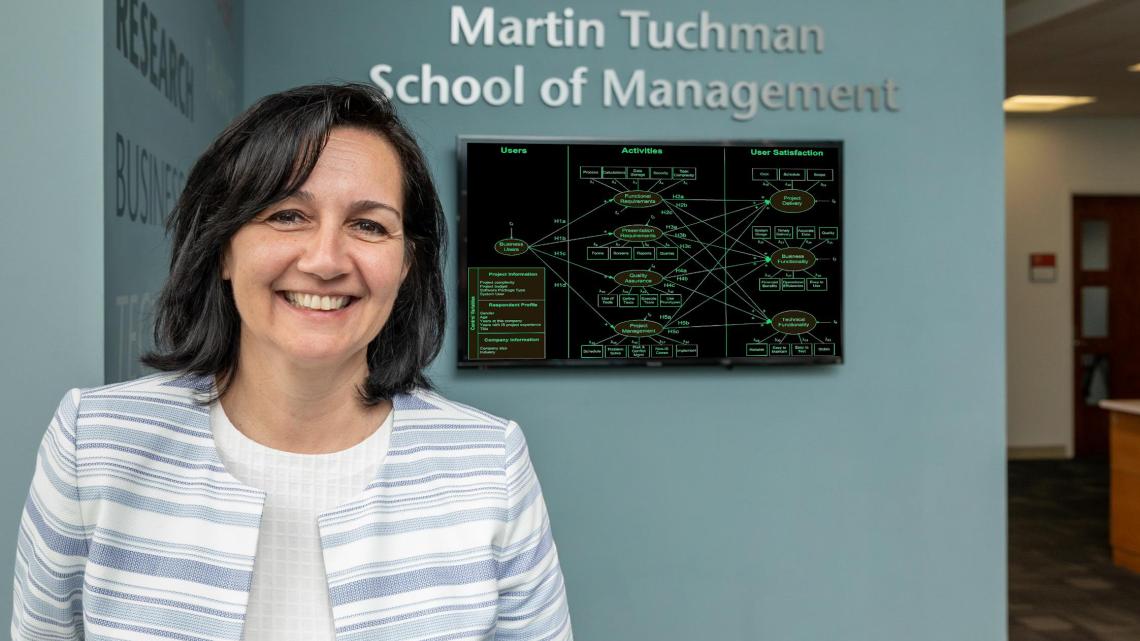
Oya Tukel leads the Martin Tuchman School of Management at New Jersey Institute of Technology like a business — and a scrappy, entrepreneurial one at that.
“We’re nimble and flexible with a simple organizational structure. We’re very flat. We share the work. Also, faculty has flexibility to teach in different areas,” said Tukel, now beginning her seventh year as dean of MTSM.
The leader, whom NJBIZ recognized as one of the Leading Women in Business for 2025, attributes the school’s success to a clear vision, the support of business leaders and a strong partnership between the dean’s office and faculty, which breeds consensus.
“We work well together. We’re very clear with our vision and about who we are,” she said. “It makes things easier for me to be able to lead.”
What do recognitions like the one from NJBIZ mean to you?
It’s not really me getting these things; it is the school’s recognition. Six years ago, few people knew MTSM. It was not fair because we were good. But we didn’t do the right things to get the word out. Now there is a brand reputation.
Was there a turning point or is this an accumulation of all that work?
Kaizen. Continuous improvement. I didn’t say no to any opportunity and I took the risk. Some things work and some don’t. If it doesn't stick, we go to plan B. Like Team Apex in the movie “Formula 1,” we cannot and we will not do what the others are doing because we can’t win that way. We can’t look at those who are financially different, larger capacity and do what they do to win. We have to have a different path. We have this technology story. We have a good story to tell with our competency and that's a winning proposition.
How does MTSM distinguish itself from other business schools?
Our clear distinction is being part of an applied sciences polytechnic university where we have this technology infrastructure available. There is money for research, there is money for software, there are big data centers. So, what we teach are business concepts within that tech infrastructure. We integrate tech and business into everything we do.
Why is that important?
If you looked at the Fortune 500, or the Fortune 100 even, most companies are tech-driven. I’m not talking about PayPal and things like that. I'm talking about hospitals. So, if you have a good use of technology that gets you in a better place, makes you efficient and cost effective, you are a successful company today. That’s the same thing with us. We have to teach that kind of business thinking. Here we have data analytics-based decision-making, critical thinking and an entrepreneurial mindset. That's our competency.
Where do you get your ideas for updating the curriculum?
To a certain extent, from our Board of Advisors. At the same time, I follow tech schools like MIT. I also look at LinkedIn postings about different ideas out there and read books. For example, I’m reading “Nexus” by Yuval Noah Harari. It’s about information networks from historical times all the way to the AI era.
The new programs you introduced include fintech, a tech MBA and a concentration in business and sports data analytics. How popular is fintech so far?
It has picked up really nicely, from 44 students majoring in it at its inception in the fall of 2021 to 259 in the fall of 2024. Last year, we actually had more students in financial technology than in business, because business has concentrations, one of which is finance.
You’ve cultivated and expanded financial support and business expertise from Martin Tuchman, Paul Profeta and the Leir Foundations. How has that enhanced the student experience?
It has brought thought leaders to campus so students can better understand what’s going on in the marketplace. Our students are very focused on studying, working and trying to make ends meet. They don’t take the time by themselves to go to New York City to listen to somebody at a conference. This allows us to open up our campus to talk leadership. We can bring high caliber scholars, business people and CEOs and have students be in that atmosphere. Also, we’re doing more competitions. Students are able to challenge themselves.
How is MTSM stitching artificial intelligence into its curriculum?
In some courses, AI plays a supporting role. In others, it’s an analytical tool and for others, it provides technical support. The integration of AI depends on how quantitatively oriented the course is. And in graduate studies, faculty members have been asked to revise their curriculum and their course syllabi.
How have the faculty kept pace on this?
This summer, 15 full-time faculty agreed to get professional development. They signed up for a 12-week online program from MIT. It’s rigorous and the lectures are by MIT professors. Our faculty agree to learn. That’s great. That’s fantastic.
