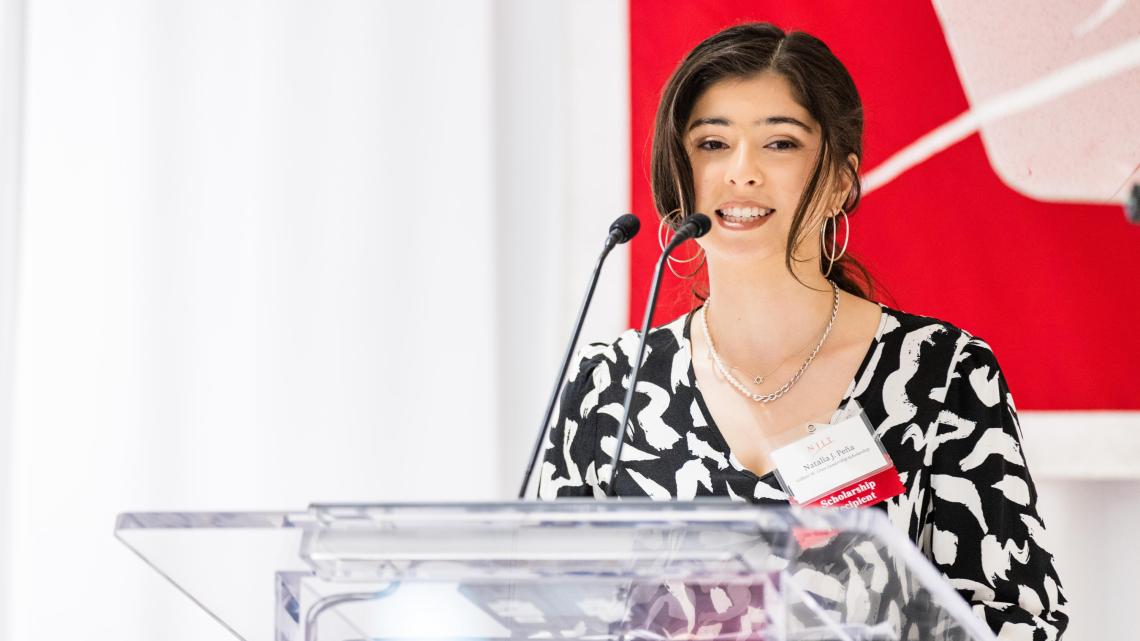
Before she ever toured NJIT, Natalia Peña had already made up her mind.
A scholarship offer from the Albert Dorman Honors College changed what college looked like for Peña and her family, easing the biggest question hanging over her future. “For the first time, my worries about how I would afford college faded,” she recalled in remarks this spring at NJIT’s Scholarship Luncheon.
Now graduating as a computer engineer, Honors College student and Fulbright semi-finalist, Peña leaves NJIT with a path shaped by research, student leadership and community-building — and with plans to pursue graduate study in human-computer interaction.
But Peña’s story is not one of a student who arrived with every step already mapped out. By her own telling, it began with one opening, then another, then another.
College, she said, was never a question of if, but of where and how. For Peña, that moment carried meaning beyond her own decision. Her family’s stories of perseverance, education and sacrifice had long shaped her sense of what was possible. At NJIT, the “how” came first. The rest — her academic direction, research interests, campus leadership and the community she would help build — came into focus over time.
One opportunity led to the next
One of the clearest turning points came in a course called “Design Thinking: Addressing Structural Inequality,” taught by Professor Michael Lee. That class introduced Peña to human-computer interaction and gave shape to instincts she had already been carrying with her.
“It wasn’t me complaining; I was noticing a lack of inclusive design,” Peña said, reflecting on what the course unlocked for her. She had long been interested in art, UI/UX, diversity and computers, she said, but the class helped her see how those interests fit together — and how designing with a wider range of users in mind can improve technology for everyone.
That realization helped point her toward work that sits at the intersection of engineering and human need. Through the Honors Summer Research Institute, Peña joined NJIT’s People + Interfaces + Data (PID) Lab under Assistant Professor Roni Barak Ventura, where she worked on a project examining how visually impaired individuals access exercise and fitness. The experience, she said, solidified her desire to pursue human-computer interaction more seriously. Before that, she had also interned at Public Citizen as an AI and Elections intern, gaining a look at technology from the policy side.
She is still open about where that path may lead. For now, Peña says she is especially interested in UI/UX and research and development, with stakeholder feedback remaining central to how she thinks about the work. “There are plenty of ways I could try to do good or expand access,” she said.
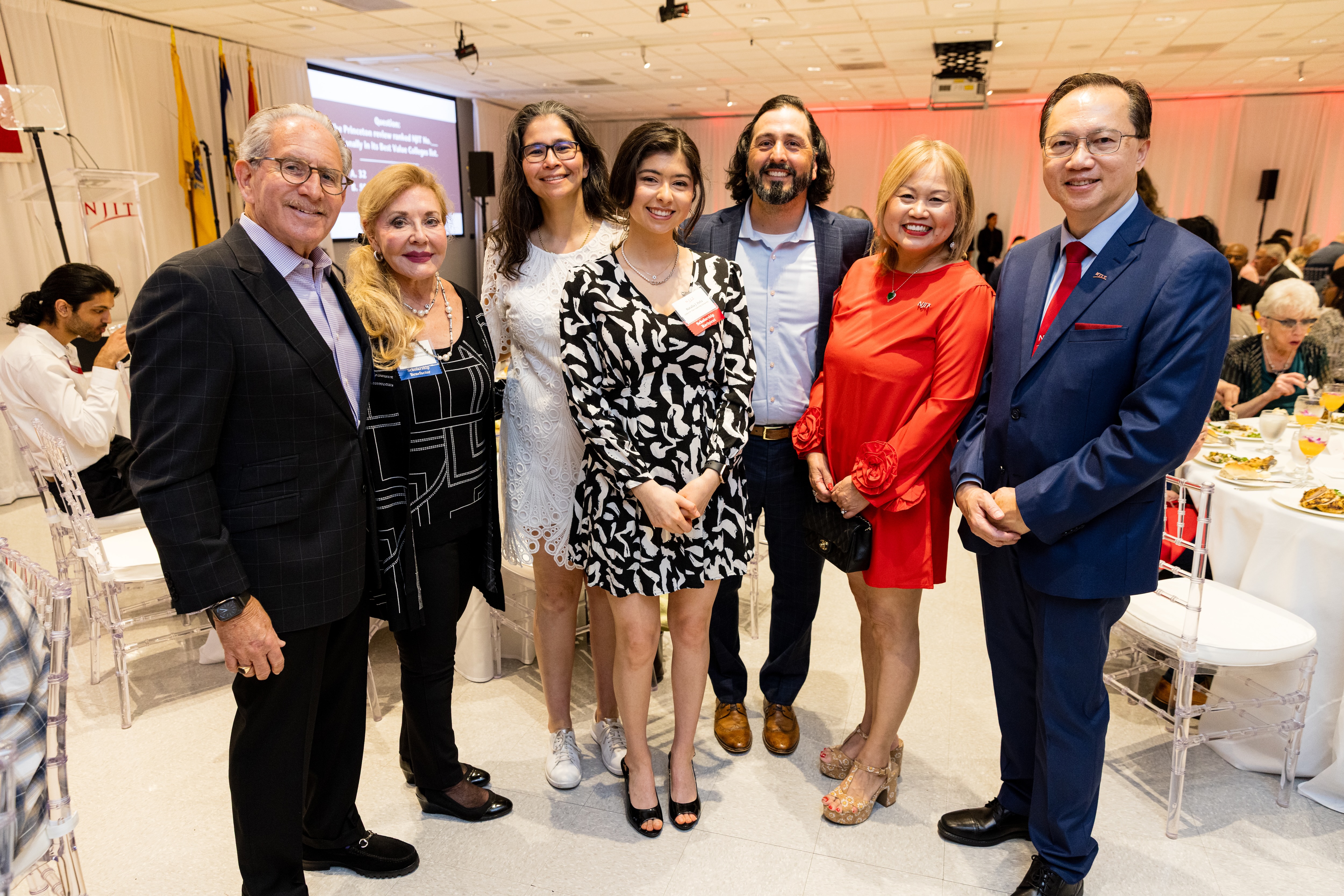
Peña was a recipient of the Diane and Joel Bloom Scholarship. She spoke at the annual Scholarship Luncheon event where students and donors have a chance to meet.
What makes her NJIT story compelling, though, is that it did not unfold through one neatly planned sequence. Peña describes it instead as a snowball effect.
“There isn’t a singular resource or opportunity that I think changed me,” she said. “It’s been a series of doors that have opened for me when I needed them to.” A resident assistant introduced her to Student Senate. Work there brought her into contact with DEI leadership, which led to SHPE and the Hispanic Heritage Month Planning Committee. A video project from her design course helped her land a job with NJIT’s Media and Technology Support Services team. Volunteering at Electrical and Computer Engineering open houses opened still another lane. At each step, one involvement led to the next.
That process changed her view of what her future could be. “I had no clue what I was going to do after university,” she said. “I just hoped the answer would reveal itself, which it kind of did, the more I put myself out there and asked other people for their advice.”
Building community along the way
As her academic direction sharpened, so did her sense of what mattered most to her on campus.
Peña said student leadership and community-building became the most central parts of her NJIT experience. Through Student Senate and Hispanic student organizations, she helped build traditions and spaces that made campus feel more welcoming and more reflective of the students who call it home.
Her efforts included beginning the annual Día de los Muertos altar tradition and helping create events through the Society of Hispanic and Latine Appreciation, including programming that centered culture, identity and belonging. “My central pillars of advocacy, identity, and academics never wavered,” she said. “They’ve just developed and deepened while I’ve found new ways to express them.”
That work was visible in different corners of campus life. Early on, Peña was featured for her role in the Honors biodiversity project “Monarchs & Milkweed.” Later, she was profiled again in a feature on Hispanic and Latine student leaders. Over her four years, she kept finding ways to connect technical work with human experience, and personal identity with public contribution.
One of her favorite examples came through her work with prospective students. After volunteering at open houses for the Electrical and Computer Engineering Department, Peña was asked to host a prospective student named Charlotte for a day. Charlotte sat in on her classes, ate lunch with her and got a window seat into daily life at NJIT.
Later, she told Peña she had accepted her offer. Now, Peña said, the two have shared classes, and Charlotte is thriving. “She is just one of a few students on campus who said my input directly led to their attending NJIT,” Peña said.
Along the way, Peña also found people who helped her see more clearly what she was capable of. She credits NJIT faculty and staff, particularly in the Honors College, with encouraging her to apply for opportunities she might not otherwise have pursued, including internships, research grants and the Fulbright program.
At the Scholarship Luncheon, she also spoke warmly about Joel and Diane Bloom, whose scholarship supported her and whose encouragement, she said, made a lasting impression. Over the years, she developed a tradition of taking selfies with them at the event — a small ritual that came to symbolize something larger about being known and supported. “The Blooms are incredibly kind,” Peña said. “They had no way to know, but it felt like meeting guardian angels.”
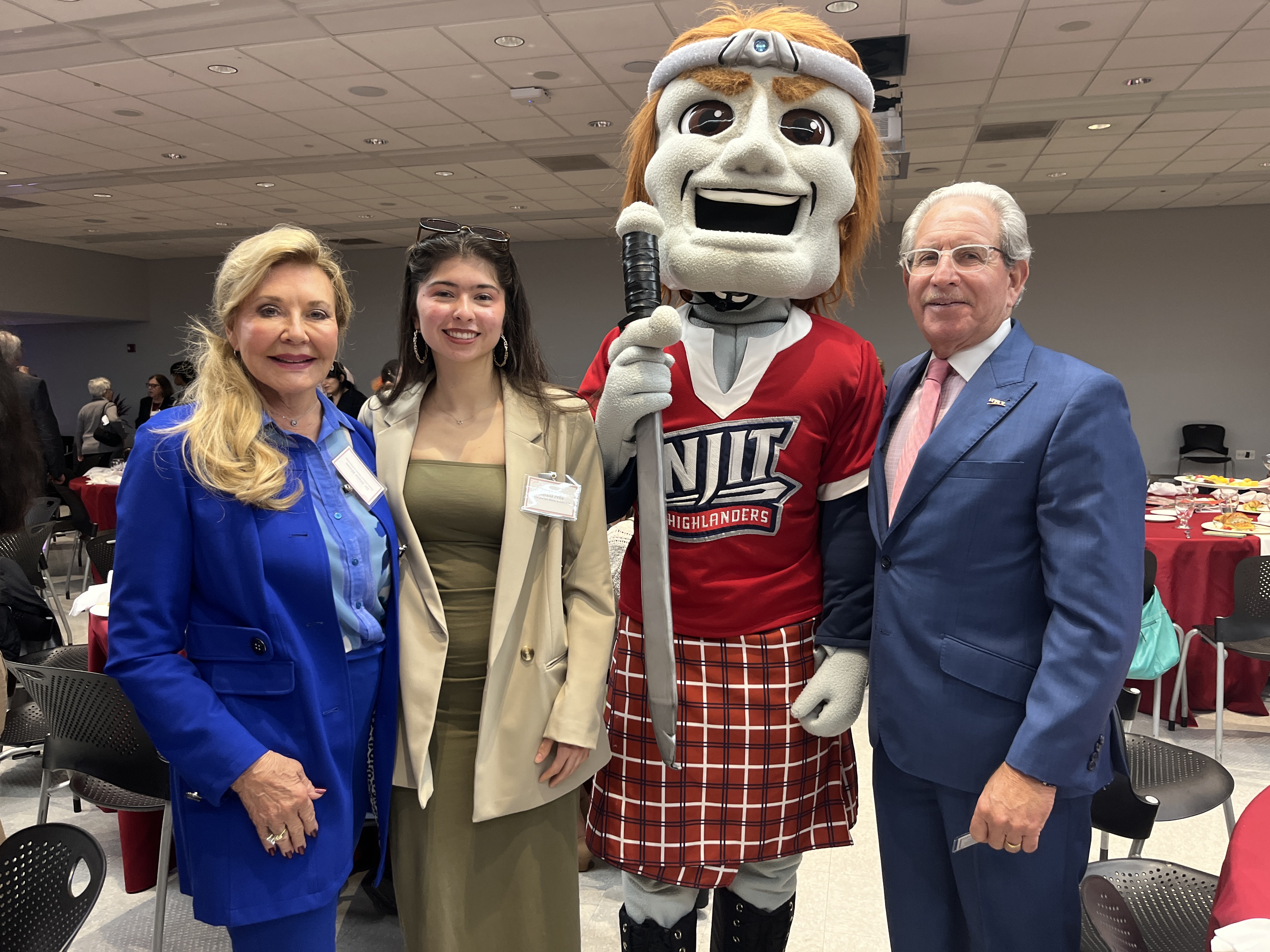
Looking back, Peña describes NJIT as “a hub of opportunity and resources” — a place where labs, clubs, courses and conversations kept opening new possibilities. She arrived unsure what shape her future would take. She leaves with a clearer sense of the kind of work she wants to do and the kind of impact she hopes to have: work grounded in feedback, shaped by inclusion and designed with people in mind.
And for Peña, that may be the most lasting lesson of all. Sometimes a path does not appear all at once.
It opens one door at a time.
