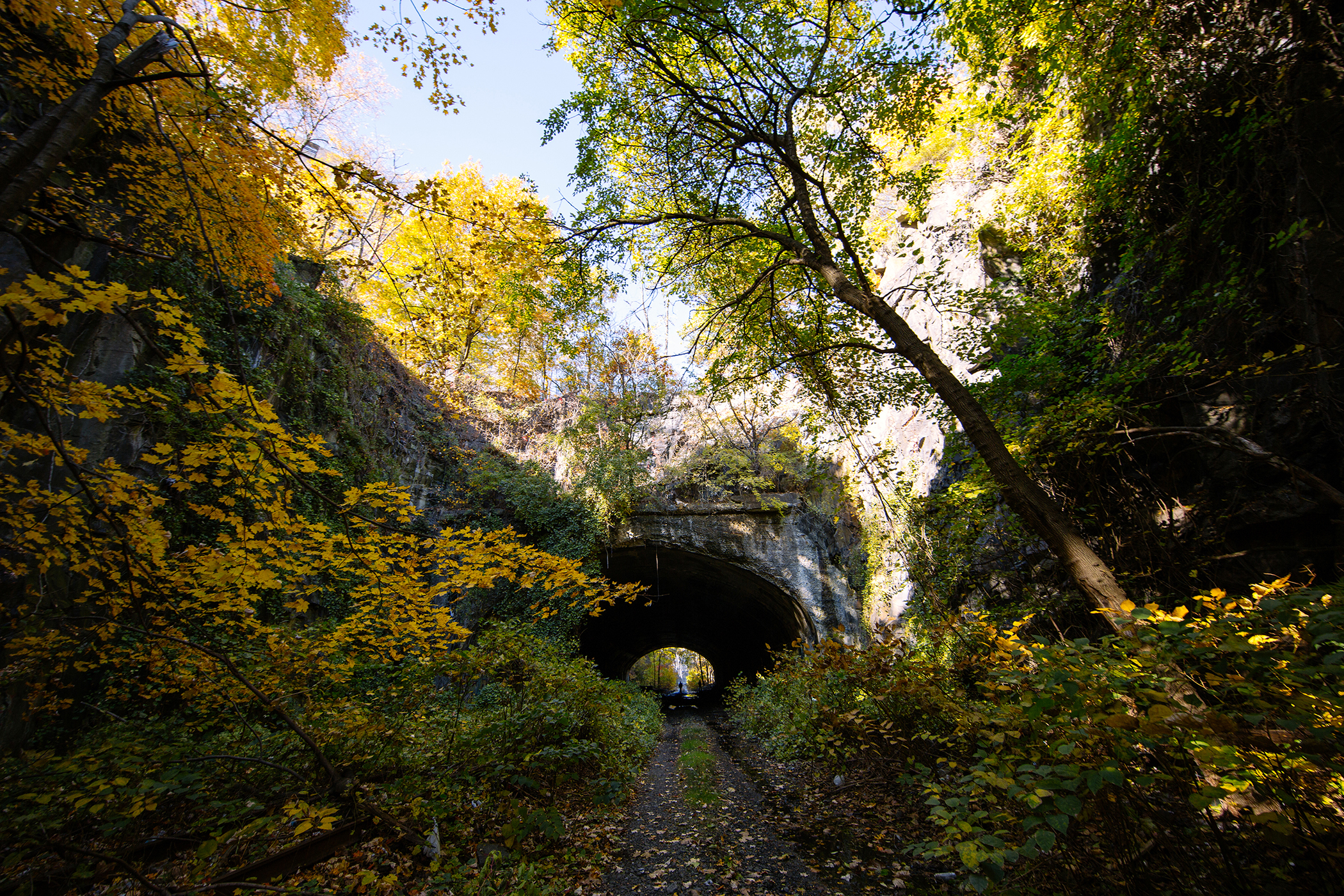
Students in Adjunct Professor Vincent Marchetto’s architecture studio are redesigning an abandoned railroad right-of-way in Jersey City as a 21st century urban greenway. Reconnection: The Bergen Arches studio focuses on the mile-long Erie Cut, a 60-foot-wide channel blasted from the live rock of the Palisades to a depth of 40–75 feet and crossed by four monumental arches.
Opened in 1910 and abandoned in 1957, the Cut was once lined with railroad tracks carrying the steam trains that were central to Jersey City’s thriving industrial economy. Occupying a 17-acre site parallel to Route 139 between John F. Kennedy Boulevard near Tonnelle Avenue to the west and Palisade Avenue to the east, the Erie Cut/Bergen Arches is now an urban forest.
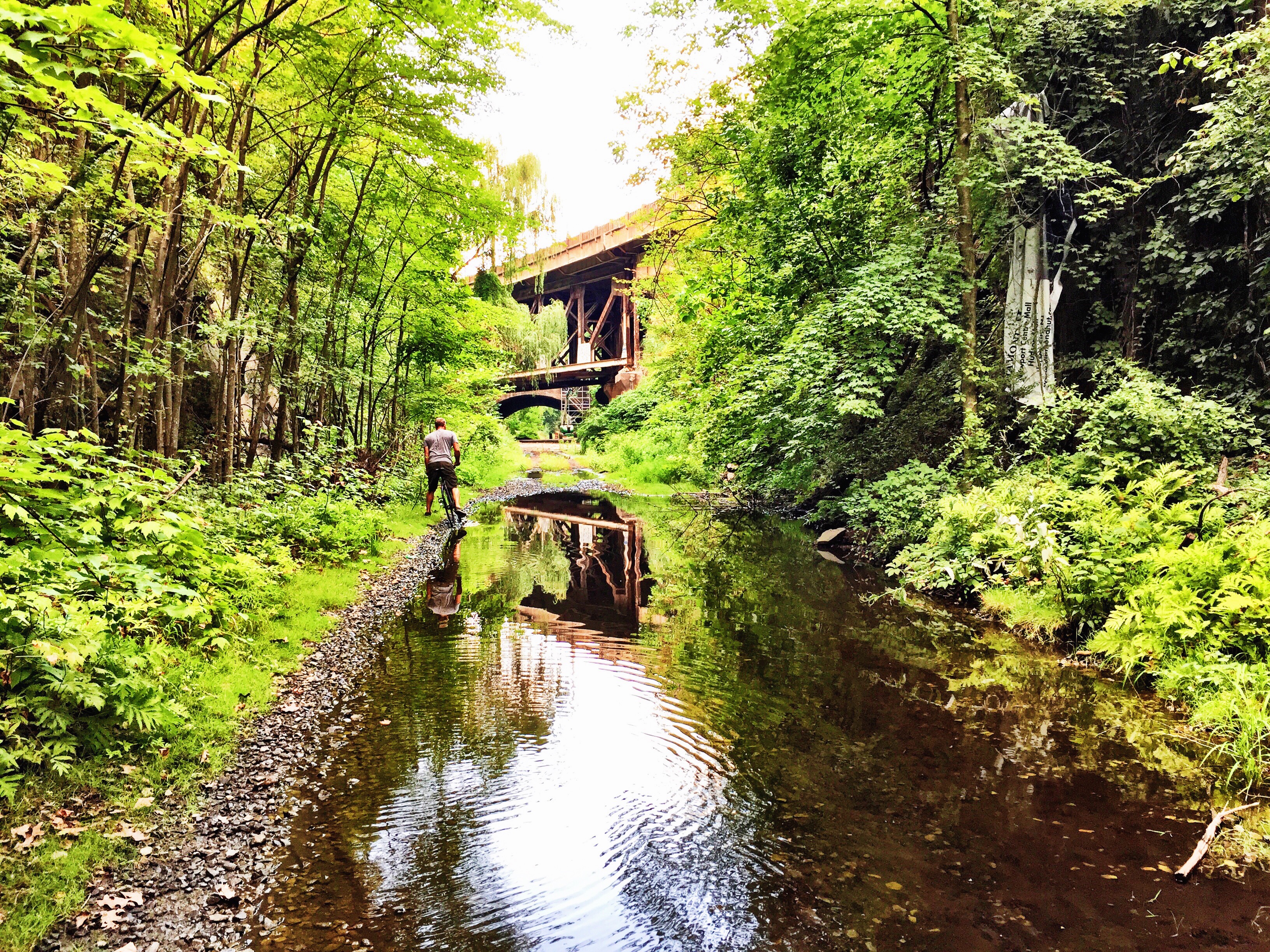
Urban forest in the Bergen Arches, photo credit Bergen Arches Preservation Coalition.
“Elevated freight lines, like New York City’s High Line, have become linear parks and large warehouses have been repurposed into loft apartments. These transformations reflect a larger trend — the ongoing effort to make our cities more livable,” said Marchetto. “Unlike the High Line, this linear park is in a canyon-like rail cut, which presents unique challenges.”
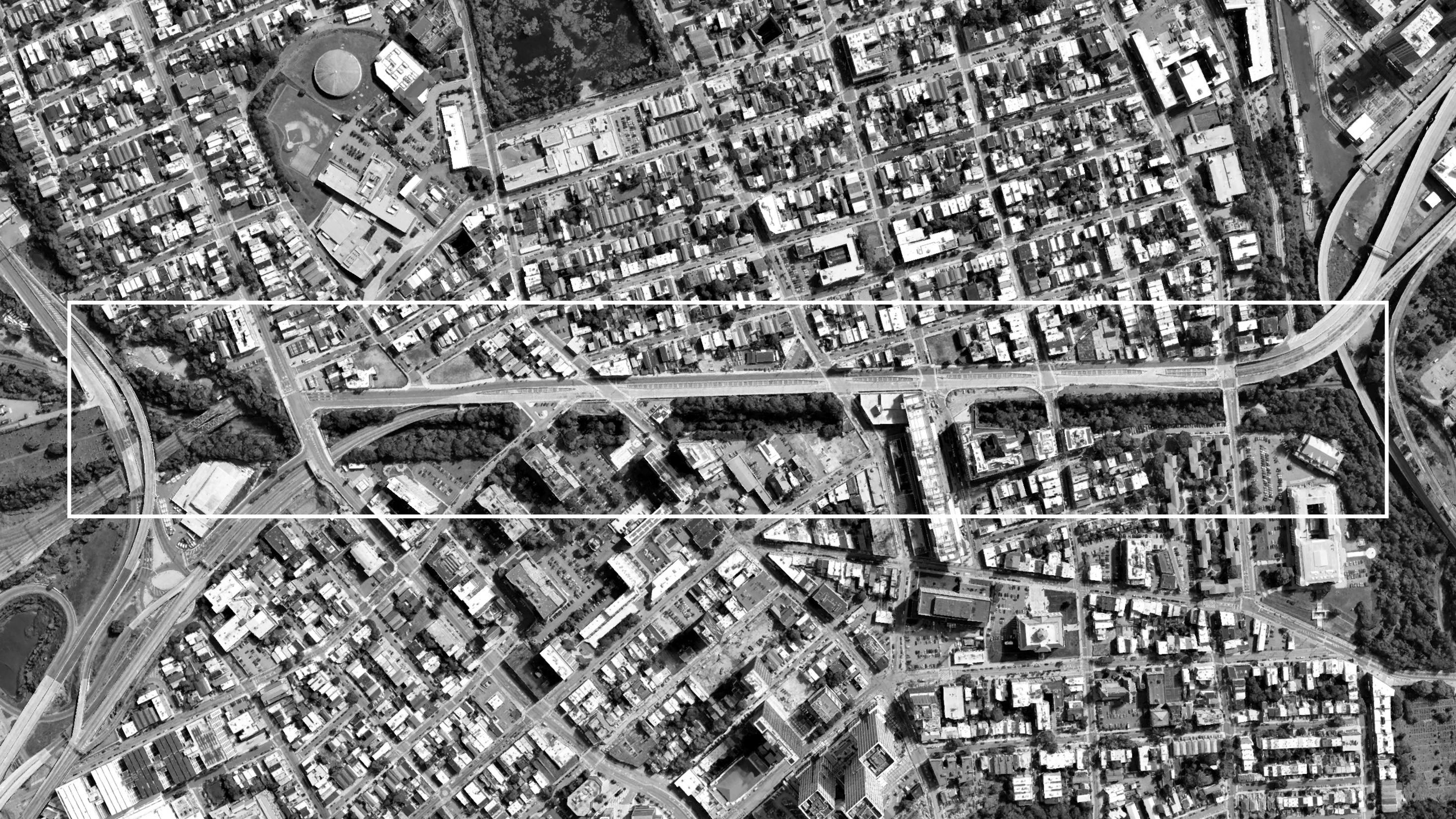
Aerial view of Bergen Arches
Student Architects’ Greenway Visions
For this project students accepted real-world conditions as critical design components, including public access, lighting, stormwater management, park operations and maintenance. A key learning objective was to balance green infrastructure and community engagement to produce designs with environmental and social benefits. For the students, the process of interacting with community members and the other stakeholders involved with the site’s redevelopment was a lesson in itself, as they had to prioritize competing agendas to arrive at the best possible solution.
Green infrastructure such as parks, tree covered pedestrian walkways (or greenways), protected bike paths, bioswales, rain gardens and waterfront access, are essential for ‘livability’ in cities. These features mitigate urban heat, reduce traffic, absorb storm water, clean the air and improve quality of life.
Green spaces and parks are also civic magnets for outdoor social interaction and recreation, for residents and visitors alike. Developers also recognize that these improvements enhance a neighborhood’s quality of life and, in turn, increase property values. As the bar on affordability is raised, community involvement in development initiatives helps to ensure the full extent of community benefits are realized.
Owen Delpiu ‘26 designed multi-modal access from the street to the lower level, including wide stairs that can be used for exercise, an elevator and a slide for just having fun getting down to the ground.
“The Bergen Arches studio taught me how architecture can reconnect people to forgotten spaces,” said Delpiu. “I explored the idea of architecture as repair by creating safe public access into the Bergen Arches. Through movement and experience, having access transforms the site into a space where people can engage with and reconnect to the history and the natural environment of the Arches.”
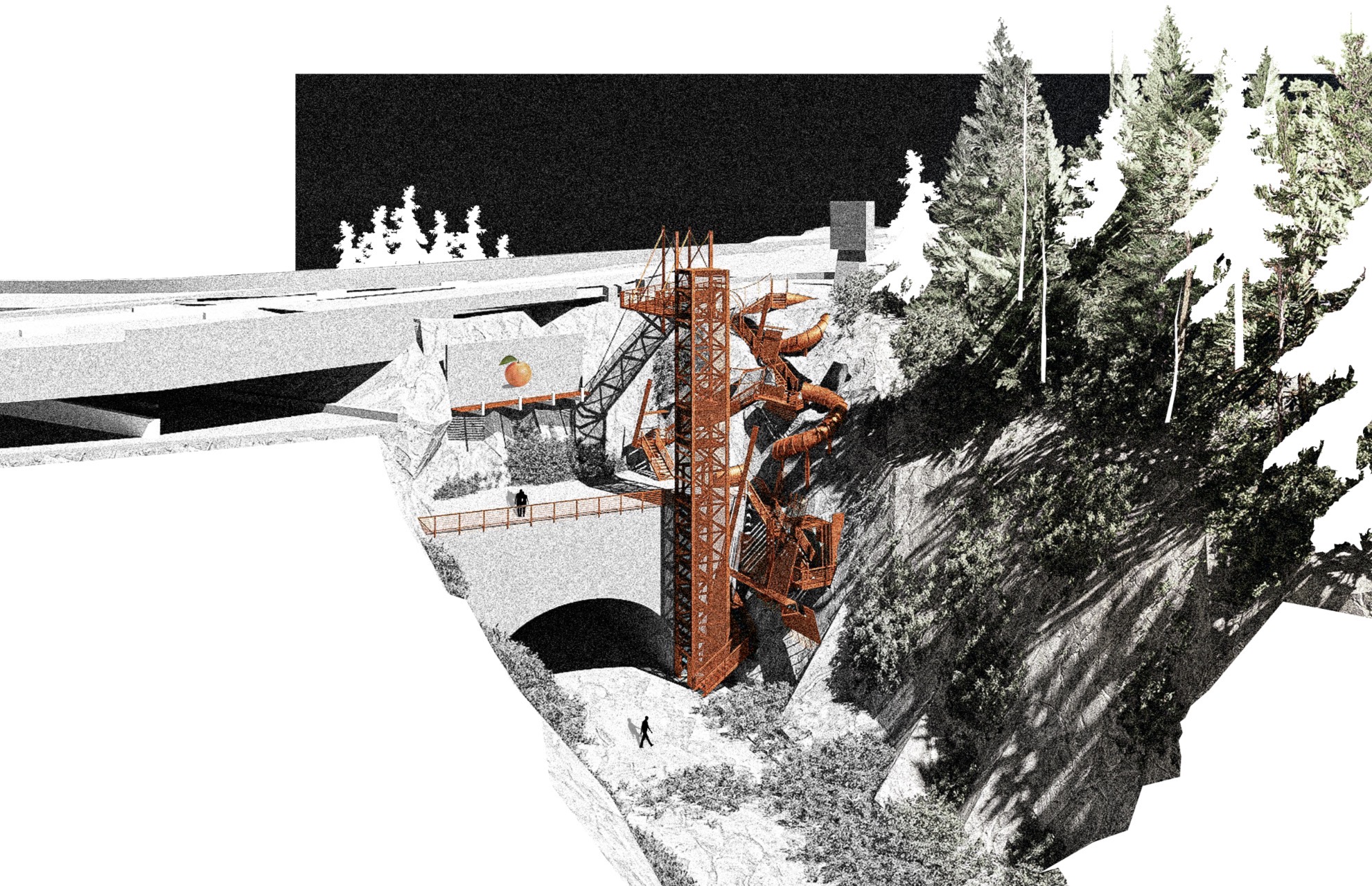
Owen Delpiu’s design for access from the street level to the greenway.
Amanda Bonfrancesco ‘26 explored the idea of design beyond the individual building, using a systems approach that connects infrastructure, ecology and public experience.
“My project focused on a ‘living spine’ that mitigates stormwater while shaping movement through the site, creating an ecosystem integrated into the landscape,” said Bonfrancesco. “The living spine was designed to integrate the green space the community envisions while naturally guiding circulation and creating a safer buffer between public activity and any potential NJT transit infrastructure, acting as a natural fence.”
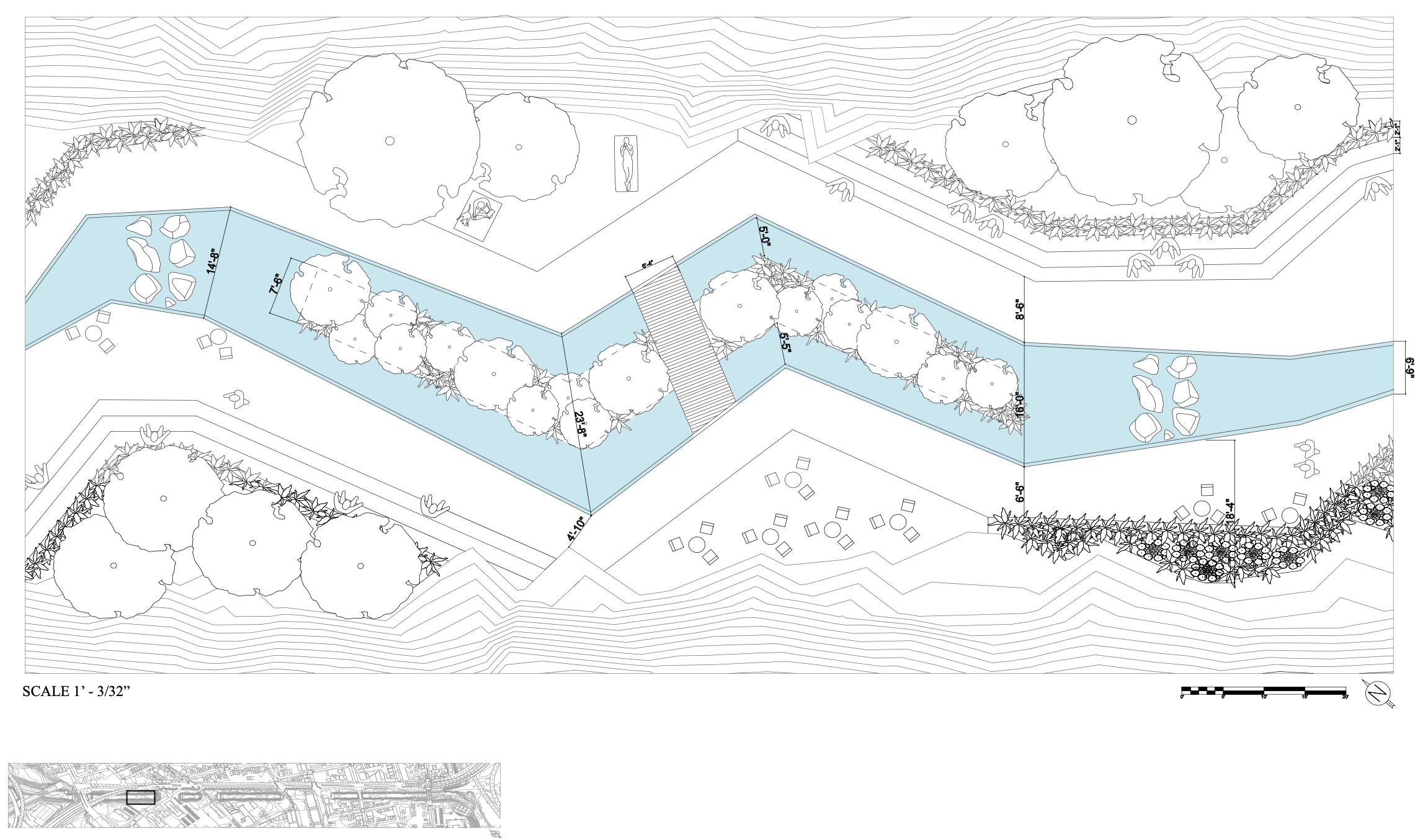
Proposal for water management and buffer by Amanda Bonfrancesco.
A Community Effort
Students reviewed the Bergen Arches feasibility study as part of their pre-design research and Marchetto connected them with the myriad agencies, community organizations and design firms involved in the redevelopment effort, including the Port Authority of New York and New Jersey , New Jersey Department of Environmental Protection (NJDEP), New Jersey Transit (NJT), the Jersey City Department of Infrastructure, New Jersey Bike and Walk Coalition, Journal Square Community Association, Sustainable Jersey City, New Jersey Conservation Foundation, the Bergen Arches Preservation Coalition, NHDM Architects, Supermass Studio, and Arup.
Students toured the Cut with NJT and NJDEP to gain first-hand information on the site. Members of the architecture firms, as well as the agencies and community organizations, attended both the midterm and final reviews providing valuable perspectives on the student design proposals.
Rahid Cornejo ‘16, an alumnus of Hillier College’s New Jersey School of Architecture and project director of the Bergen Arches Preservation Coalition along with other members of the coalition, is advocating for the former train tracks to become the connector between the Essex-Hudson Greenway and the Sixth Street Embankment.
“The Bergen Arches are more than a standalone project. They are the keystone of a regional system, transforming individual investments into a unified and accessible network. As a historic piece of Jersey City’s industrial and transportation legacy, the Bergen Arches represent a critical missing link that can connect major already funded projects into a continuous corridor for light rail, cyclists, and pedestrians while preserving natural green space and creating long term economic and community benefits for Jersey City,” Cornejo said.
Cornejo and Chris Gratto of New Jersey Conservation Foundation have set up an education and exhibit space in Journal Square where the 3D printed model of the Bergen Arches is on exhibit to facilitate conversations with community members and stakeholders. The model shows the Arches in-situ with surrounding streets and buildings and adjacent roadways, the tunnels, arches and rock formations are modeled and help to visualize the possibilities of transforming the site into green infrastructure.
“The connection between the Bergen Arches and the Embankment offers students a wide variety of potential study and engagement areas including transit, infrastructure, stormwater management, climate resilience, museum design, public space design, and educational outreach,” said Gratto.
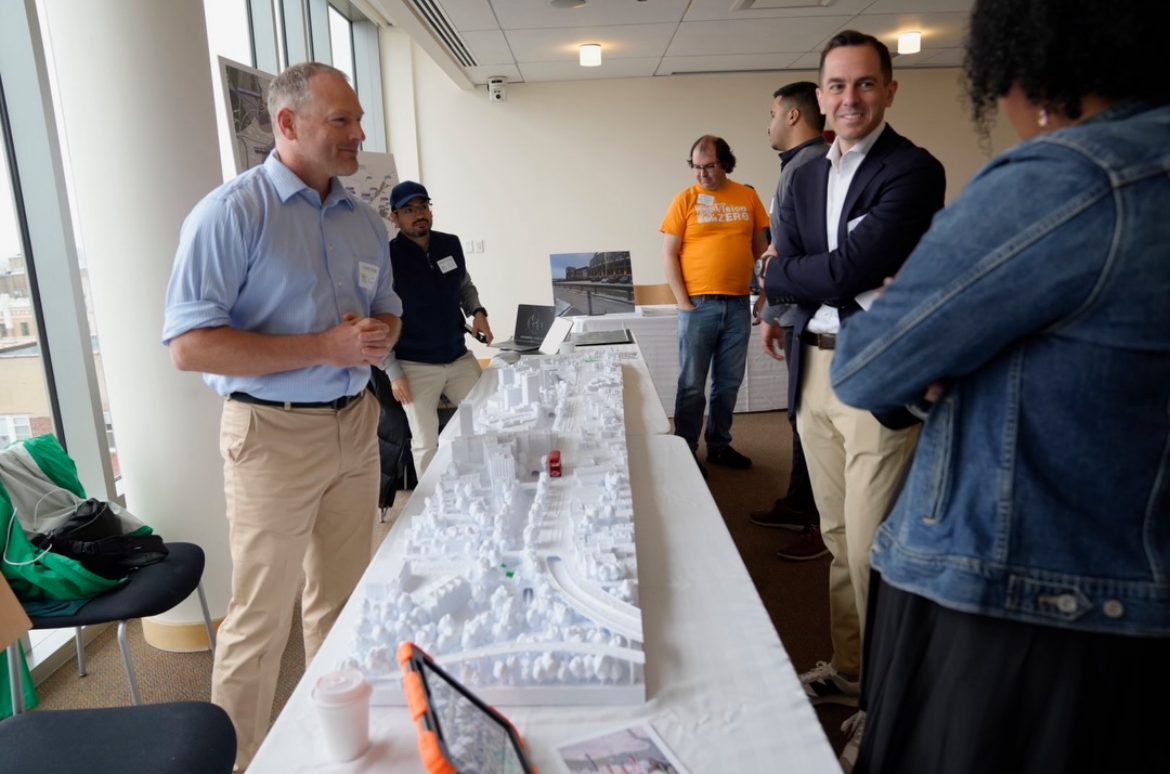
Chris Gratto (left) and Congressman Rob Menendez talking with community members at the Hudson County Complete Streets Transit Forum.
In December of 2025 the NJ TRANSIT Board of Directors announced that they are moving forward with plans to extend the Secaucus-Meadowlands Transitway to Jersey City utilizing environmentally friendly vehicles like electric or autonomous buses and shuttles. Meanwhile, community members continue to campaign for transit that includes bike and pedestrian options, while also advocating for the community benefits of an urban greenspace.
“Working with different agencies and community stakeholders showed me how impactful design depends on collaboration across disciplines, which ultimately influenced my decision to pursue a master’s degree in civil engineering and work at a civil engineering firm. This experience strengthened my interest in bridging architecture and engineering, allowing me to develop a more well-rounded approach to designing resilient and thoughtful urban spaces,” said Bonfrancesco.
Marchetto, a principal at MHS Architects, recognizes the educational value of immersing students in projects that require collaboration across multiple stakeholders.
"Being able to understand a project from multiple perspectives is essential to success in today's profession. New Jersey has so many complex sites with extraordinary potential — the Bergen Arches being a prime example — and NJIT is playing a meaningful role in researching them and advancing the dialogue about how these sites can be reactivated for the future."
To learn more about NJIT student and alumni involvement in the Newark phase of the Essex-Hudson Greenway see this article: Newark Segment of New Jersey’s Transformative ‘Greenway’ is Driven by NJIT Alumni and Students
