From Gateway Tunnel to Route 80 Emergency: NJIT Alumnus Brings Real-World Expertise Back to Campus
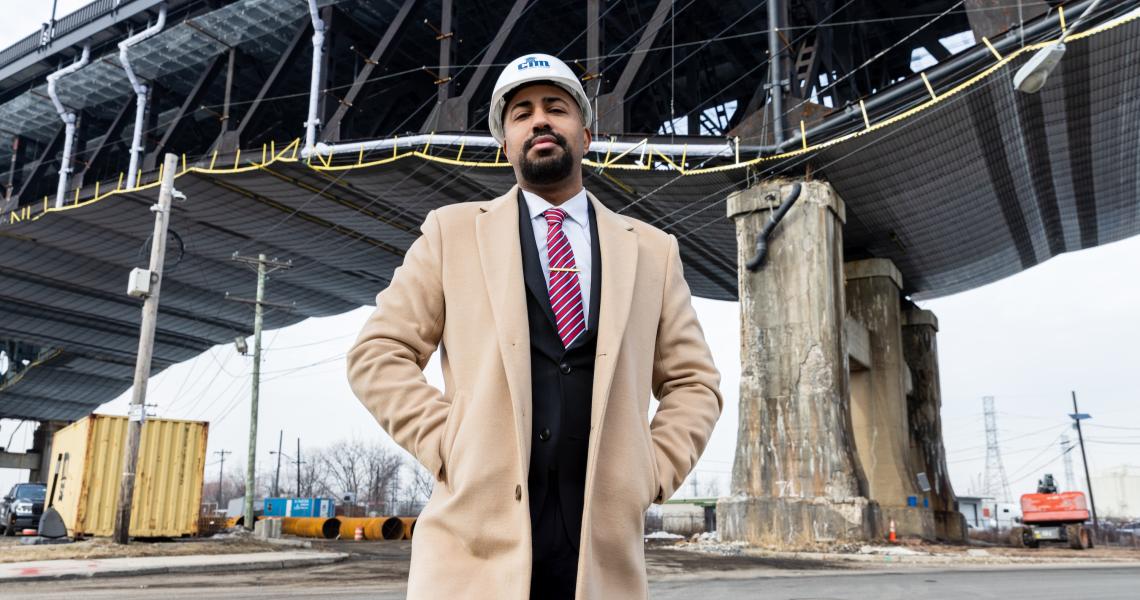
Three-time NJIT graduate Mohab Hussein has returned to his alma mater as a university lecturer after holding significant engineering roles on two of New Jersey’s most closely watched infrastructure efforts: the Hudson Tunnel project and the Route 80 abandoned mine collapse emergency response.
Hussein’s pathway back to NJIT began with a series of increasingly complex public-sector assignments that drew on the technical depth he developed during his bachelor’s, master’s and doctoral studies in civil engineering. In 2023, the Governor’s Office appointed him as New Jersey’s representative to help advance the multibillion-dollar Gateway Program’s Hudson Tunnel Project — one of the largest infrastructure projects in the United States — focused on modernizing rail connectivity between New Jersey and New York.
Hussein spent more than a decade at New Jersey Department of Transportation, holding several key positions, most recently as the supervising engineer at the Division of Bridge Engineering and Infrastructure Management, where he oversaw major infrastructure initiatives and managed hundreds of transportation projects totaling over $5 billion.
In his appointment to the Gateway Program, he represents New Jersey on the Technical Standards Committee, the senior engineering group responsible for setting project-wide technical requirements. The committee reviewed cost-driving design decisions, addressed interagency technical issues and evaluated how engineering choices would affect long-term construction, operations and resilience. Hussein also managed the New Jersey Surface Alignment, overseeing civil works from North Bergen to the tunnel portal, including utility coordination, roadway adjustments, drainage systems and constructability reviews in partnership with NJ TRANSIT, municipal agencies and federal and bi-state partners.

“I’ve always felt that NJIT prepared me not only with technical skills but with the confidence to take on challenges of any scale,” Hussein said. “Being selected to lead the Gateway Project by the Governor is a tremendous honor. This is a once-in-a-generation opportunity to improve transportation for millions of people, and I am proud to represent NJIT in this work.”
His tenure with the Gateway Program continued in early 2025, but he was suddenly tasked by the New Jersey Department of Transportation commissioner to lead the emergency engineering response to the Route 80 abandoned mine collapse. The incident, which caused major traffic disruptions and required immediate stabilization, placed Hussein at the center of a fast-moving, high-stakes operation involving geotechnical assessments, safety evaluations and coordination with construction teams working under compressed timelines.
Ultimately, the roads affected were reopened earlier than anticipated.
Following the completion of the emergency project, Hussein returned to NJIT as a university lecturer. He now teaches courses that integrate foundational engineering concepts, especially with concrete products, with the practical realities of multi-agency coordination, technical governance and the demands of large-scale infrastructure work.
“Returning to NJIT felt like a natural next step in my career,” Hussen said. “After spending over a decade in public-sector engineering leading large-scale infrastructure projects, I realized that sharing those experiences with students could provide them with invaluable real-world insight.
“My goal is not only to teach engineering principles, but to help students understand the broader impact of those principles in real-world applications. The biggest thing I want to impart is the importance of problem-solving, multi-agency coordination and technical governance — skills that go far beyond textbooks and are crucial for tackling the challenges of modern infrastructure.”
Hussein’s career, which spans three NJIT degrees and public-sector engineering assignments that carry statewide impact, shows how NJIT grads are deeply involved in the infrastructure pipeline. His return to campus brings those experiences directly into NJIT classrooms, where students benefit from real-world insight into the challenges and possibilities of modern civil engineering.