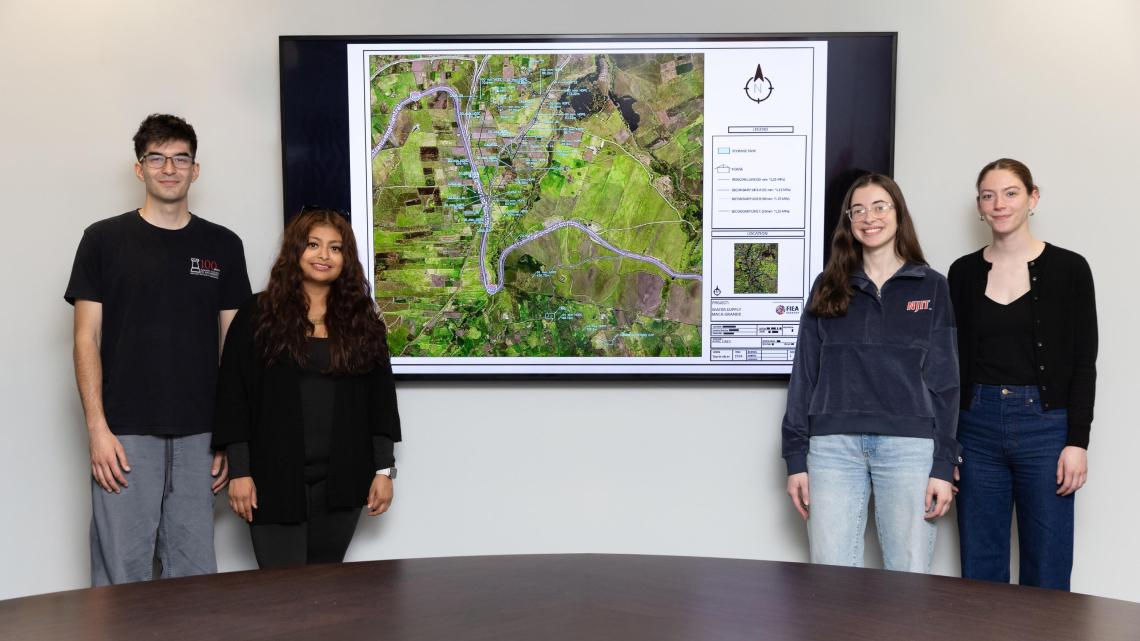
A team of Engineers Without Borders students who designed a gravity-driven piping system to bring clean water to houses in a remote village in Ecuador is the 2025-2026 winner of the Outstanding Student Chapter Award, presented at the 28th annual Newark College of Engineering’s Salute to Engineering Excellence.
The system they engineered on campus was built and installed earlier this year by community volunteers who were overseen by an Ecuadorian construction company. It now delivers filtered spring water to 15 families in Maca Grande, a small agricultural community in the Andes. The villagers had previously walked up and down a long, steep slope to collect water from a stream below them that was contaminated by agricultural runoff and often littered with trash.
“Clean water is something we take for granted,” said Klara Tinaj CEE ’26, vice president of the EWB chapter. “The village residents were spending an hour walking to get water from a stream that was not even clean.”
Earlier teams of EWB students worked on the first two phases of the project: a cap that encased the spring well head and protected the water from contamination as it flowed through clean soil and gravel, which acted as natural filters, to the main pipe; and the tank to store the water, from which it is distributed to individual houses. The students advised on design elements of each and raised money for both phases of the project.
But the project then languished for a year, noted Jay Meegoda, distinguished professor of civil and environmental engineering and the EWB chapter’s founder. He credits the current team with reviving and completing it.
“This project would not have happened without these students,” Meegoda said. “They put their heart and soul into it and singlehandedly designed most of it. They also raised funds to help pay for it.”
Tinaj and Kerry Archer CEE ’26, the EWB chapter president, took on the project as part of their minor in environmental engineering. They recruited Stephanie Herrera-Chavez CEE ’26 and Paul Ionescu CEE ’26.
The project took on some urgency when the students learned that a nearby village was taking steps to appropriate the tank.
“We were notified by Engineers in Action, our partners in Ecuador, that the neighboring community had noticed that the tank wasn’t being used. They were planning to go through the legal process of gaining access to it through the Ministry of Environment,” said Archer. “This is one of the reasons the project got back on track so quickly.”
The team began to meet on Monday nights on campus last summer to design the system and write the implementation package, including project schedules, material needs, cost estimates and construction, safety, operations and maintenance plans. Both were subject to rigorous review by professional engineers in Ecuador.
But first, Ionescu noted, they had to learn the water modeling software program, EPANET, that the Ecuadorians were using, to ensure they were properly designing the water pressure, flow and velocity that corresponded with specifications in Ecuador.
“The mapping application showed us the elevations and distances between houses so we could determine the size and length of pipe we needed and whether the pipe layout on the existing grade would provide sufficient pressure for their needs,” he said. The team met regularly with partners in Ecuador by Zoom.
The chapter raised more than $6,500 in six months through corporate donations, fundraising campaigns, and a competitive award of $2,500 dollars from the national EWB USA Xylem WASH Impact Fund. The students also secured tens of thousands of dollars in construction and supervision support through coordinated funding channels. The money paid for materials and construction.
Herrera-Chavez recalled a 20-degree day in mid-January when the crew stood outside of Panera soliciting funds until closing time.
“I had never done this sort of fundraising, face-to-face,” she recounted. “People don’t usually give, so I had to step out of my comfort zone and learn how to be confident in asking. But knowing we were helping other people, while bonding with each other, made it a great experience.”
William Pennock, an assistant professor of civil and environmental engineering and an EWB advisor, recalls looking down the hillside to the ravine below on a visit to the site in 2019 with a group of NJIT students who were working on the first phase.
“Our two days in the community felt like a trek and an adventure, but for the villagers, this is daily life,” he recounted. “In winter, the conditions are rugged.”
