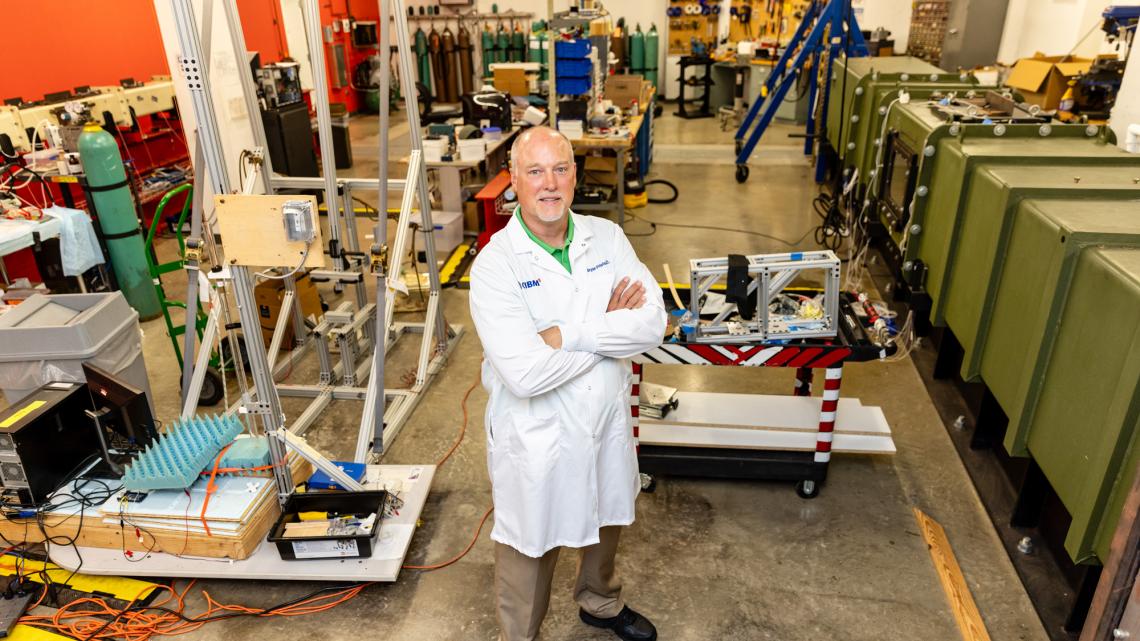
Bryan Pfister, a pioneer in the study of brain injuries and their impact on the central nervous system and human behavior, is a newly inducted Fellow of the Biomedical Engineering Society.
Pfister, a professor of biomedical engineering and chair of the department, was tapped in late 2025 for his significant contributions to the field in research and education, as well as for advancing diversity initiatives and for his sustained service to the community. He led, for example, the Fifth Biomedical Engineering Education Summit, which focused throughout on diversifying the biomedical engineering workforce.
The Center for Injury Biomechanics, Materials and Medicine, which he directs, explores long-term damage to the brain from moderate and mild repetitive injuries suffered by athletes, soldiers and law enforcement officers.
Unlike a soldier near an explosion or a football player who has been slammed by a linebacker, they may feel little immediate impact. The cumulative effects of low-level blasts, even from firing weapons, for example, can cause neurological problems such as sleep and memory disorders and cognitive deficits, Pfister noted.
He explained, “If you have a mild hit, the first hit, does that exposure put your brain in a vulnerable state, even if there is no detectable injury? Research on animals shows us that a mild shock wave doesn’t do much, but if the subject is hit again, then yes, we see neuroinflammation and measurable behavioral changes. With repetitive injuries, deficits develop over time.”
Center researchers began studying these injuries five years ago to explore their impact on service members. Their goal is to understand the precise mechanisms driving persistent and chronic changes, which can then become targets for treatment.
In one approach, they’re focusing on damage to the blood-brain barrier, a tightly packed layer of cells around the brain that are the central nervous system’s first line of defense. Under normal conditions, they admit only the tiniest molecules, repelling pathogens and most foreign substances.
With repeated low-level impacts, the brain becomes more permeable, admitting foreign molecules and cells from the peripheral system, such as monocytes, which release cytokines to fight inflammation. The brain’s own immune cells, microglia, also mount an anti-inflammatory response. If this process is sustained, it can become pro-inflammatory and turn toxic, killing neurons.
Researchers at the center also seek to pinpoint the exposure levels that put the brain into a vulnerable state to help decide when someone returns to duty or a game, for example.
“Is it the number of times someone is hit, how hard, or the intervals between the hits that matter? There are many biomechanical parameters involved in head injury. How each parameter leads to injury remains to be determined,” Pfister says. “This is essential to setting exposure standards and to provide a threshold above which immediate treatments should be made.”
The Center also studies traumatic brain injuries caused by blunt impacts sustained on battlefields, for example. In the university’s blast simulation lab, researchers measure the connection among the strength, distance, speed and positioning of a blast and the type and degree of injury it causes. They also assess the physical damage to both the structure of cells and their capabilities, including the ability to transmit signals.
“In our multi-scale analyses, we study everything from neurons in a dish, to animal models, to full-scale inanimate human models,” noted Pfister, who specializes in damage to nerve axons, which comprise the nervous system’s communications infrastructure.
As department chair, Pfister has for the past decade led efforts to diversify the field, raising the participation of women and students from under-represented groups, who now account for 50% women and about 44% of enrollment in the major, respectively. In 2023, he established U-RISE, an undergraduate research training program that matches students with mentors and provides year-round research activities. The goal is to train a diverse group of students who will transition to Ph.D. programs in the biomedical sciences.
Pfister was inducted in 2024 as a fellow of the American Institute of Medical and Biological Engineers, “for outstanding contributions to the implications of biomechanics on the development, injury and repair of the nervous system.”
