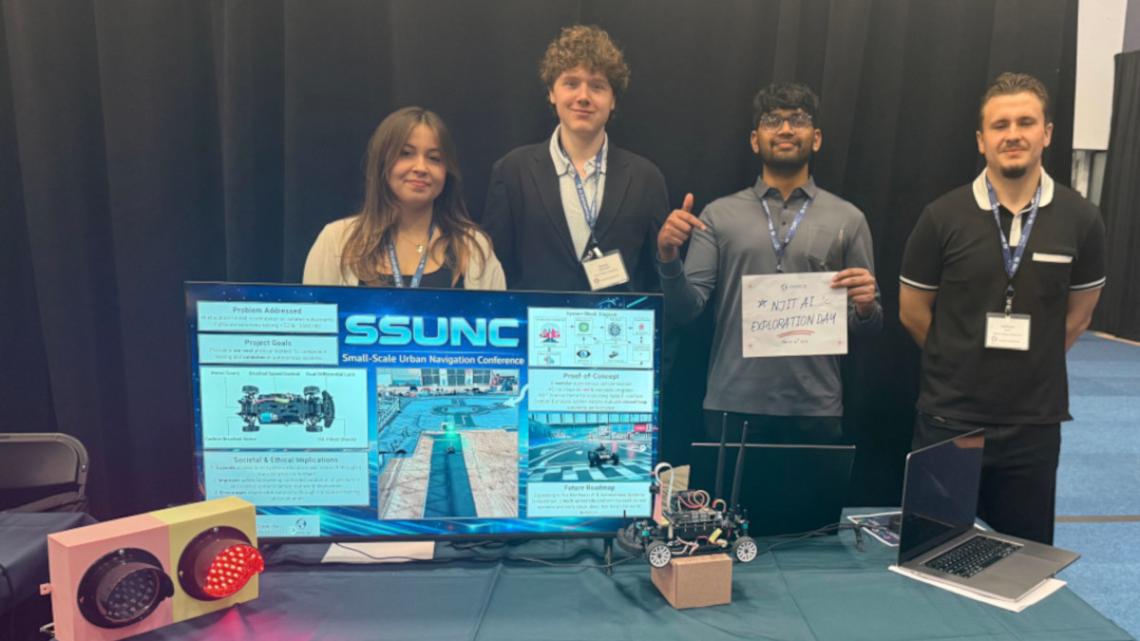
Students won the Real World Impact award at New Jersey Institute of Technology’s spring 2026 Artificial Intelligence Exploration Day not for what they built, but for how they built it.
The team of Bartek Broclawik, Matthew Sudol, Pola Szwaczka and Om Vaghasiya knew that autonomous vehicles are an established technology. Yet in designing one of their own, in the form of a toy-sized model, they employed heavy use of AI to develop it and created a trail of lessons for anyone in the NJIT community to learn.
“The parts that used AI were research, outreach, fixing failures, and code,” explained Broclawik, the team captain.
Broclawik, a senior from Wallington majoring in electrical engineering, said the idea had multiple roots. He’d founded a club, Advancement of Career Development Collective, for students to work on engineering projects in a collaborative and professional manner — doing so would help them land internships and jobs, he reasoned. Tao Han, associate professor of electrical and computer engineering, supplied the high-tech model car equipped with a single-board computer and sensors. Han introduced them to Joyoung Lee, associate professor of civil and environmental engineering, who studies how real-life autonomous vehicles behave at yellow lights. Han and Lee are the club’s co-advisers.
Broclawik and his teammates decided to start with the basics. They’d learn to use AI for vibe coding — the concept of instructing an AI system to create code for you, by typing in prose — and they would keep iterating until it worked. They would start simple by making the car move forward, watch for green and red lights, and stop or start again accordingly.
The team used OpenAI’s ChatGPT 5.4. They also recently began trying Anthropic Claude. “Its first-try accuracy is better than ChatGPT,” Broclawik said, echoing what many professional developers have found. In addition to code itself, they also used AI to help determine which mechanical components were required.
Using such methods, “We developed the perception and decision architecture using classical computer vision: camera based ROI extraction, red/green traffic light detection, filtering across multiple frames for reliability, and a deterministic stop/go state machine. This allows the vehicle to interpret a real hazard and respond autonomously under constrained conditions,” Broclawik said. “We also combined it with hazard-state logging like timestamps, detections, decisions, and throttle level. This creates the groundwork for future labeled datasets.”
The model works with near-perfect accuracy, as tested in Lee’s laboratory located in the former theater of NJIT’s Central King Building. Now they are building another car, this time from scratch, which will recognize yellow lights and pedestrians. Looking forward, Broclawik said, the model itself could begin using AI through supervised learning models trained on the data they collected. Future directions may integrate advanced autonomous decision-making and run the open-source Robot Operating System.
Beyond the science, the team also used AI to help them correspond with academic and industry professionals. “AI let me communicate at the level of the people I was reaching out to, before I had the years of experience that would have otherwise justified it,” Broclawik added. “Almost every, if not all, external facing asset we have produced — the club logo, the posters for competitions, the flyers, the documentation handed to advisors and Deans — they started as a raw idea from the team and AI was the translation layer between what we were thinking and what a professional organization would actually output. We’re also currently in conversations with Bergen Community College to export the systems. That outreach started the same way, a polished proposal that opened a door I wouldn’t have been able to knock on otherwise.”
“AI served as a force multiplier as well as supplemented our earlier low membership count,” Broclawik stated. “Members took away how to prompt the AI to create a usable inference, then leveraging our technical expertise to review its outputs and advance the system forward. AI allowed us to compress months of conceptual structuring, technical writing and systems decomposition into far shorter cycles … This is the sole reason as to why we were able to present at the AI Innovation day.”
“For NJIT students and builders, the key lesson is clear: AI works best not as a replacement for expertise, but as an accelerator for disciplined thinkers. The strongest use cases were using it as a secretary with hundreds of pages of meeting minutes taken directly from our conversations. When a component failure occurred and we couldn’t identify where, AI recommended validation paths and the methodology to test, and many times it worked. [We] demonstrated how AI can be used as a coworker and significantly increase productivity velocity, even with a small team size.”
Among the AI Day judges, “I really enjoyed meeting the research group and learning about their project,” said NJIT’s Kim Chen, director of writing in the Department of Humanities and Social Sciences. “Their work did not try to reinvent the wheel; instead, they took an existing technology and customized it … While their efforts were Herculean, their application was community-based in its specificity.”
"The platform demonstrates a clear path from prototype to real-world impact and shows how AI can safely handle ever-changing urban hazards on a small scale," added judge Elisa Kallioniemi, assistant professor of biomedical engineering.
Broclawik intends to graduate in December 2026. The project experience, he hopes, will help land his dream job as an AI hardware engineer.
