Newark college engineering

NJIT's Top Student Researchers Take Center Stage at Dana Knox Student Research Showcase
This month, the work of NJIT’s top student researchers was put on display at the 2018 Knox Student Research Showcase, “A Glimpse Into the Future”.
The showcase, which annually honors outstanding research done at NJIT by its graduate and undergraduate students, awarded Najmaddin Akhundov first place among this year’s graduate researchers for developing a computational model to track and control invasive species that threaten the environment.

NJIT Gives Back With Nearly 60,000 Hours of Community Service
Volunteerism is a mainstay at NJIT, with students and faculty engaged in a range of initiatives to better the community. Such efforts, amounting to more than 59,000 hours of community service over the past year alone, have been recognized both nationally and locally.
Fostering a Vision for The Weiss-Aug Group: Dieter Weissenrieder '76
Dieter Weissenrieder emigrated from Germany in 1960 as a tool and die maker to work for his uncle’s tooling business. He quickly became the manager of the company, and after working for the family business for 10 years, the company was sold to a large firm. He then founded Weiss-Aug in 1972 with his partner, Kurt Augustin, while pursuing his industrial engineering degree at NJIT.
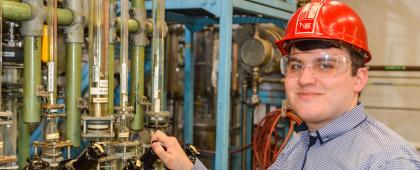
Fulbright Winner Brendan Dente Heads Off This Summer for a Two-Year Stint in the Netherlands
Brendan Dente ’18, a chemical engineer with a talent for product design and a yen for travel, has won a Fulbright scholarship to spend the next two years earning a master’s degree at one of Europe’s major STEM hubs, the Technological University of Delft (TU Delft) in the Netherlands.
He intends to spend his time there “delving deeply into molecular engineering,” a subject that focuses on the arrangement of molecules in chemical compounds in order to improve products.
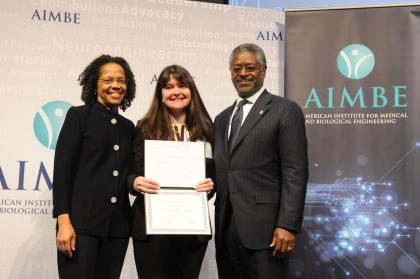
Tara Alvarez is Named a Fellow of the American Institute for Medical and Biological Engineering
Tara Alvarez, a professor of biomedical engineering who studies the links between visual disorders and the brain and develops novel devices to identify and treat them, has been named a fellow of the American Institute for Medical and Biological Engineering (AIMBE).
Alvarez joined approximately 150 new fellows, who represent the top 2 percent of the medical and biological engineering community, at an induction ceremony this past weekend at AIMBE’s 2018 annual meeting at the National Academy of Sciences in Washington, D.C.
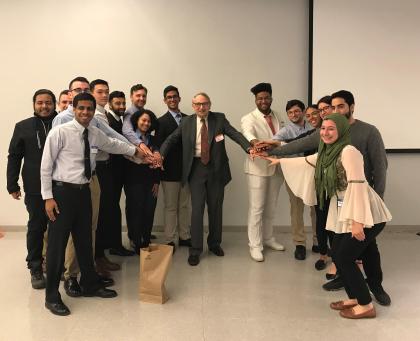
Innovation Day 2018
An interdisciplinary engineering team developing an enzyme-blocking drug designed to reduce levels of LDL, or “bad cholesterol,” was the winner of this year’s TechQuest challenge, announced this week at NJIT’s sixth annual Innovation Day.
Come Meet NJIT's Undergraduate Inventors
Innovation Day is a showcase of cutting-edge, student-led research that includes inventions that improve lives, novel business ideas, computer games and fundamental scientific research. This year, nearly three dozen student projects – from mapping applications for the transportation industry, to human control interfaces for surrogate robots, to novel drugs that target cholesterol – will be on display in the Campus Center on April 10.
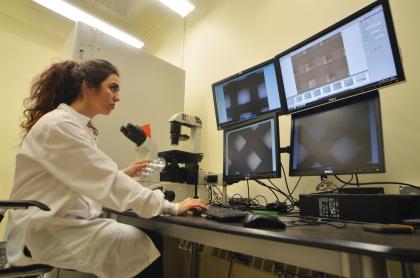
Undergraduate Ecosystems: Engineering Tissues with 3D Printers
INSTRUCTIVE BIOMATERIALS AND ADDITIVE MANUFACTURING LABORATORY

Score! Soccer Alumna Accepted Into Women Athletes Business Network
“One of the things that I’m pretty passionate about is women being competitive and not having negative connotations around being competitive… I think that sometimes women don’t embrace that enough,” said Erika Taugher ’08, ’09, a star soccer alumna who earned a bachelor’s in mechanical engineering and a master’s in international business.
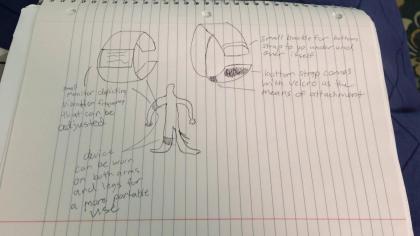
NJIT Students Take No. 2 Spot in Health Care Competition
Who better to develop ways to encourage young people to watch after their health than other young people? Such was the reasoning behind the first-ever Horizon BlueCross BlueShield of New Jersey’s (BCBSNJ) Health Care Transformation Challenge, conducted last year.