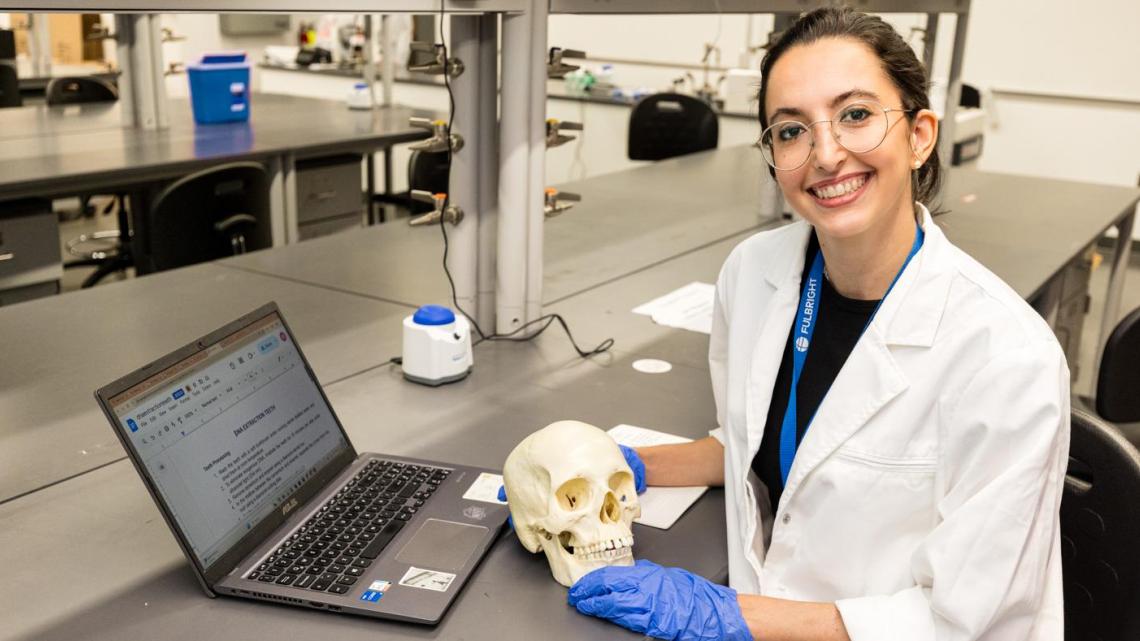
There are currently over 13,000 unsolved forensic cases aiming to identify unknown human remains in the U.S. alone (NamUs, 2025), but NJIT graduate researcher Maria Castagnola is helping pioneer new DNA-based forensic methods that may one day lead to breakthroughs.
Castagnola, a native of Argentina, arrived at NJIT in 2023 after earning a master’s in pharmacy and biochemistry from the University of Buenos Aires. Her academic journey took a leap forward when she was awarded a Fulbright scholarship — a distinction held by more than 60 Nobel laureates — which soon opened the door for research opportunities in the United States.
The move ultimately has brought her to pursue her Ph.D. under NJIT Assistant Professor of Chemistry Sara Zapico, whose research in the field of forensic epigenetics is exploring new ways to extract identifying information from human DNA that can assist in everything from C.S.I. cases to identifying victims of mass disasters.
“Being awarded the Fulbright allowed me to pursue research that truly matched my interests,” Castagnola said. “I was drawn to NJIT because of Dr. Zapico’s work in forensic epigenetics and how supportive she is as a mentor. It felt like the right place to take my work to the next level.”
Since, Castagnola has been advancing lab techniques to help forensic teams answer a critical question during investigations: How old was a person at the time of their death?
At NJIT’s ForenBios Lab, she’s finding new ways to extract DNA from partial bones or teeth, while tracking subtle chemical changes in DNA from these remains — known as methylation patterns — that change predictably with age.
Her work could help pinpoint a person’s age even decades after death.
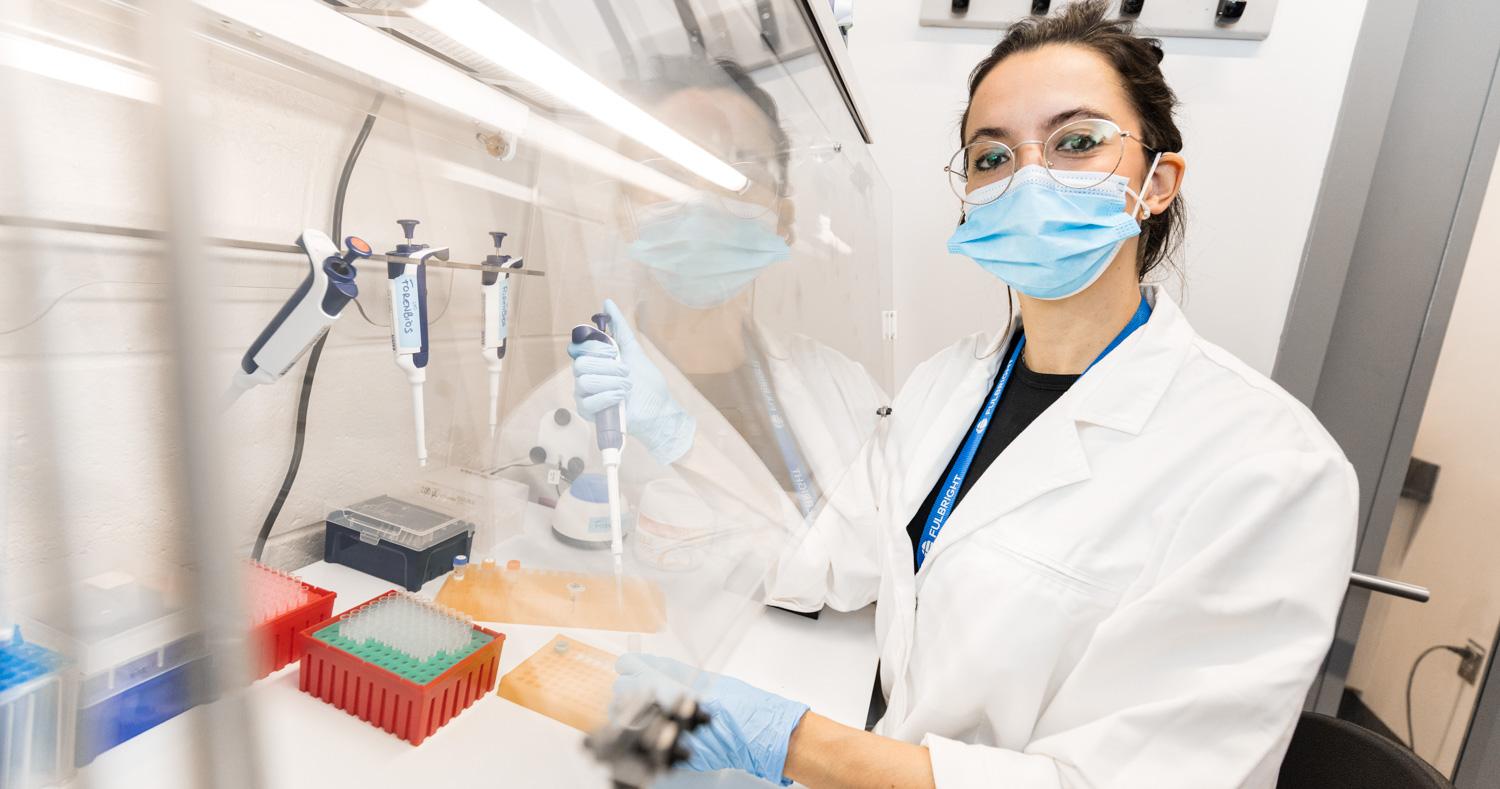
“Being able to estimate age from just a tooth or a bone can make a real difference in narrowing down someone’s identity by focusing investigations on a smaller pool of potential matches,” Castagnola said. “Our research allows us to extract and analyze DNA methylation from teeth and bones, even when the samples are far from ideal … it’s especially important in cases where other clues have been lost.
“In forensic anthropology, age estimation in adult individual remains is challenging, often with errors of plus or minus ten years. Our work focuses on specific DNA sites that relate to chronological age, particularly in teeth, which resist degradation longer than other tissues.”
Castagnola has quickly made her mark with several research breakthroughs.
Recently, in a study published in EC Dental Science, Castagnola's team achieved a first in her field — demonstrating that DNA, RNA and proteins can be simultaneously extracted from human teeth. Castagnola says the finding has potentially significant implications for both age estimation and postmortem interval (PMI) research.
“Being able to extract DNA, RNA, and proteins all at once from the same tooth sample allows us to gather a fuller picture — from identifying someone to estimating how long they’ve been deceased — even when we’re working with limited or degraded remains,” Castagnola said. “This approach opens new possibilities for solving cold cases and responding to mass disasters.”
They also showed that a 24-hour treatment of dental tissue in lysis solution, commonly used to break down tissue and extract DNA, yields the highest quality genetic material from teeth.
“Most labs use shorter incubation times during DNA extraction in other types of samples, like body fluids, but we found that, in human remains, particularly in the case of degraded ones, letting dental tissue sit in lysis solution for 24 hours dramatically improves DNA quality,” she explained. “It’s a simple adjustment that can make a huge difference in getting usable results from tough samples without the need for expensive new tools.”
Beyond extraction, Castagnola is refining age estimation techniques through forensic epigenetics, focusing on DNA methylation markers that resist degradation.
“Our work on DNA methylation markers focuses on those that hold up well over time, even in degraded samples,” Castagnola said. “By refining these markers, we hope to reduce the usual margin of error in age estimates and help investigators zero in on identities more quickly and accurately.”
Already, Castagnola’s research has drawn attention at major forensic science conferences — including the American Academy of Forensic Sciences conference hosted in Baltimore, the nation’s largest gathering in the field.
Castagnola says her work could soon be adopted by crime scene investigators, forensic anthropologists and support humanitarian efforts worldwide.
“These techniques are still evolving, but because they use commercially available kits, we expect them to be adopted in forensic labs within the next few years,” she said. “Forensic anthropologists and disaster response teams will likely see the biggest benefits first, gaining new tools to extract more detailed information from remains that were previously difficult to analyze.”
“Forensic genetics is about restoring identity and supporting justice,” Castagnola said. “I am committed to helping those involved in forensic cases and seeking justice for them. While this Ph.D. is a key milestone in my career, I hope to continue advancing forensic epigenetics to make a real difference.”
