
Professional accolades started arriving early in the career of Matthew P. Adams, an associate professor of civil engineering at New Jersey Institute of Technology (NJIT) and co-director of the Materials and Structures Laboratory (MatSLab). In 2015, Adams was still working toward his Ph.D. when he was recognized by the American Concrete Institute (ACI), earning their Young Member Award for Professional Achievement for his work supporting young professionals in the concrete industry.
More than a decade later, Adams has received a new honor from the ACI, a nonprofit technical society that oversees global concrete production standards and education programs related to concrete fabrication and use. The organization recently elected Adams to its Board of Direction; Adams and three other newly appointed directors will serve in those roles for a three-year term, ACI representatives announced April 9.
Adams, who also leads NJIT's Structures and Materials Engineering Group, learned of his nomination last summer, when ACI CEO Fred Grubbe told him that he had been selected for consideration by the executive council.
"That was a surprise," Adams says. "As a 41-year-old associate professor, I believe I’m quite young to be nominated for the board; but I was eager to serve the institute that has meant so much for me and I agreed to stand for the election!"
His research explores the chemistry of concrete production by developing and testing new materials to understand how they affect concrete sustainability, resilience and long-term durability. A particular area of interest is novel low-embodied-carbon materials, which have a low carbon impact across their life cycle and can be used in concrete formulations as an alternative to standard components that produce greater quantities of greenhouse gasses.
ACI isn't the only organization to acknowledge Adams' achievements. He was named a Richard P. Nathan Public Policy Fellow in 2020 by the Rockefeller Institute for Government. He is a member of ASTM International and has received research funding from the American Concrete Institute Foundation, the Port Authority of New York and New Jersey and the United States Department of Transportation.
New Life for Slag
Adams is also technical lead for The Steel Slag Initiative, funded by a $5 million grant from the U.S. Department of Transportation in support of an academic consortium — NJIT, Rutgers University, Oregon State University and the University of Florida — and administered by Rutgers. Under the grant, scientists investigate new construction uses for slag, a byproduct of steel manufacturing.
Slag is commonly added to concrete as a more sustainable replacement for a type of high-strength binder called portland cement (in 2020, cement production was estimated to account for about 8% of global CO2 emissions). Most slag used in this way is a byproduct of steel manufactured with blast furnaces. However, blast furnace use has declined in the United States; most domestic steel production now uses electric arc furnace (EAF) systems, which produce slag with lower chemical reactivity. As a result, blast furnace slag for repurposing in concrete must be imported.
"Our goal for this work is to understand how we can process or modify EAF slag differently to make it reactive and more viable for use in concrete," Adams says.
As part of the initiative, researchers at NJIT are also analyzing market trends and construction policies and codes, to better understand other barriers that may discourage building projects from using EAF slag produced in the U.S.
"Combined, we expect to be able to increase EAF slag performance and quickly get the material utilized in the field," Adams adds. "This way we can reduce reliance on an imported material, create a market for an underutilized high-value domestic material, and ensure adequate material supplies for the foreseeable future."
The most important professional organization I’ve been a part of
Adams' association with the ACI began when he was an undergraduate at the University of New Hampshire. At the first ACI convention he attended, he met his Ph.D. advisor. Another ACI member who worked at NJIT later encouraged Adams to apply for a faculty position there, which he started in 2015.
"ACI is, for me, the most important professional organization I’ve been a part of during my career," he says. "The ACI Foundation has provided funding for my research, I’ve had several amazing mentors that I met through the Institute, and I’ve been lucky to be a mentor for some younger engineers who are doing amazing things. So, I can directly link my own career progression to my involvement in the Institute."
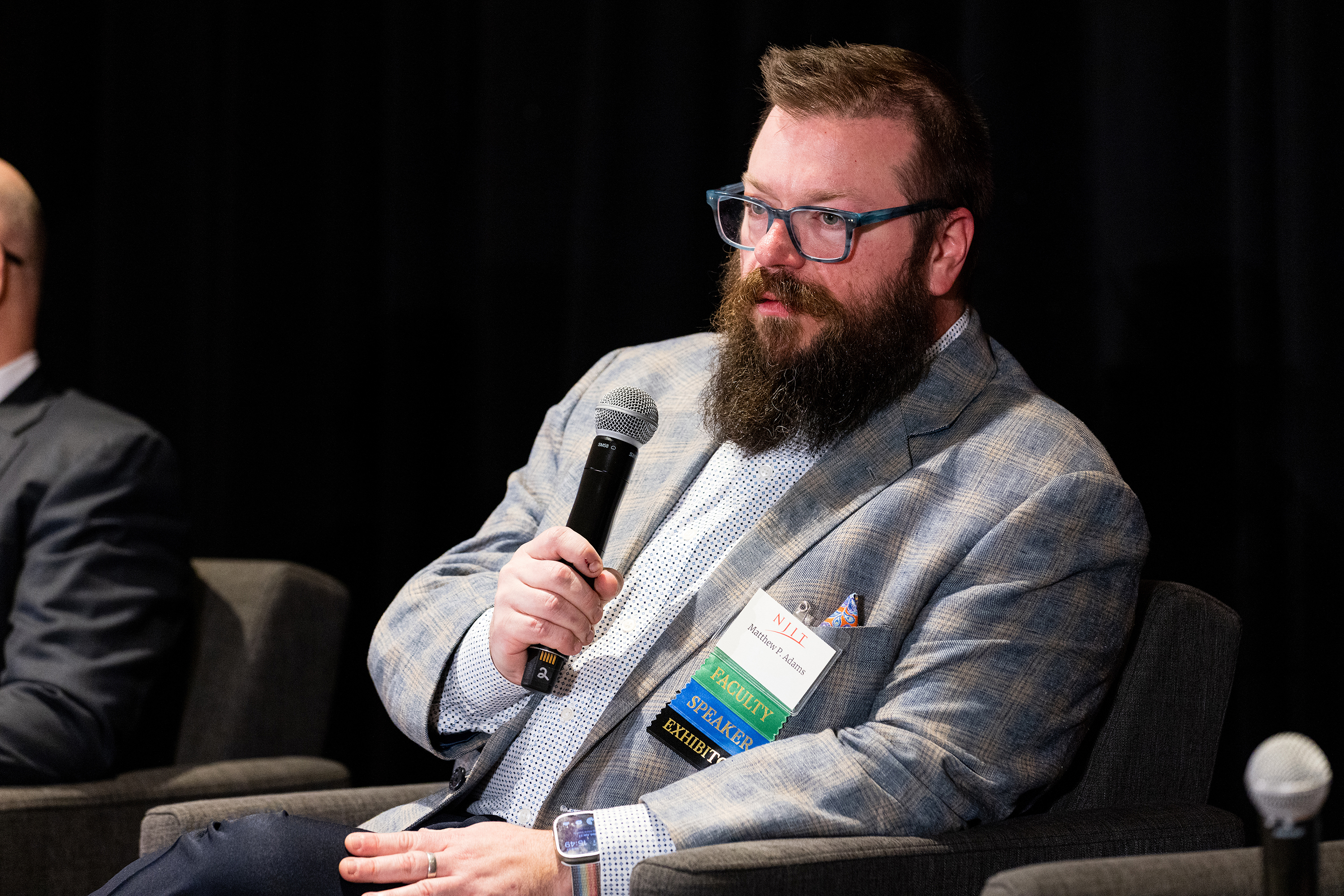
At NJIT's Infrastructure Forum on April 22, 2026, Adams appeared on the panel "Technological Advancements from Academia."
In 2019, Adams became an ACI Fellow; he has served as chair on several ACI committees and was the founding chair for the Young Member Activities committee. As a director, he and his fellow appointees will shape the vision and direction of the institute, and advise on its financial oversight.
"We make sure that member dues are being used responsibly, we help make sure the institute is being agile and responsive to needs within the community of concrete industry professionals," he says. Another new ACI appointment for Adams, on the Technical Activities Committee, places him in the group responsible for final approval of all documents produced by the institute, including building codes — legal requirements for the design and construction of systems such as structural components, ventilation and plumbing, in residential and commercial buildings.
His role as director offers a fresh perspective on the services ACI provides engineers at every career stage, he says.
"My short time with the Board has already exposed me to the multitude of training, certification, knowledge development and student support that the Institute is involved in, particularly on the global scale."
When Adams received his first ACI award he was still carving a career path; his goals were to become a professor, continue his research into concrete materials and leave his mark on the industry. His present-day reality has exceeded those expectations — he credits that in part to the support he received over the years from the ACI and NJIT — bringing him into the realm of policy-making and building code development to increase the use of sustainable concrete materials.
"While the scientific research we do is very important, the work we do to move research into the field and update our building codes and construction policy are the things that feel more impactful."
