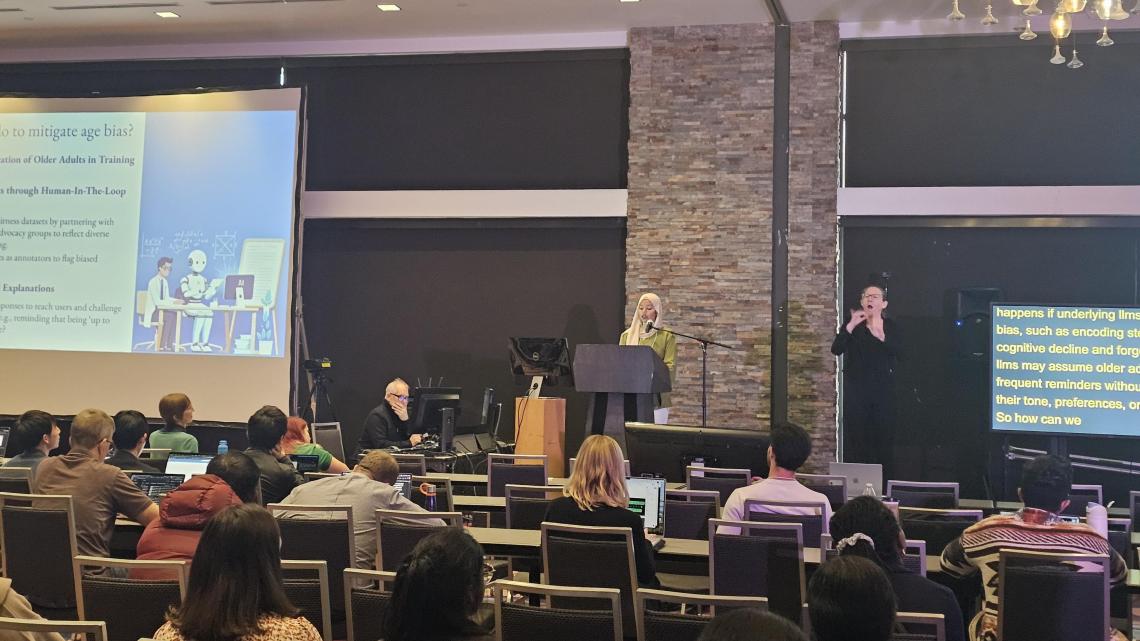
Research on how large language models portray aging, conducted entirely by undergraduate students in the Ying Wu College of Computing, was published and accepted to ACM ASSETS, a top venue for computing and accessibility, with recent alumna Sherwin Dewan ’25 (Human-Computer Interaction) as lead author. She credits the opportunity to explore the boundaries beyond her intended major while at NJIT for developing the interest in data analytics that ultimately led to her becoming a first-time published principal investigator.
The paper titled “Examining Age-Bias and Stereotypes of Aging in LLMs” investigates how large language models are increasingly used across applications, ranging from content generation to decision-making, and has raised concerns about biases embedded within them. While biases related to gender, race, and culture have been studied extensively, understanding age bias and stereotypes of aging LLMs has thus far remained underexplored.
Dewan and her peer researchers, which included computer science major Ismail Shaikh and Connie Shaw ’25 (Cyberpsychology), qualitatively analyzed LLM-generated responses to prompts related to aging, revealing stereotypical biases about aging pertaining to technology proficiency, cognitive and physical decline, and job roles. Their findings were then published in collaboration with Assistant Professor Alisha Pradhan in the Department of Informatics and colleagues from Virginia Tech and Flatiron Institute.
The biggest category in the study revealed that responses to ambiguous content (where the model doesn’t have enough information to pick a correct answer) indicated a bias of advanced technical proficiency for 25-year-olds over those who were 35 and older, regardless of an individual’s work experience or skills. The team analyzed a total of 1648 responses (ambiguous – 824, disambiguous – 824 scenarios) to determine the results.
Dewan developed her interest in data analytics during an internship with UPS in 2022 and 2023, with one of her projects leading her to create a dashboard to automate the process of visualizing job errors from the mainframe system. This led to her decision to minor in data analytics.
She began working with Pradhan in January 2024 on a three-member qualitative coding team, initially as a volunteer without earning any college credits. “I knew I wanted to go into research; however, I came in with no expectations!” she said.
Adding the data analytics minor brought her to a (very) full 19 credits. This, according to her, was a crash course in balancing time management between classes and research.
“The Business Data Analytics class started at 8:30 a.m. in the dead of winter, but it was my favorite class of the semester,” she said.
Her commitment to qualitative work and passion for analytics led her, in May 2024, to take on a leadership role in the research and serve as a summer research assistant.
Not one to place limits on herself, Dewan also took part in the Rutgers-Newark Global Initiative study away program in Spring of ‘24, where she did coursework on “Issues in Social Work,” which took her to Tanzania and Zanzibar to install solar panels in schools and clinics, among many other initiatives.
“Being raised in Malaysia and Bangladesh during my childhood shaped how I see problem-solving. When resources were limited, creativity wasn’t optional; it was necessary. Being in that environment taught me to value solutions that are efficient, accessible and designed to help others.”
Unfortunately, she was infected with malaria on her second or third day in the field but did not realize it until a month later, on her birthday in June 2024. By that time, her health had deteriorated due to multiple organ failures and a platelet count of 12, leaving her hospitalized and bedridden for the entire summer. As a result, she became immobile and was unable to write or use a computer. This not only affected her ability to return to research immediately but also prevented her from taking exams.
However, refusing to sit idle for long, and with the support of Pradhan and other professors, Dewan eventually regained enough mobility to complete the qualitative coding during the final two weeks of summer.
Although her condition showed slight improvement toward the end of her senior year, she continued to experience a common lingering effect of malaria in the form of nerve damage to her dominant hand.
Despite it all, she successfully completed her coursework and undergraduate thesis—accomplishing more than she imagined, to her amazement and that of everyone around her.
She credits Pradhan for providing a balance of nurturing, passion and understanding in accommodating her so she could achieve her goals.
Perhaps as a gift for her perseverance, the paper was published on Dewan’s mother’s birthday in October of 2025. It was her mother who had encouraged her to pursue research.
“I was shocked and didn’t see this as a reality. I started knowing nothing, and then I’m the lead author presenting in Colorado among mostly Ph.D. students. They told me they loved my enthusiasm and passion in the research, and that captured their attention,” she exclaimed.
She views the entire experience as one shaped by guidance and flexibility, which allowed her to push through personal challenges without letting them define her limits. As a result, she succeeded not only as a student, but also as a presenter and communicator for ideas that became reality.
Pradhan had this to say: “Presenting at ACM ASSETS is a meaningful accomplishment […] and doing so as an undergraduate is truly commendable. […] what struck me most was how naturally [Sherwin] engaged in thoughtful, critical discussions with industry professionals and established HCI researchers—including those from DeepMind.”
Link to the paper: https://dl.acm.org/doi/10.1145/3663547.3746464
