
Flat, square and fingertip-size, a microcontroller doesn't look much like a brain — but it certainly acts like one. Microcontrollers are hubs for complex devices, with components that can sense, store and share data. These tiny electronic "brains" can drive sophisticated technologies that perform a variety of tasks, from monitoring a person's heart rate to directing the ebb and flow of robot swarms.
Now, a team of researchers from New Jersey Institute of Technology and collaborating institutions is pushing the limits of what a very small controller can accomplish without compromising its diminutive size.
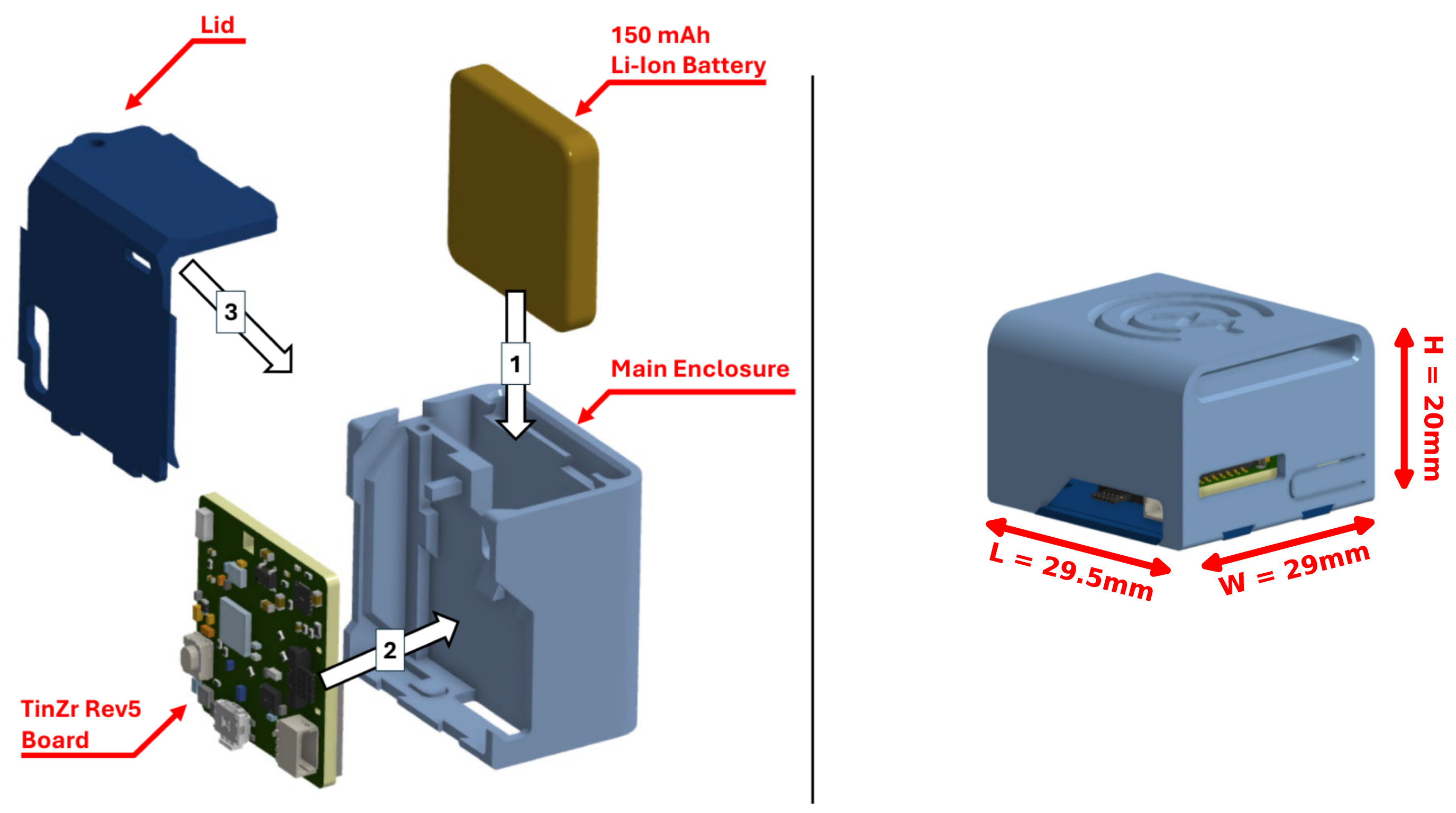
TinZr (pronounced TIN-zer) is a square microcontroller measuring just 0.98 inches in width and length. It uses an open-source operating system and software, and despite being about the size of a quarter, TinZr supports an inertial measurement unit for tracking motion and orientation; a microSD card reader; and a battery management circuit, and is enabled for wireless data acquisition using WiFi and Bluetooth. TinZr also supports communication interfaces — analog, digital and serial — through general purpose signal pins, according to researchers who developed the microcontroller. They described the device in a study published online Sept. 5 in the journal HardwareX.
Small size combined with functionality make TinZr stand out among other microcontrollers for wearable devices and sensing applications, says lead study author Ludvik Alkhoury '18. Alkhoury earned a Ph.D. in electrical engineering at NJIT and is now a postdoctoral associate in the Brain and Health Imaging Institute at Weill Cornell Medicine in New York City.
"You couldn't find anything on the market that has the same size, same form factor, and also has all the functionalities that we wanted," Alkhoury says.
Seeds for TinZr were planted while Alkhoury was pursuing his doctoral degree at NJIT under the guidance of the study's senior author Moshe Kam, NJIT interim provost and executive vice president of academic affairs (at the time, Kam was the dean of the Newark College of Engineering). They were developing a type of oximeter — a wearable device for monitoring heart rate and oxygen saturation levels — for use under the acceleration and G-force pressures experienced by pilots in the U.S. Navy.
"In the course of doing that, we learned a lot about the process of collecting this kind of physiological data," Kam says.
"It's an acquisition system"
The toll these extreme forces take on the human body is considerable, and can cause pilots to lose consciousness without warning. Small, wearable devices that monitor blood pressure, heart rate and respiration can be lifesaving in situations where a pilot is unaware that they are in trouble.
"At the time, we already had some restrictions regarding the form factor, the size and the shape," Kam explains. Adapting to these limitations motivated the researchers to see if they could come up with a design that was even smaller, and less expensive to build; TinZr was the result. And with a battery, wireless communication options and the ability to store data on a solid-state card, TinZr is well-suited for collecting quantities of data over time.
"Think of it as a brain," Alkhoury says. "It's an acquisition system. You can attach auxiliary sensors to it, and it will read from the outside world."
Other potential uses for TinZr quickly arose, such as monitoring brain signals in monkeys, measuring movement in construction workers to track the consequences of high-impact work, and regulating the motion of drones as they fly in formation.
"This is a pretty universal machine. It is not bound to any particular application," Kam says. "Researchers in the place where we work, at NJIT, were able to use it in very different settings."
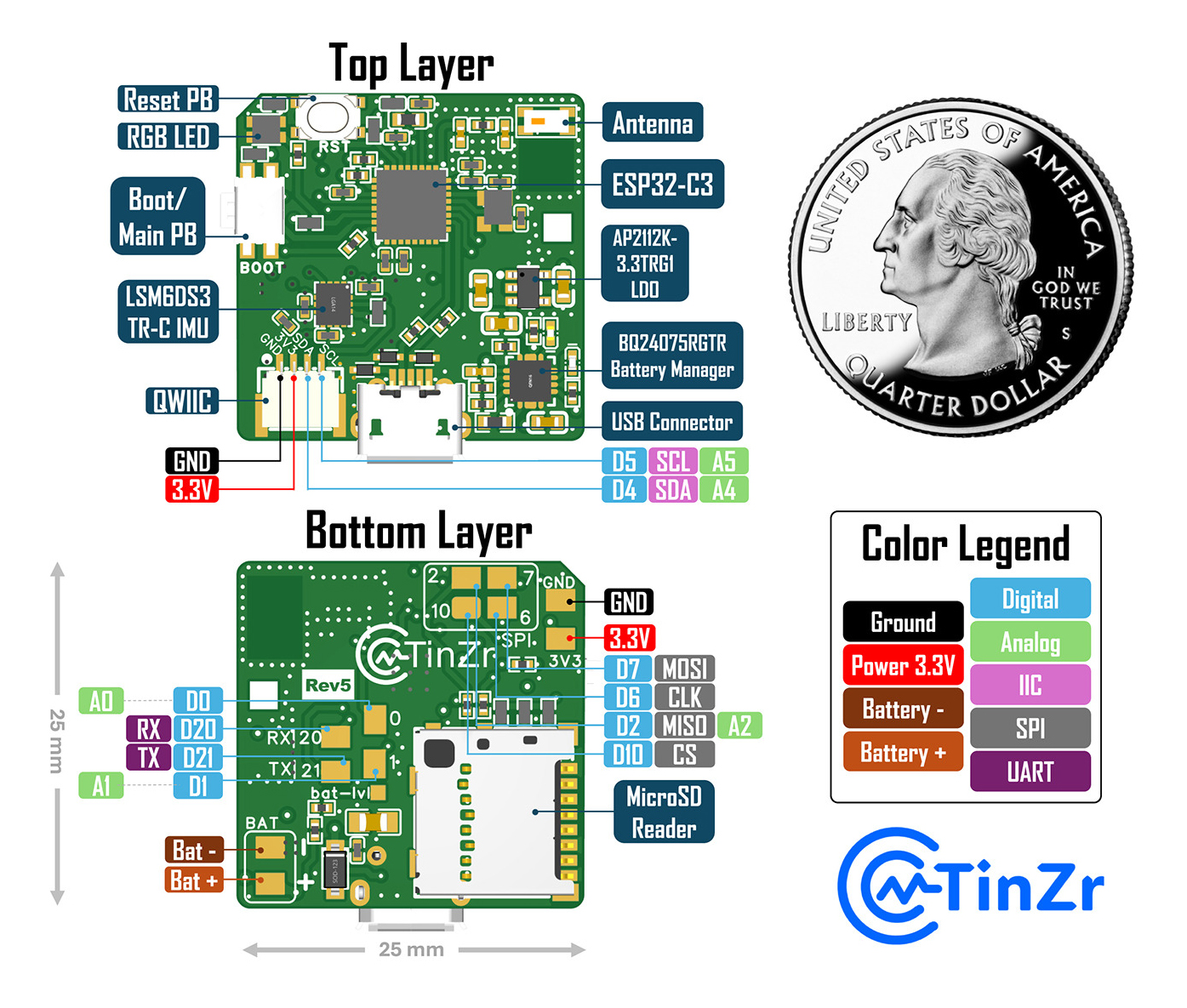
TinZr uses an Arduino library that is available to download on the developer platform GitHub, and all production materials — including printed circuit board design files, 3D-printable enclosure models and component lists — are available on the research data repository Zenodo. The total estimated cost of the hardware for one TinZr microcontroller, including shipping and customs fees, is $65.
Releasing the software and hardware as open source means that TinZr is highly adaptable to users' needs — even if the microcontroller's creators don't yet know what those needs may be, Alkhoury says.
"If someone is in a different field, a field that we never even thought about, and they don't necessarily love the entire design, they can modify every and any single aspect of it, which is a very nice feature," he says. "I really encourage people to use it and just explore it."
While the researchers have anticipated a number of applications for TinZr, they are hoping that those who try the device will identify even more, Kam adds.
"We are really eager to see what kind of users this will find," he says, "and it will be interesting to see what they do."
