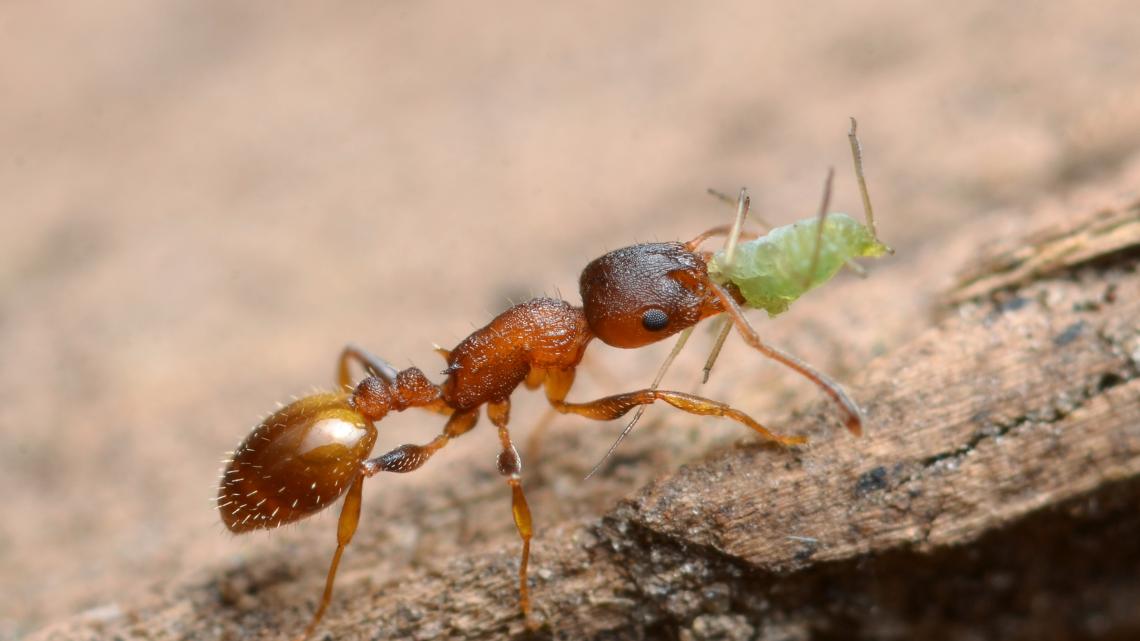
In ant colonies, a single ant can be the catalyst for a wave of mob activity, launching brief bursts of coordinated movement involving hundreds or even thousands of swarming workers, according to new simulations from New Jersey Institute of Technology.
About three decades ago, biologists discovered that acorn ants in the species Leptothorax acervorum, Temnothorax allardycei, T. rugatulus, and T. rudis would periodically move together as one. Masses of insects in the colony suddenly surged into action and then subsided, seemingly at random intervals. Collective spikes of activity aren't exclusive to ants or other animals; schooling fish, fireflies' signals, chemical reactions and firing neurons do this, too. But not all complex systems — or even all types of ants — produce short bursts of synchronized motion.
To better understand what launches and shapes patterns of collective movement and rest, researchers built a mathematical model inspired by waves of ant activity. Their findings, published August 5 in the journal PRX Life, show how just one ant in a colony — a "first mover" — activates a group. Moving from ant to ant, motion then ripples through the colony, activating a significant portion of the colony before the wave eventually runs its course.
"In many collective systems, such cascades typically appear only if enough individuals are already active themselves — a quorum of sorts," said study co-author Simon Garnier, an NJIT professor of biological sciences. "The most surprising result is that a single ant is able to trigger an entire cascade of activity." This work is part of an NSF grant for which Garnier is the lead principal investigator, exploring activity management and energy use in group systems made of autonomous individuals.
Garnier and two co-authors at New York University's Tandon School of Engineering — doctoral student Michael Napoli and Maurizio Porfiri, a professor and director of the Center for Urban Science + Progress — created a model that represented each ant as it moved independently through a virtual nest. Every ant could switch between three states: active, inactive, or temporarily unresponsive.
"These switches could occur spontaneously or be triggered by encounters with active nestmates," Garnier said.
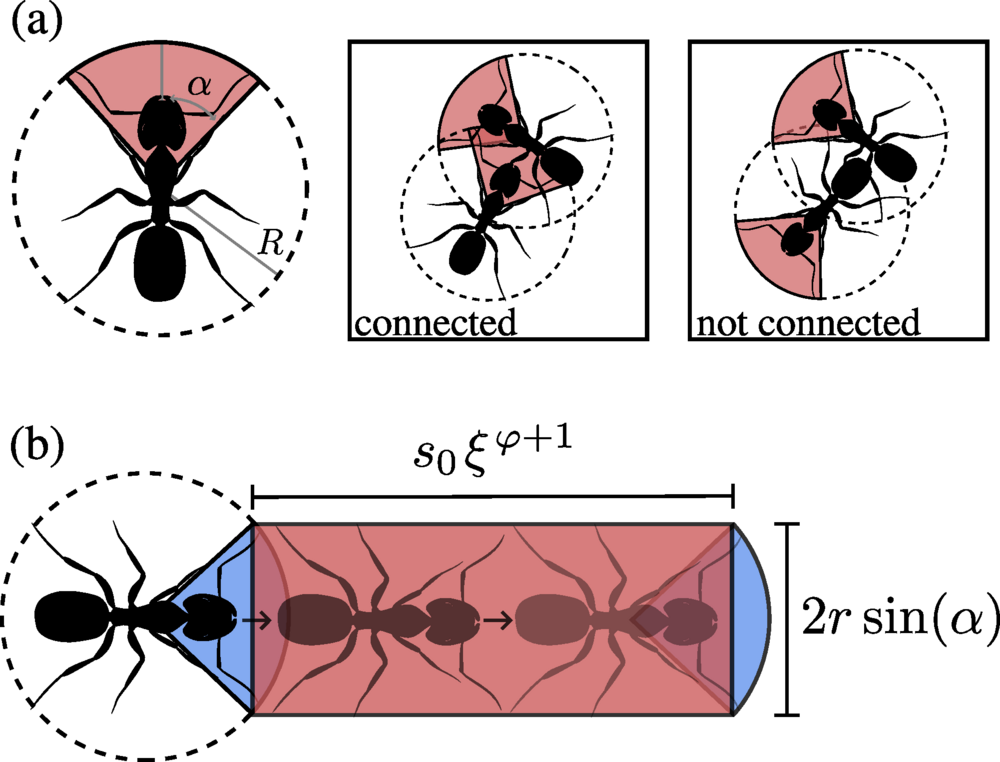
The researchers then varied movements and interactions between ants, to see when individual activity would not affect other ants, and when it would launch coordinated movement within the colony. Using data from prior research of actual ant colonies, the scientists weighed variables such as the density of ants, ant movement speed and sensing distance between nestmates.
According to the simulation, when ant density, speed and distance were just right, one ant's movement was all that was needed to nudge a large portion of the group into motion.
Synchronized activity bursts among ants reflect a delicate equilibrium, balancing the transmission of a single ant's actions with the colony's ability to "deactivate" the cascade, the researchers found. Allowing that deactivation creates a rest period before the next wave of movement, which is a key part of these activity patterns. As social insects, ants rely greatly on high-speed communication between individuals; cycles of movement bursts not only demonstrate how information spreads between nestmates rapidly, but also show the importance of quiet time between calls to action.
Swift mass mobilization may help colonies respond quickly to environmental changes or threats; however, there are potential drawbacks to a colony-wide response. If the ant that triggered the cascade misread the environmental cues at the start, the group could spend a lot of energy for nothing.
"Fortunately, we showed in earlier studies that ants have a regulation mechanism against that," Garnier explains. "Once too many individuals are active, they tend to inhibit each other and the colony goes back quickly towards a more quiescent state. The end result is that the colony is very reactive without being wasteful."
The findings could help explain complex dynamics within ant colonies, and may have implications outside the insect world. Engineers could apply lessons from rhythmic ant swarms to autonomous artificial agents that also need to react as a group to cyclical changes in their environment. One such example is fleets of autonomous taxis responding to spikes in customer requests for rides, Garnier says. Looking to ants for inspiration could improve communication, interaction and coordination in autonomous taxis, speeding up their response time "without wasting energy by mobilizing too many agents at once."
