
"I am an engineer."
In a sunlit atrium on the campus of New Jersey Institute of Technology, dozens of engineers stand and speak in unison. As they recite the opening words of an oath that has resonated in their profession for decades, they pledge their commitment to engineering standards, integrity, honesty and respect, and dedicate their knowledge and skill to serving the public good.
Some faces are solemn. Others are beaming as they pronounce the oath's closing sentence: "In the performance of duty and with deep fidelity to my profession, I shall give my utmost."
Each person is then called to a table at the front of the room, where an officiant presents them with a stainless steel ring, placing it on their hand through a larger steel ring mounted on its side.
Worn on the pinky finger of the working hand, the ring symbolizes induction into the Order of the Engineer, through a ceremony that originated in Canada in 1926 and was adopted in the U.S. in 1970. Those who join the order recite the oath and wear the ring in acceptance of their civic responsibilities as engineers. Membership is voluntary, and is open to individuals who have graduated from an accredited engineering program or are within two semesters of graduation.
"For an engineer, it is a unique identifying symbol," says William Pennock '13, an assistant professor of civil and environmental engineering and one of the ceremony's organizers at NJIT. "It is also a very nice thing to have a component of ethics in graduation," he adds.

Some compare the ceremony's oath, titled "Obligation of an Engineer," to the Hippocratic Oath taken by graduating medical students, which outlines an ethical code for the practice of medicine, says Pat Natale '70, '75, a member of the NJIT Foundation board of directors and of the Newark College of Engineering's (NCE) board of visitors. Natale emphasizes that the order is important because it promotes ethical practices alongside high professional standards.
"It's about doing the right thing in the right way," he says. "In the end, the engineer has an obligation to protect the health, safety and welfare of the public. That's in the code of ethics of ASCE, the American Society of Civil Engineers, the National Society of Professionals Engineers (NSPE) and virtually every engineering society."
Natale was a presenter at the ring ceremony for NJIT alumni on Oct. 17, held during Homecoming weekend, and since the 1980s he has been involved in other induction ceremonies through NSPE.
Because the ring is worn on the pinky finger of the working hand, it comes into contact with every design and document that an engineer touches. Each time that happens, "you remember that you're impacting public safety and public health," Natale explains. "It's a reminder: don't cut corners. You cut corners, people could get hurt."

Engineering students can receive a ring prior to their graduation, at an Order of the Engineer ceremony held in the spring semester. Alumni who graduated without joining the order — from 1994 to 2025, NJIT did not hold the ceremony — are still eligible. Robert Okojie '91, '93, '96, a research electronics engineer at NASA, was one among dozens of alumni to receive a ring at the October ceremony (Okojie was also honored that weekend as a winner of the 2026 Alumni Achievement Award). Accepting the ring marked a new milestone in his professional journey, he says.
"Having that ring, in many ways, solidifies my recognition as an engineer," Okojie explains. "It's a special feeling, a feeling of belonging, a feeling of being special in a profession that requires intensive concentration and the commitment to professionalism, building things that don't fail and building things that humanity and the general public will appreciate using."

Chemical engineer Marie Aloia '85 had recently retired, but that didn't stop her from taking the oath and receiving her ring.
"I always wanted it," Aloia says. For the past two decades, Aloia has taught high school engineering, and she hopes to use her new ring as a teaching tool in her ongoing volunteer work in STEM education.
"I love engineering," she says. Participating in the ceremony "is a pledge to always use your smarts for good."
And for Dielanda Dumay '95, '03, '08, an adjunct instructor at NJIT in mechanical and industrial engineering, the ring and ceremony reinforce the idea that engineers should always take pride in their work.
"It's a commitment," Dumay says. "As a citizen, there is a desire to do things according to certain standards, and to be able to improve more lives. To me, that's what this represents: I'm going to give you the best of what I can do."
History of the Order
The Order of the Engineer traces its roots to an engineering tragedy that unfolded in Canada on August 29, 1907: the Quebec Bridge Disaster. A cantilever bridge spanning the St. Lawrence River collapsed while under construction, killing 75 workers, and an official inquiry found that the bridge's top engineers made serious calculation errors and displayed poor judgement in allowing work to continue despite warning signs that the bridge was in trouble. By trying to complete the bridge faster and more cheaply, they jeopardized construction and put workers in danger, causing dozens of deaths.
The disaster so disturbed engineer Herbert E.T. Haultain, a professor at the University of Toronto, that in 1922 he proposed that graduating engineers undergo a formal ceremony and affirm that they will perform their chosen profession ethically and with attention to public safety. Haultain approached British novelist and poet Rudyard Kipling to write the text for the ceremony, in part because Kipling had already written about engineers' duties in a poem "The Sons of Martha," published the year that the Quebec bridge collapsed.
"It is their care in all the ages to take the buffet and cushion the shock. / It is their care that the gear engages; it is their care that the switches lock," he wrote.
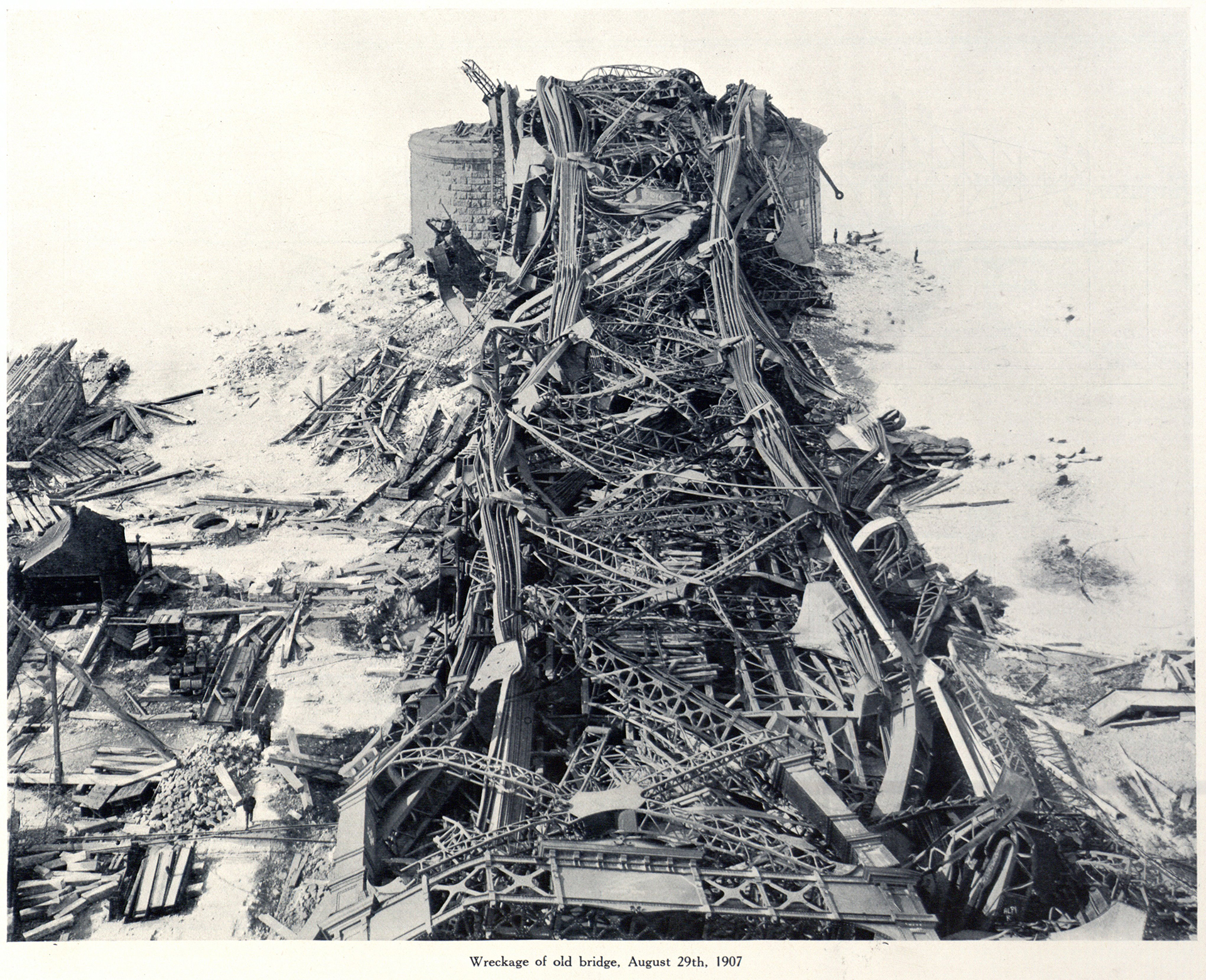
Kipling's text for the new engineering pledge was adapted in consultation with past presidents of the Engineering Institute of Canada, and engineers recited for the first time in 1925 in ceremonies held in Montreal and Toronto. Those performing the ritual — titled "The Calling of an Engineer" — received an iron ring, as did participants in the years that followed, and rumors arose that the rings were forged from the wreckage of the Quebec bridge. While that notion is poetic, it is also false, as the bridge was made of steel, Kip Wedel, an American history professor at Bethel College in Kansas, wrote in his book about the order, "The Obligation."
Canadian officials copyrighted their ceremony and declined to expand the organization to include the United States, so American engineers began developing their own version of a ceremony and pledge. On June 4, 1970, the Order of the Engineer debuted in the ballroom of the Cleveland Engineering Society on the campus of Cleveland State University, attended by 170 engineering seniors, faculty and working engineers. They received stainless steel rings, which remain the standard for rings issued in the U.S. ceremony; the committee that developed the U.S. ritual selected steel "as a symbol of the strength, and fullness of the profession," they wrote in a 1970 memo.
Today, the American order includes over 100,000 members. While the collapse of the Quebec Bridge is now a distant memory, other engineering tragedies — the explosion of the Space Shuttle Challenger in 1983, for example — are invoked at the ceremony as a sobering reminder of the responsibilities that engineers continue to bear.
"I believe most engineers by training are ethical, professional and do the right thing," Natale says. "I think we all need to be reminded of that when the boss says to get it done quicker. Sometimes you have to say no."
The Order at NJIT
The first Order of the Engineer ceremony at NJIT took place on May 25, 1978, but the practice halted in 1994. Pennock spearheaded its return in 2025, in part because he wanted students to experience what he had missed. Prior to his own graduation in 2013, he recalls, his engineer father asked him where his ring was. "What ring?" Pennock responded. He had never heard of the order or its ceremony.
"I graduated feeling sad that I didn't have this opportunity," he says. He eventually received a ring during his graduate studies at Cornell University, and when he joined NJIT's faculty, he was determined to bring the order back. Moshe Kam, now NJIT's interim provost and executive vice president of academic affairs, was the NCE's dean at the time, and Kam supported the idea "from the beginning," Pennock says.
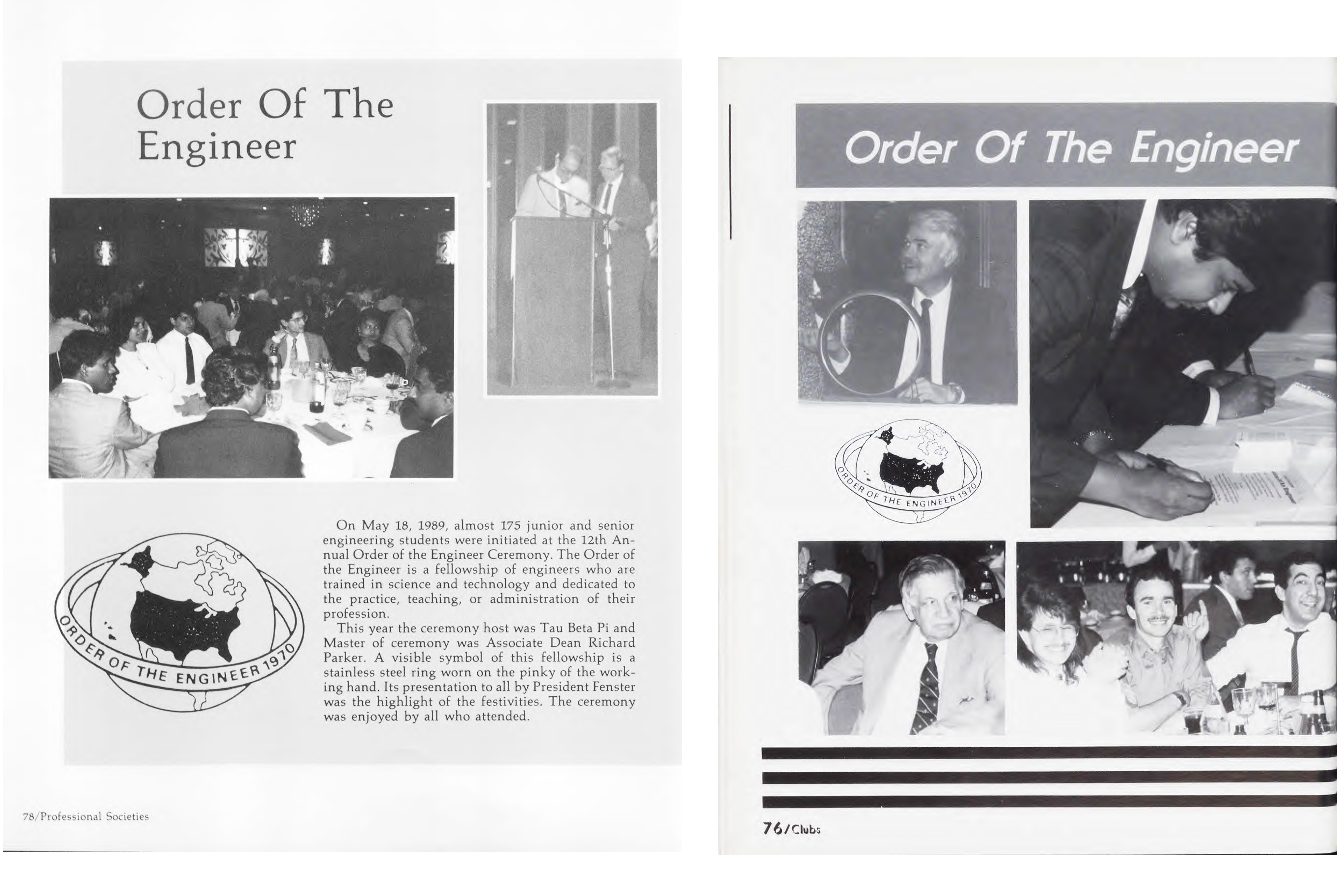
Staff in the NCE dean's office also provided support, Pennock recalls. Lucie Tchouassi, associate dean for academics; Angela Vega-Irvin, director of administration; infrastructure coordinator Carolina Yanez; and business manager Priscilla Milne, were all instrumental in reconnecting NJIT to the order and assembling resources to relaunch the university's chapter.
Jerry D'Alessio '93, '95, '16 got his ring when he received a bachelor's degree in mechanical engineering. A senior director of applied biomechanics at Stryker, a medical equipment manufacturing company, D'Alessio is also the chair of NJIT's board of visitors. He participated in the Order of the Engineer ceremonies in 2025 and 2026, and the 2025 event was especially meaningful to him.
"I was excited to bring the ceremony back," D'Alessio says. "But I was more excited because my son was graduating that year and he was going to be inducted."
In 2025, 75 students participated in the induction ceremony. By 2026 that number had nearly doubled, and interest from students, alumni and faculty continues to grow.
"Since I put my ring on, I haven't taken it off," says Tchouassi. She received her ring in 2025 and is one of the ceremony's organizers.
"You can always see it," she says. "It's something that you wear with pride."
If you know, you know
Though all who wear the ring are engineers, the rings can mean different things to different individuals. OluwaTobi Awoleye '26 graduated with a B.S. in civil engineering, and he views his ring as a reminder of the time and effort he invested in his education.
"This ring is also an achievement, in a sense, because I went through five years of engineering school and I'm receiving a ring for all my hard work," Awoleye says.
Riya Karande '26, an electrical engineering major, says that her ring symbolizes her acceptance of accountability in her professional life.
"You want to create products or help the world in a positive manner," she says. "Having that ring on your working hand is a memento or a reminder of the ethics behind what you do."
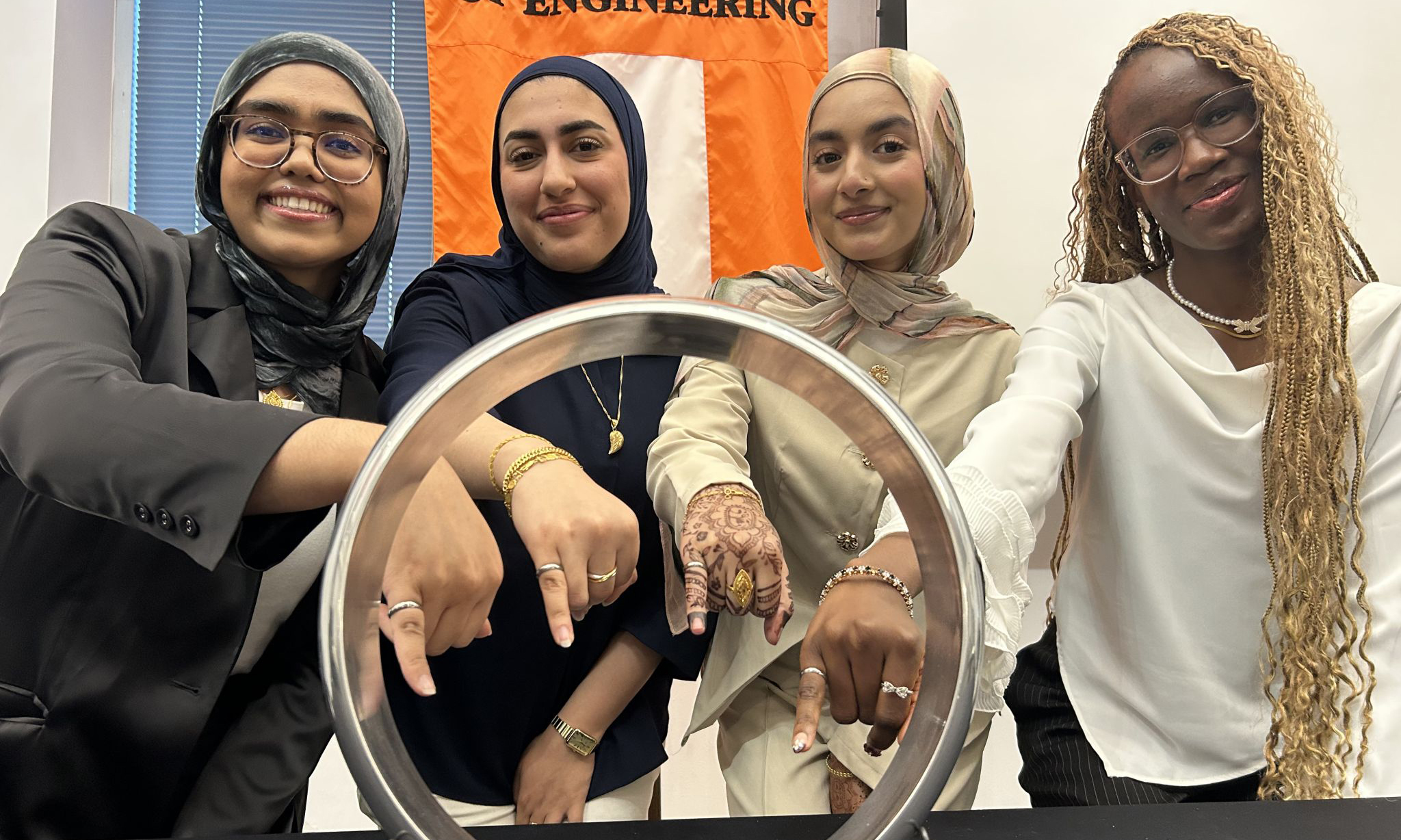
For Emmanuel Akinyele '24, an industrial engineer, the ring reassures him that he can meet future challenges.
"Even when at times I doubt myself, I have something to remind me that I have this responsibility, and I can keep going," he says.
Mechanical engineer Patryk Adamczyk '26 wears his ring because "engineering is more than just making decisions and getting stuff done," he says. "Following a moral code is more important than any job that you will have."
Among engineers, spotting someone with the telltale pinky ring sparks a connection, acknowledging that they share similar professional values.
"This is something that other engineers would recognize," says chemical engineer Kyrsten Taylor '26. "If you know, you know."
At NJIT and beyond, the community of engineers in the order will only expand as future graduates and alumni accept the ring and all it represents, and come together to speak the pledge's opening words: "I am an engineer."
"Continuing to reinforce the reason and ethics in our profession is the major impetus for this event, and one of the things I'm proud to participate in," says D'Alessio. "Hopefully it'll get bigger and bigger until the entire graduating class does this, not just a select few."
