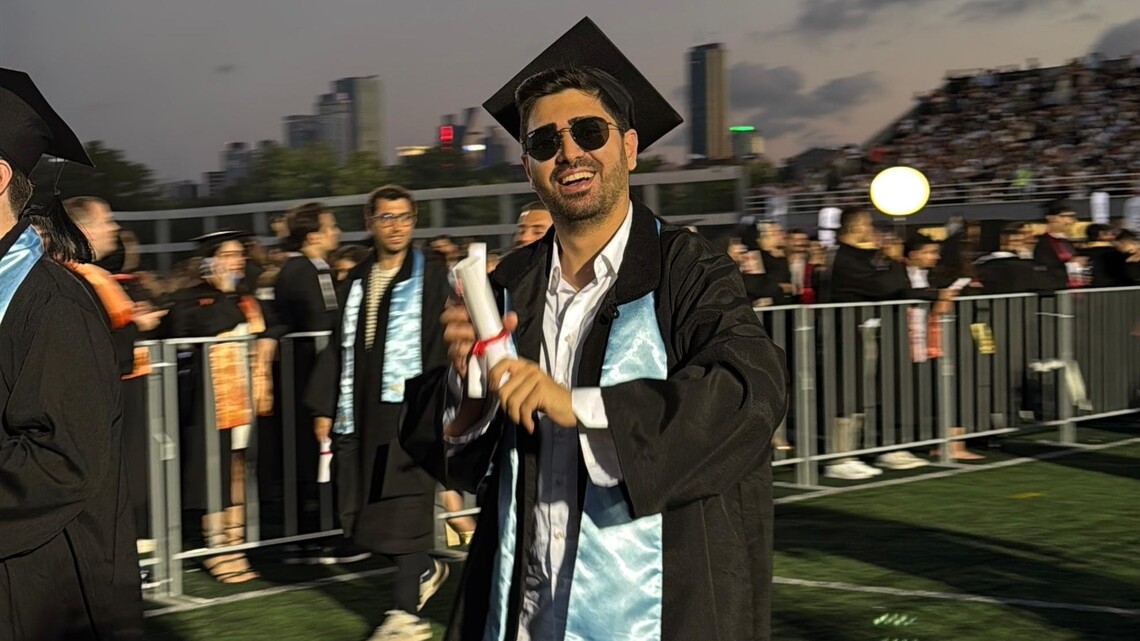
Omer is a Ph.D. student in the Helen and John C. Hartmann Department of Electrical and Computer Engineering at the New Jersey Institute of Technology (NJIT). He earned his B.S. in Electrical Engineering through the ITU-NJIT Dual Degree Program and began his doctoral studies in Fall 2025.
His research focuses on computer vision and multi-target tracking for human sperm analysis. Specifically, he works on methods to detect individual sperm cells in microscopic video recordings and track their movement across consecutive frames to enable accurate motility measurements. Since sperm motility is a key indicator of semen quality, improved tracking methods can contribute to more reliable semen analysis. Omer is also a co-author of a research paper introducing the Human Sperm Microscopy Videos (HSMV) dataset, led by his colleague Atilla Sivri, for which he contributed to frame-by-frame sperm cell annotation. The paper is currently under revision. Alongside his research, he serves as a teaching assistant for undergraduate courses.
What would you say could be the next big thing in your area of research?
I believe the next major advancement in my field will be the development of reliable tracking methods rather than focusing solely on detection. Although deep learning has significantly improved the accuracy of identifying sperm cells in individual frames, consistently tracking each cell over time remains a challenge. In crowded samples, sperm cells frequently cross paths, collide, and move in and out of focus, making it difficult for tracking algorithms to maintain accurate identities.
Since motility measurements depend heavily on the accuracy of these tracks, improving tracking reliability will be essential to advancing automated sperm analysis. I also believe large, carefully annotated datasets will play an important role by allowing researchers to evaluate and compare methods using consistent data. Our HSMV dataset is a step in that direction.
You first joined NJIT as an ITU-NJIT Dual Degree undergraduate student. How did you find NJIT's undergraduate training different from that of ITU?
One of the biggest differences I noticed between the two institutions was their grading systems. At ITU, grades were primarily based on midterm and final examinations, and most courses had little to no homework. As a result, final exams carried significant weight, leaving students with limited opportunities to recover from a poor exam result. At NJIT, coursework typically involved a more balanced combination of homework assignments, projects, quizzes, and examinations. This approach provided me with multiple opportunities to demonstrate my understanding and maintain my academic performance throughout the semester.
Since you started your Ph.D. studies at NJIT, how have you found life as a Ph.D. student different from your undergraduate experience at NJIT?
My undergraduate experience at NJIT was primarily focused on coursework, without the additional responsibilities of teaching or research. I also had a close group of friends to study with, and we helped each other through our assignments and coursework. As a Ph.D. student, my experience has become much more independent. Many of my former classmates have graduated and moved into industry, so I now have to navigate more of my academic and professional responsibilities on my own. Balancing teaching assistant duties, research, and my own coursework has presented new challenges and requires greater independence, time management, and adaptability.
