Jordan Hu Returns to NJIT for Fireside Chat on Leadership, Opportunity and Giving Back
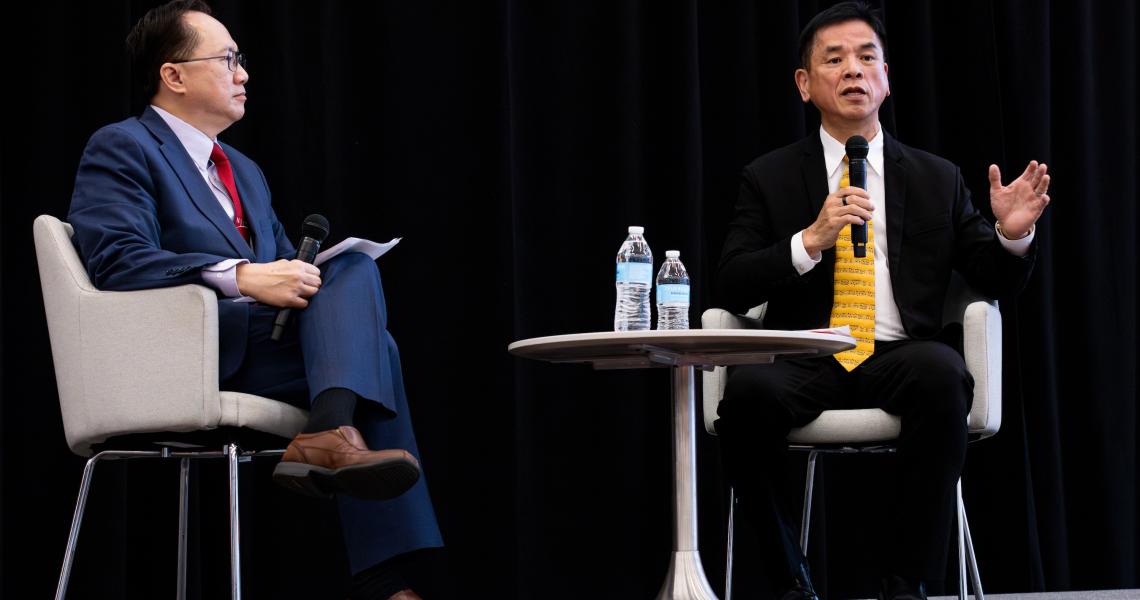
Jordan Hu ’89 returned to NJIT for a fireside chat that moved beyond career success to examine the harder realities behind entrepreneurship, the value of trust in leadership and the university experience he said made his American dream possible.
Hosted by NJIT’s AAPI Employee Resource Group and Office of Inclusive Excellence, “Leadership & Legacy: Navigating Corporate America as an Asian Professional” brought Hu — founder and CEO of RiskVal Financial Solutions and benefactor of the Jordan Hu College of Science and Liberal Arts — into conversation with NJIT President Teik C. Lim. The event also reflected NJIT’s broader recognition of its identity and support for Asian American, Native American and Pacific Islander communities on campus.
“Diversity is the strength that we have,” Lim said in his welcoming remarks introducing Hu. “The more diverse thoughts that come into the room, the better the solution is.” He then turned to Hu’s path from NJIT graduate student to entrepreneur, describing him as someone who had been given an extraordinary opportunity and made full use of it.
Entrepreneurship is not for the faint of heart
“Entrepreneurship is a dream for a lot of people, but it can also be a nightmare,” he said, describing the startup phase of RiskVal as an almost-10 year torment. He spoke candidly about the strain of building a company while raising a family and about the emotional and financial pressure that comes when a founder is still trying to reach stability. The challenge, he said, is not only whether someone wants to pursue a dream, but whether the idea can survive long enough to prove its value in the market.
That realism shaped much of Hu’s advice to students and early-career professionals. Asked what skills will matter most over the next five to 10 years, he pointed to technology and, specifically, artificial intelligence. Even without understanding every implementation detail, he said, people need to become comfortable using AI rather than resisting it. “The more you embrace it, the more you find value,” Hu said.
Still, he argued, no technical tool can replace the core skill that matters most. “The most important skill that we humans can have is a problem solving skill,” he said. But it was trust that underlined his success and his advice.
You can never be successful by yourself.
“You always have somebody that has to walk with you.” He urged the audience to build the kind of character that makes others want to seek help, partnership or advice from them. “That trust is invaluable, priceless,” he said.
Asked about undervalued skills, Hu pointed not to a technical specialty but to preparation. He said he trains his team to be ready with a two-minute elevator speech at any moment, arguing that important opportunities often arrive unexpectedly and vanish just as quickly. Entrepreneurship, he added, cannot be approached as a nine-to-five role. It requires a different lifestyle, one in which problems are revisited constantly until a workable answer emerges.
The discussion also returned to the challenge of being heard in rooms where one’s background may not be the norm. Lim asked how Asian professionals — or anyone who finds themselves as the only representative of a demographic in the room — can make sure their perspectives are understood. Hu responded by stressing clarity, organization and preparation. People may arrive with assumptions, he suggested, but the best answer is to speak to the facts, organize ideas well and make sure others understand you.
Hu and his NJIT legacy
In one of the event’s more personal moments, Hu explained why his relationship with NJIT remains so important to him. He recalled coming to the United States as a newly married student after his mother borrowed money to make graduate school possible. After comparing schools, he concluded NJIT was the most financially realistic option. A scholarship, he said, made an enormous difference — so much so that it allowed his wife to join him in the United States just two months later. “This is my American dream,” Hu said.
Hu described NJIT as the place where he found the education, support and opportunity that helped shape both his Wall Street career and his later philanthropy. In an earlier profile, Hu said, “My American dream started with NJIT,” and the university noted that his historic gift would support scholarships, academic development and research across the college that now bears his name.
The NJIT of today has undergone a huge transformation from when Hu graduated, he noted. That change did not happen on its own. Seeing the cumulative work of faculty, staff and leadership deepened his sense of duty to support NJIT with not only treasure, but time and talent as well. To that end, Hu continues to mentor students, faculty and staff and maintains an office near the college’s dean, Kevin Belfield.
By the end of the afternoon, Hu’s message had settled on a simple but demanding idea: success is never solitary. Titles, products and accomplishments matter, but leadership ultimately depends on whether people trust you enough to keep following. “You cannot be successful yourself,” Hu said in his closing advice. “The most important thing is the people around you.” A true leader, he said, builds a trustworthy kind of leadership — one rooted not in shortcuts or self-promotion, but in honesty, credibility and the ability to bring others along.