The Whole System: How an NJIT Engineer Built a Career on Seeing Every Part of the Picture

When Chris Wunderlich was finishing his final semester at New Jersey Institute of Technology, he had two job offers sitting in front of him. One was from Picatinny Arsenal, the U.S. Army's premier research and manufacturing hub for weapons systems, where he would have gone deep into warhead design. The other was from DeSisti, an Italian lighting and rigging company headquartered on Route 22 in North Jersey. He took the job with the Italians.
"I could not think of two things that were more diametrically opposed," Wunderlich said, laughing at the memory. But the choice — theatrical rigging over weapons systems, breadth over depth — turned out to be the first conscious step in a career philosophy that has defined everything since.
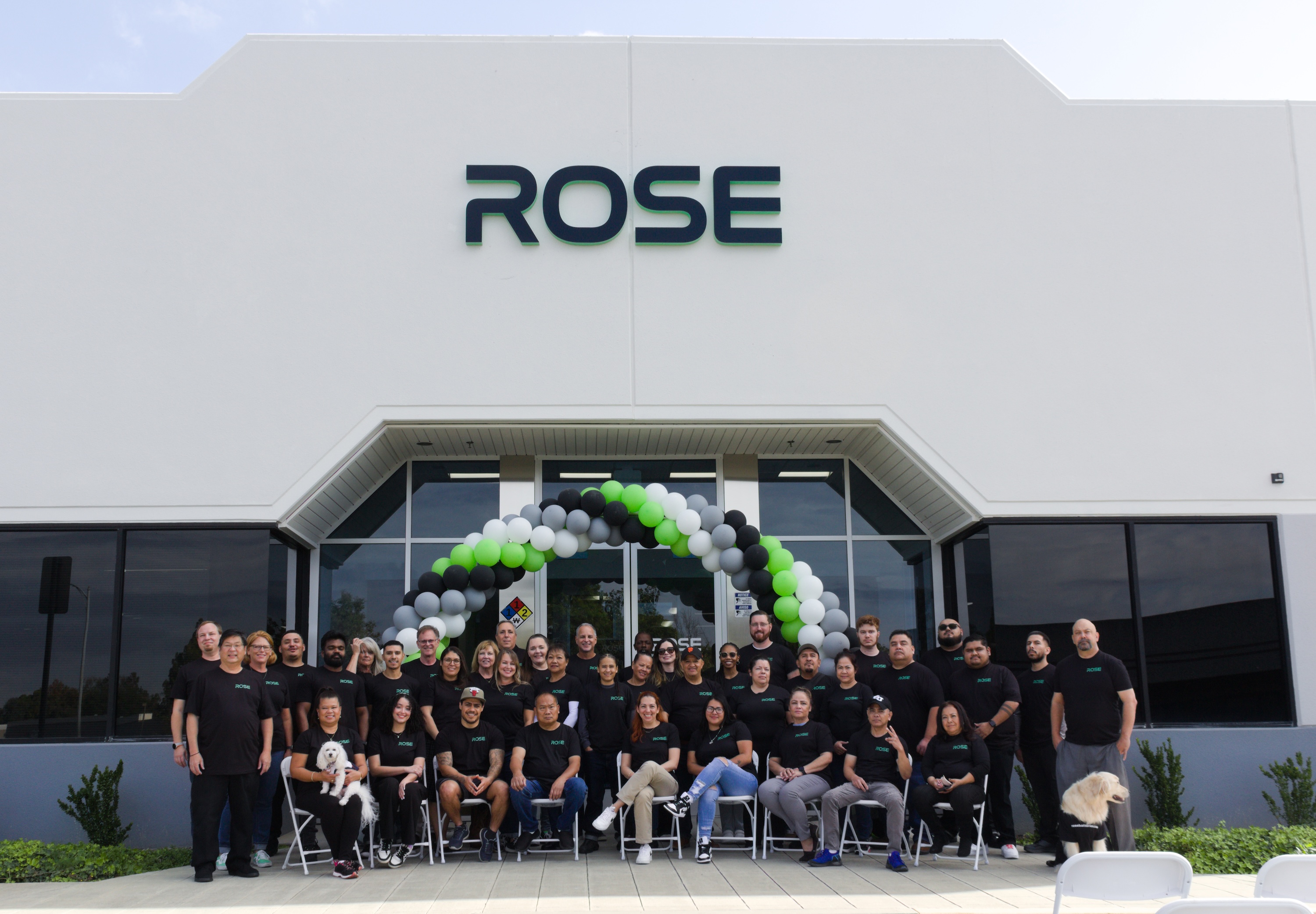
Today, Wunderlich is the Chief Executive Officer of Rose Batteries, a San Jose–based engineering and manufacturing company that designs custom battery packs, chargers and power supplies for some of the world's most demanding applications — military systems, medical devices, autonomous vehicles and oceanographic instruments, among them. The company’s work increasingly sits at the convergence of evolving battery technologies and real-world constraints, where performance depends as much on how systems are engineered and deployed as on the underlying chemistry.
The company has shipped more than six million batteries, serves over 500 customers, and has maintained ISO 9001 certification for more than 25 years. He became CEO in 2024, capping a rapid ascent through the company's leadership ranks since joining in 2021.
A Family Tradition
Wunderlich grew up in a household where technology wasn't a novelty — it was furniture. His mother earned a computer science degree in the early 1980s, when that was uncommon for anyone, let alone a woman. His father worked in materials engineering. There was always a computer in the house, from early Atari systems onward.
"STEM was always kind of in my face," he said. "My parents made a point to make sure we realized that technology is a tool you can use to solve all kinds of problems, and what you do with it is wherever you take it."
By the time he was choosing a university, the pull of engineering — its problem-solving scope, its direct connection to how things are made and how systems behave — pointed him toward NJIT. He enrolled in the Newark College of Engineering, graduating in 2006 with a degree in mechanical engineering and as a member of the Albert Dorman Honors College, the university's flagship academic honors program.
Ask Wunderlich about NJIT, and one name comes up immediately: Herli Surjanhata, who taught 3D design and CAD. The class covered parametric modeling in Pro/ENGINEER and CATIA — tools that allowed students to simulate tolerance stacks, thermal expansion, and structural analysis before a single physical part was made.
"I could trace a lifelong love of CAD back to that class," Wunderlich said. "And the thinking it instilled — that better is more important than perfect, that you can iterate, that you just hit print and do it again — has helped me be a lot less stressed throughout my entire career."
That iterative mindset extends well beyond CAD. It has become, for Wunderlich, a framework for how organizations should operate: get something better into motion, learn from it, adjust. Waiting for perfection, he has found, is its own form of failure.
If you have no foundation to build from, you're going to build a bridge to nowhere.
That same discipline — learn the fundamentals before you trust the simulation — threads through the battery industry work he does today, where new chemistries are producing genuine breakthroughs alongside a fair amount of noise. "I need to know where inside these bounds reality can be found," he said of evaluating vendor claims. His engineering education, he argues, gave him the lens to tell the difference.
Everything Is Part of a System
Wunderlich is the kind of leader who makes his way to the shop floor, a philosophy built from experience. Early in his career, at Clark Cooper, a solenoid valve manufacturer, he worked alongside machinists with 40 years experience on manual mills and lathes. Some had never finished high school. All of them could conceive of solutions that no engineering textbook described.
"Getting your hands really dirty makes a huge difference in how successful you'll be as an engineer," he said. "Just being the engineer and saying 'I said do this' is not going to win friends and influence people."
This bottom-up credibility has followed him into the executive suite. It informs how he reads a company's operations, how he earns trust from technical teams, and how he diagnoses problems that might look like one thing on a P&L but trace back to something entirely different on the production floor. Everything, in his view, is part of a system. The pieces have to fit together — and you cannot manage what you have never understood.
The same systems lens applies to the subjects he found most challenging at NJIT. Electrical engineering never came naturally to him. He struggled to be inspired by the coursework. Much later, someone offered a reframe: think of electricity as water. A resistor is a nozzle. A capacitor is a tank. Wire gauge is pipe diameter. "I wish somebody had explained it to me like that when I was taking the class," he said.
Getting your hands dirty makes a huge difference...
Back then, EE wasn’t his game and he wasn’t sure exactly how he’d use it. Now, as CEO of a battery company, electrical engineering is among the most critical disciplines in his building. "All of the stuff I really disliked has become more and more important the farther I've gone in my career," he said.
The lesson he draws from that is one he'd offer to any student at NJIT today: take it all in, even the parts that seem irrelevant. You don't have to love every subject. You just have to understand that every piece of the system is there for a reason.
Learning How to Learn
When Wunderlich reflects on what NJIT gave him, the diploma is almost beside the point. "The first thing is the piece of paper," he said. "But the second thing I really learned in college is how to learn how to learn."
In an era saturated with information — and increasingly with AI-generated content of variable accuracy — that skill has become more valuable, not less. The ability to evaluate sources, identify what's credible, and know enough about a domain to recognize when something doesn't add up is, he argues, the real product of an engineering education. "What is reality? How do you tell the difference between the stuff that is nonsense and the stuff that's actually helpful?" he asked. "It's hard to do that without some kind of foundation."
That foundation — built in Newark, deepened across two decades of manufacturing floors, boardrooms and international supply chains — is still very much in use. Rose Batteries is navigating a pivotal moment in its industry. Rose Batteries is operating within battery technology’s most active fronts: engineering packs for harsh temperature swings, developing custom systems for critical-care medical devices and tracking emerging chemistries such as sodium-ion and silicon lithium as they move closer to practical use. The picture is of a company serving demanding applications while keeping close watch on where battery science is headed next.
Wunderlich is thinking in systems, as always, watching carefully for what's real and what's noise.