Engineers Center Sustainability at NJIT, Launch New Seminar Series
Environmental and natural disasters challenge engineers to think about designs that not only withstand damage, but also protect the environment and communities. To that end, a new seminar series at the New Jersey Institute of Technology encourages students to consider sustainability-based solutions for civil infrastructure and environmental systems.
This effort is based on a framework developed by Engineering for One Planet (EOP), and was implemented through a seed grant provided by EOP's mini-grant program, an initiative run in collaboration with the American Society for Engineering Education. Ashish Borgaonkar, an assistant professor in NJIT's School of Applied Engineering and Technology and one of the organizers of the seminar series, led the effort to acquire the grant. Other team members include Lucie Tchouassi, Associate Dean for Academic Affairs at the Newark College of Engineering (NCE), and Roni Barak Ventura, an assistant professor in the School of Applied Engineering and Technology.
The seminars are part of a multi-pronged approach at NJIT "for integrating sustainability throughout the engineering curriculum and programs," said Borgaonkar. NJIT also recently introduced sustainability modules into courses teaching fundamentals of engineering design, and has launched a sustainability-focused minor in the Civil and Environmental Engineering Department.
The first sustainability seminar took place February 26 during National Engineers' Week (February 22–28), when a powerful storm highlighted just how effectively a single extreme weather event could disrupt cities' normal functions. A blizzard on February 22–23 deposited nearly 30 inches of snow in many parts of New Jersey — including the Newark area — causing NJIT to modify operating status, holding some classes virtually and rescheduling several of the week's events.
We understand the importance of sustainability
With the timing, frequency and strength of recent storms breaking historical patterns, it's more important than ever for engineering students to learn about sustainability options and how to put them into practice, Borgaonkar told the seminar audience. And though sustainability has historically been absent from many engineering programs, that perspective is rapidly changing, says NCE dean Moshe Kam.
"Increasingly, we understand the importance of sustainability and the need to school future engineers in doing it and maintaining it," Kam says. Sustainability can be a complex topic because it touches upon economic and legal issues as well as engineering challenges, he explained.
"What we hope to do in this sequence of lectures, which mostly is geared towards first-year and second-year students, is to introduce them to the concept of sustainability, to make sure that it becomes part of the horizon of things that they are looking for, and to prepare them for more formal and more structured set of classes in the laboratories that will deal with the issue."
From pollution cleanup to policy shaping
At the inaugural seminar, Kam introduced speaker Michel Boufadel, a Distinguished Professor in the Department of Civil and Environmental Engineering. Boufadel is also director of NJIT's Center for Natural Resources (CNR), which conducts studies about reversing the effects of pollution; evaluates natural resources for energy production; and assesses and mitigates major hazards.
Boufadel conducted scientific assessments for two major environmental disasters with far-reaching impacts: 1989's Exxon Valdez oil spill in Alaska's Prince William Sound, which spilled 10 million gallons of oil, and 2010's Deepwater Horizon accident in the Gulf of Mexico (renamed "Gulf of America" in 2025 in an executive order signed by President Donald Trump), leading to the biggest oil spill of all time — 130 million gallons. Both incidents caused ecological damage that persists to this day.
Boufadel also investigated the aftermath of 2012's Hurricane Sandy, the largest Atlantic hurricane on record, to understand how powerful hurricanes can introduce hazardous compounds into environments, and how those compounds degrade over time.
The idea is to work with communities
In his talk, Boufadel described how he and other scientists analyze sites affected by oil spills to understand why oil lingers in ecosystems, and gauge the effectiveness of oil-eating bacteria and other methods for biodegrading oil as potential solutions. At CNR, researchers are partnering with the City of Newark and the New Jersey Department of Environmental Protection to assess how trees help communities by cooling air, producing oxygen and absorbing excess rainfall. In another CNR project with the New Jersey Office of Emergency Management, researchers evaluate what makes cities vulnerable to flooding.
"The idea is to work with communities to help them prepare for floods, come up with infrastructure solutions and then work with them on emergency assistance and emergency planning," Boufadel said.
By increasing engineers' involvement in sustainability practices, engineers will be better-positioned to help shape the policies that improve sustainability, he added.
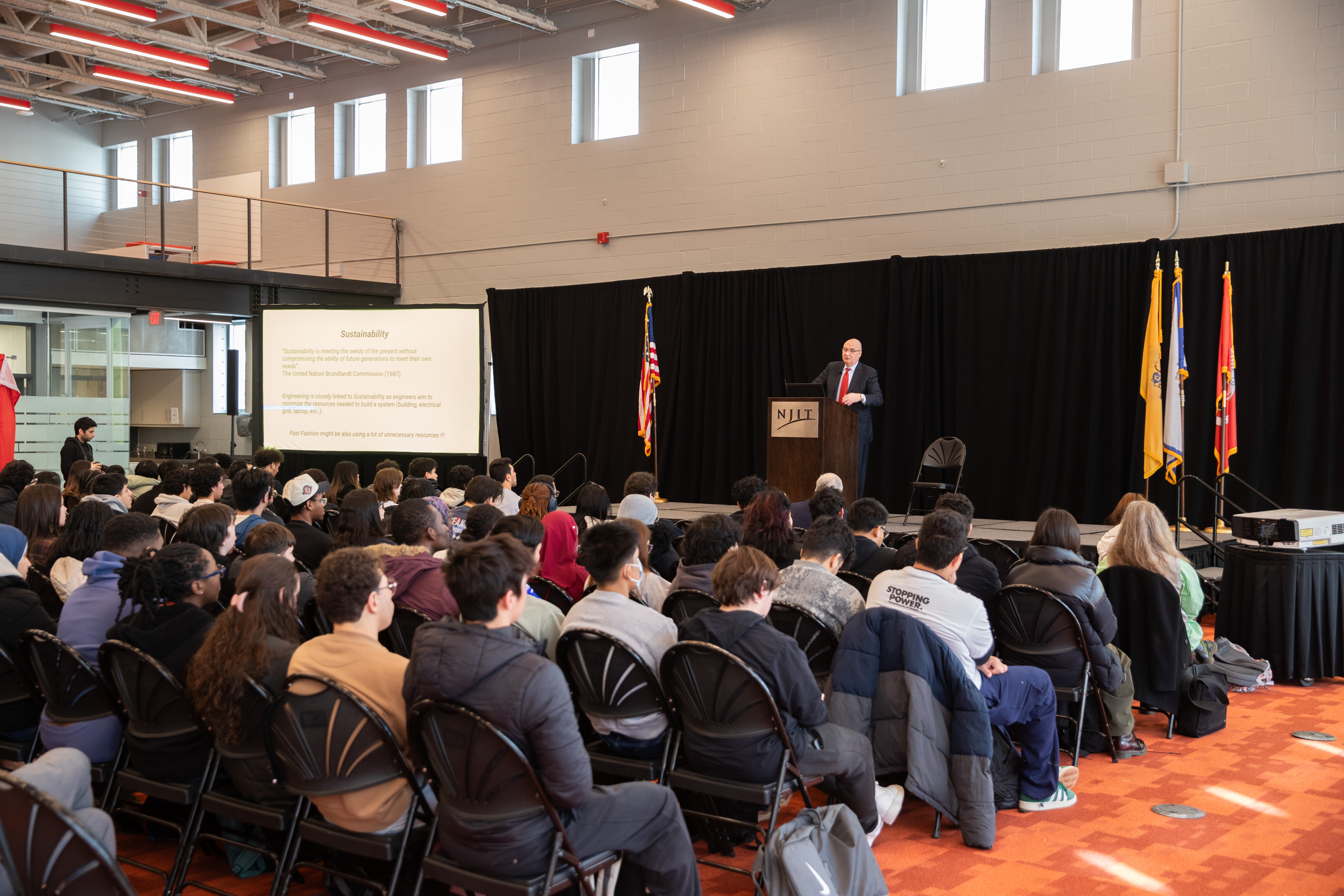
Speaker Michel Boufadel addresses engineering students at the kickoff sustainability seminar on Feb. 26.
After the lecture, CNR students presented several of the center's projects. A screen display about stormwater management showed how researchers deployed drones to conduct site surveys in neighborhoods that often flood during heavy storms. That data helps to calibrate stormwater models so that experts can find infrastructure solutions, said presenter Ahmad Ibrahim '28, a CNR member and PhD candidate in environmental engineering who uses machine learning to predict flood levels.
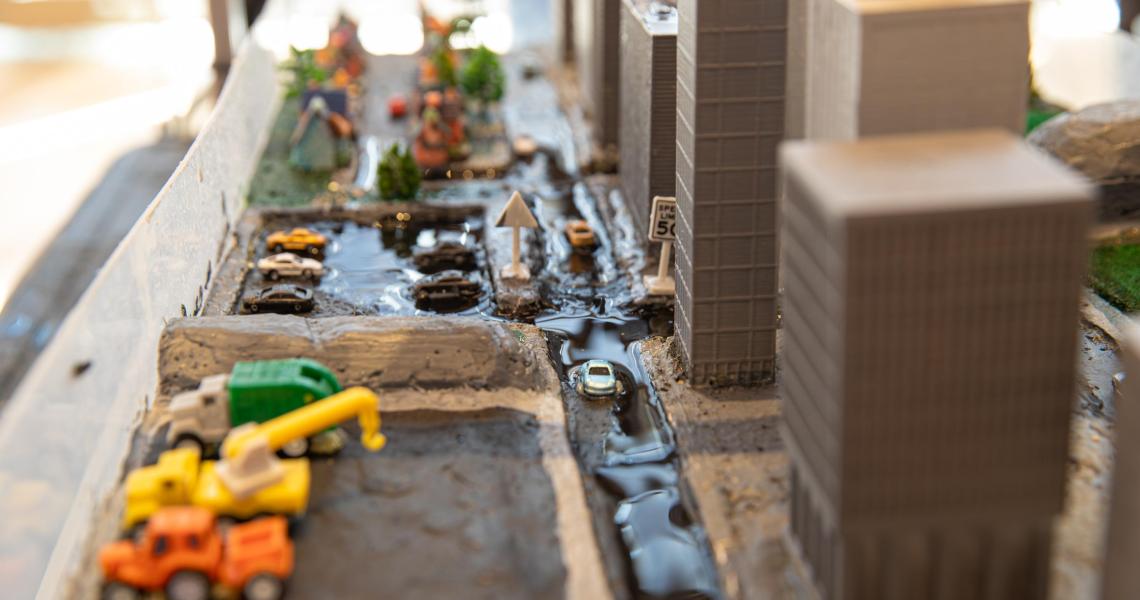
In a digital model, the addition of rainfall in varying amounts revealed how water moves through a city. On a table nearby sat a physical model of generic city streets; one zone on the left side had infrastructure designed to absorb excess water, and one zone on the right lacked that infrastructure. When an operator turned on a shower head and saturated the streets with simulated rainfall, it revealed a key difference between the two neighborhoods.
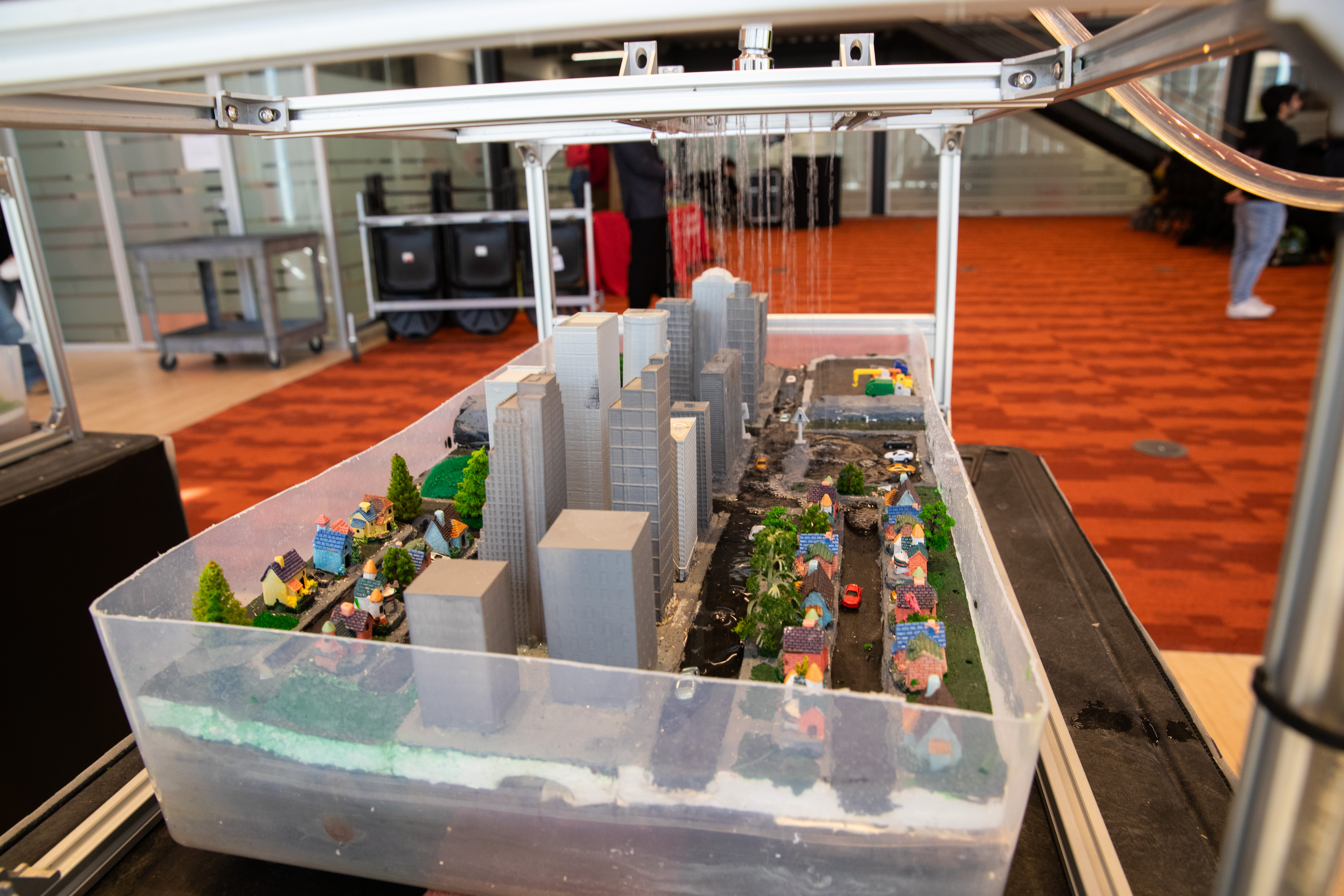
Simulated "rainfall" on a 3D model of a city produced by the Center for Natural Resources, demonstrating how green infrastructure can prevent flooding.
"On the left side, you'd see less water over time, whereas on the right side, water would stay pooling for a longer amount of time because there's nothing to absorb it," Ibrahim noted. And with the digital model "we can simulate it for an actual city instead of this hypothetical scenario."
Another physical model showed the absorption power of a stormwater garden full of greenery. "We've actually seen this in applications in real life," Ibrahim said. "I was in New Orleans last year, and we saw a bunch of stormwater planters. They're usually large, but they're made to be very beautiful as well, so it feels like a park. It adds to the aesthetic of a city. And on top of that, it's very effective at reducing stormwater runoff."
The opportunity for real-world impact is what drew Ibrahim to environmental engineering, after he earned a Bachelor's in electrical engineering.
"When I came to environmental engineering, we immediately started working with communities," he said. "We'd install cameras and sensors within the cities, and we'd talk to the city members and they'd tell us their stories. We can see the impact that we can potentially make if we put our minds together."
NJIT's next sustainability seminar is planned for the next National Engineers' Week in February 2027. However, the response to the first event was so positive that organizers are considering scheduling an additional seminar for the fall semester of 2026, Borgaonkar says.
Learn more about NJIT's Center for Natural Resources and the Office of Sustainability.