Alumna Blazes Trail from NJIT Forensics Program to NJ State Troopers’ Exclusive Ranks
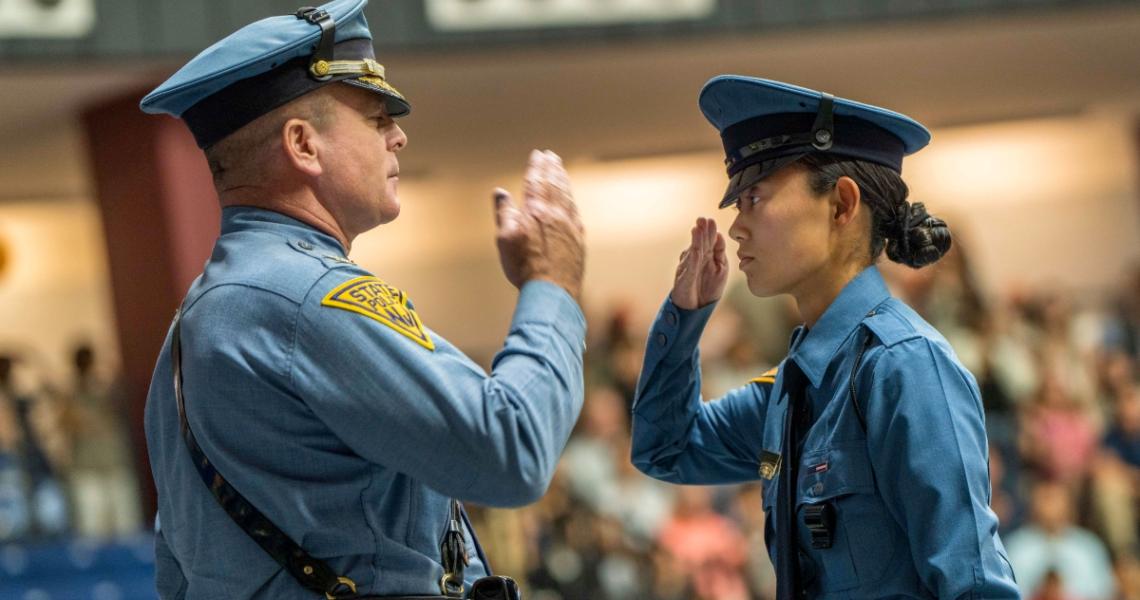
On a normal day, Trooper Zoe Welch ’24 pulls out of her station and steers her cruiser along the pine-lined highways and backroads cutting through southern New Jersey. For Welch, it’s a routine patrol — but also a very different path from NJIT peers who graduated with STEM degrees alongside her just over a year ago.
In fact, Welch is the first graduate of NJIT’s forensic science program to join the exclusive ranks of New Jersey’s State Police.
Each year, thousands across the Garden State apply to become state troopers. Yet, in the agency’s 104-year history, fewer than 10,000 have donned the unmistakable French blue uniform.
Welch was among just 148 recruits to complete NJSP’s rigorous 26-week residential academy training in Sea Girt from February-August last year, graduating as part of its 167th Class.
“It was a mix of everything emotions-wise,” Welch said of graduation day. “You made it through — but you also know it’s just the beginning.”
“I like helping people and making a tangible difference,” added Welch, a Jackson, N.J. native. “As a trooper, you’re there on the ground, connected to what’s happening and applying everything you’ve learned in real time. It’s rewarding.”
For Welch, the road to Sea Girt began long before the uniform fittings and early morning roll calls.
Just before graduating from NJIT with a double major in forensic science and biochemistry, Welch entered the NJSP’s yearlong, nine-step application process — physical tests, written exams, background investigations, interviews and psychological and medical evaluations.
“I walked across the stage and got my NJIT diploma, and two days later I was at Sea Girt for my initial physical qualification test,” she recalled. “The process got more intense as it went.”
Welch says the group selected for academy training faced a six‑month residential test of endurance — hours of physical and self‑defense training, and high‑pressure scenario exercises daily, and rigorous instruction across a wide range of law enforcement skills.
“It was Monday morning to Friday night,” Welch said. “You’re up at 5a.m., lights out at 10p.m., then back up around 5 a.m. for training. Sometimes they woke us in the middle of the night to test us. We started with 203 recruits — 148 graduated.”
Following the Investigation, Wherever It Leads
Welch said her path began with a love of science and math in grade school, along with watching T.V. shows such as The Flash, whose main character, Barry Allen, works as a forensic scientist.
“I was always more interested in the crime scene parts,” she said. “Watching Barry Allen work through the evidence was so cool to me.”
By senior year of high school, she’d choose to attend NJIT because it offered New Jersey’s only four‑year bachelor’s degree program in forensic science.
By sophomore year, Welch found her stride in NJIT’s Introduction to Crime Scene Investigation course taught by former Somerset County Detective Kevin Parmelee, earning the “Top CSI Cap,” awarded to the highest-performing student.
“I liked the field work more than the lab side of forensics,” said Welch, a perennial Dean’s List student, former Forensic Science Student Association secretary and Forensic Science Honor Society chair. “The CSI class and hands-on experiences I got at NJIT, like visiting the Newark Ballistics Laboratory and New York City Office of Chief Medical Examiner, inspired me.”
She also helped Parmelee launch NJIT's Shoeprint Image Capture and Retrieval (SICAR) database — one of only two N.J. forensic footwear databases.
“Zoe was a great student. It was a privilege to work with someone so energized and driven,” said Parmelee, who remained a mentor throughout her undergraduate years.
Still, it was a summer internship with the Ocean County Sheriff’s Office crime scene unit —pursued with NJIT forensic science faculty support — that cemented her direction.
“Shadowing at crime scenes that summer was intense but really brought together everything we learn as forensic scientists — documentation, scene preservation, collection of evidence,” Welch said. “Being exposed to real cases, I realized that’s what I want to do.”
During her senior year, she approached Parmelee to discuss her next step.
“I explained the realities of such a career and introduced her to a few officers,” Parmalee recalled. “From that point, her drive to succeed did the rest.”
Today, Welch applies her training in uniform. After completing NJSP’s Trooper Coach Program, she now patrols independently as part of Troop A, one of four troops statewide, responsible for southern New Jersey.
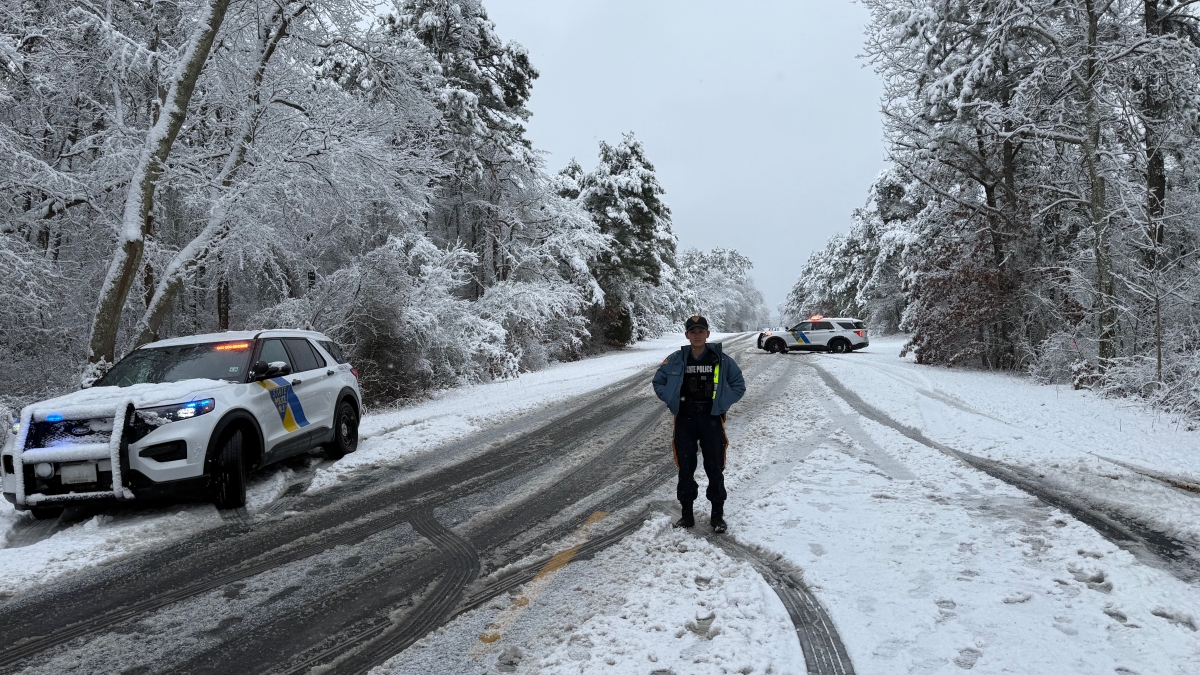
Assigned to field operations across four townships, she monitors major roadways and responds to 911 calls — everything from domestic violence cases to motor vehicle crashes, and other unpredictable situations.
“No two calls are the same,” she said. “You never know what you’re walking into. A lot of times, we’re likely seeing someone on their worst day. So, it’s important to be mindful of that, to treat each case without bias and adapt to the situation.”
For now, Welch is focused on building experience before becoming eligible for specialized units like crime scene investigation — work that would bring her journey full circle.
“There’s opportunity to grow within the NJSP. I hope to join their crime scene unit one day,” she said. “Right now, I’m just trying to be the best trooper I can be — learning from every call, every experience.”