NJIT Researchers, Ham Radio Operators Partner to Track Impact of Space Weather
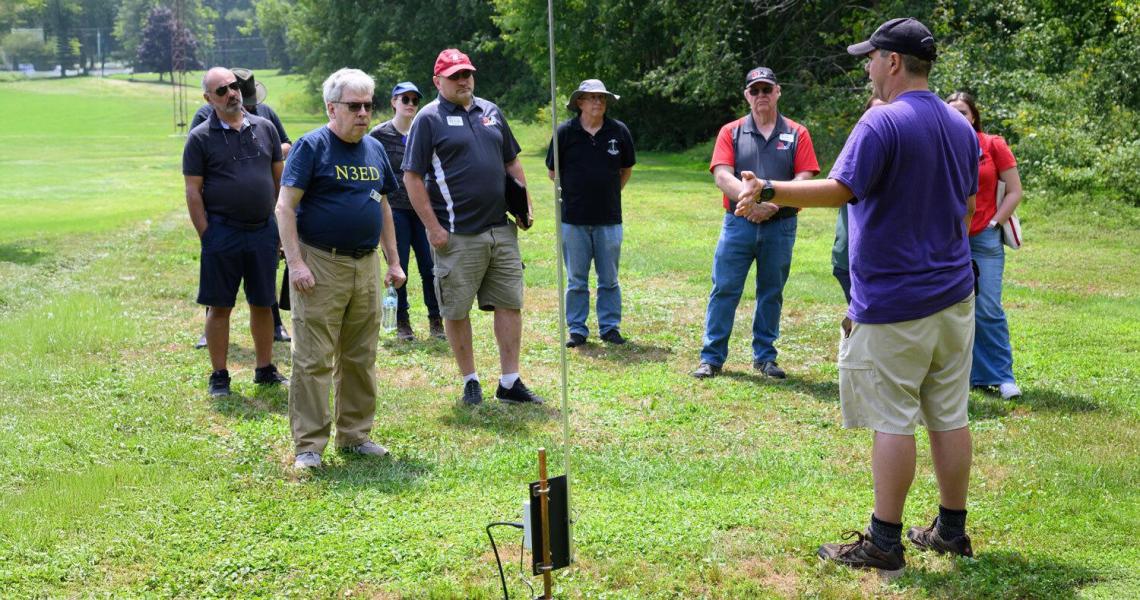
Researchers from four universities, including New Jersey Institute of Technology, are expanding a network of ham radio operators in North America to better track how the earth’s upper atmosphere is impacted by natural phenomena such as geomagnetic storms and lightning.
The researchers are also upgrading the equipment that the operators use to record data. The goal is two-fold: extend the footprint of the network and produce more refined data. That data, in turn, will help scientists and their students better understand how those phenomena cause breakdowns in satellite transmission or emergency communications. Ultimately, that could enable them to predict such breakdowns in advance.
The collaborative project is in its second phase and supported by $1.7 million in grants from the U.S. National Science Foundation. The grants pay for the equipment. The ham operators are volunteers who are licensed, tech-savvy and dedicated. That makes them ideal for this type of Ham Radio Science Citizen Investigation initiative — HamSCI for short.
“A lot of the HamSCI participants are retired scientists. They have advanced degrees,” said Gareth Perry, an assistant professor of physics at NJIT and co-principal investigator on the project. “They are very technically adept and very good at what they do. That is extremely valuable.”
Case in point: Michael Hauan of Missouri, one of the speakers at HamSCI’s annual workshop at NJIT this year, which drew more than 170 participants — including 70 online. During his presentation, Hauan noted that he uses five antennas to collect data at his site. It’s just a hobby, though. As he explained, “I’m not a scientist. I’m a doctor.”
Growing the dataset
In phase two, the researchers plan to add or upgrade 20 sites in the U.S. and Canada.
“An increase in observational sampling has always been needed. We have never had enough sensors available to truly understand the geospace system,” explained Nathaniel Frissell, the project’s principal investigator and an associate professor at The University of Scranton. “Thanks to increases in technology, we now have the ability to deploy more instruments inexpensively and to process the large amounts of data that they will create.”
Frissell laid the groundwork for the HamSCI network when he was graduate research assistant at Virginia Tech and later, a postdoctoral researcher and assistant research professor at NJIT. His interest in ham radio runs deep: he took up the hobby as a teenager and it inspired him to become a scientist. And like the hobbyists at the workshop, he introduced himself by his ham radio call sign, W2NAF. He’s excited about the prospects of phase two.
“The real-world benefits will include a better local understanding of space weather effects,” Frissell said. “Right now, space weather data is generally provided on a global, or at best, a continental scale.”
The project’s other co-principal investigator is Hyomin Kim, an assistant professor of physics at NJIT. Both Kim and Perry are affiliated with NJIT's Center for Solar-Terrestrial Research. The other two collaborating universities are the University of Alabama and Case Western Reserve University.