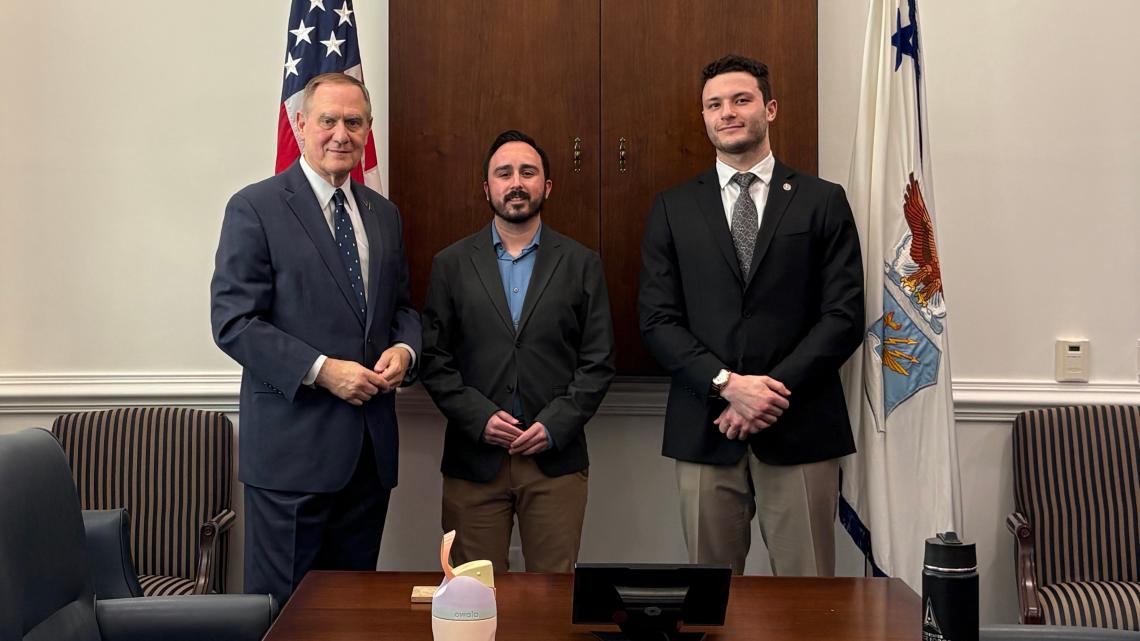
Sam Itman ’22, M.S. ’23 came to NJIT with a passion for solving complex, real-world problems that would have a tangible impact on a national scale, prioritizing mission value over private-sector compensation. His recent promotion as an innovation and AI specialist for the United States Department of the Air Force in July 2026 is a high watermark in a career that has experienced a rapid upward trajectory from his time as a dean’s list student and member of the National Science Foundation’s CyberCorps Scholarship for Service (SFS) program, which is part of the NJIT Secure Computing Initiative, to his current position in the Pentagon.
He leads with the belief that technology "presents a world of opportunities to those who are willing to discover them." And when your surname is also your calling (IT man), your destiny is pre-ordained, the great work begins early, and you dive in headfirst (Itman is a former competitive swimmer).
As one who graduated first in his class of 1,815 students, Itman aimed for a lucrative career in computing from the moment he crossed NJIT’s threshold. However, his eyes were not initially trained on government service.
“I never planned on government service. SFS sort of fell into my lap at the invitation of the P.I.’s (the four principal investigators and directors of the SFS program),” he said. “I would have gone into private industry and never gotten my M.S. in IT Administration – and never realized that this was where I belonged.”
He credits the P.I.’s and program with instilling in him a passion for taking his natural acumen for finding solutions through problem solving and using them for the greater good and protection of the country. “They know how to prepare us!” he exclaimed.
Immediately following graduation, Itman entered roles supporting the Department of Defense and Space Force missions before being chosen to serve as a technical specialist on the Air Force’s Executive Order tiger team assigned to rapidly develop solutions to implement executive orders across the total force of 700,000 personnel.
A tiger team is a small, highly skilled, cross-functional group assembled to solve critical, time sensitive problems. The task at hand involved working directly with leadership from across the Department of the Air Force, developing the capabilities to implement the administration’s executive orders, such as the Deferred Resignation Program.
Itman’s overall experience with the military has spanned cybersecurity, DevOps, and enterprise systems, and contributed to platforms tied to threat intelligence and national defense infrastructure.
In expressing concern over the nation’s rush to invest in AI technology without taking security in mind, he sees his position as playing a pivotal role in assisting the government to manage substantive change. With the stakes as high as they are presently, foresight takes time; however, he views making the country run effectively through rapid design and implementation as not only an enriching experience but one that “money can’t buy.”
According to Itman, less than 10% of federal government employees are under 30 years of age, and the public sector provides many fulfilling opportunities for recent graduates.
“The federal government is a great employer, but so is local government,” he said. “There is a very real need for tech expertise. So, while there is anxiety over private industry jobs, I think hiring is accelerating in the public service sector. If you prioritize making an impact through rewarding work and are motivated to make a difference, this is an amazing career path. I’ve met so many interesting people who have influenced my professional development.”
Itman has been recognized for contributions as part of the Executive Order tiger team and is the recipient of an early career service-level Cyber Operations Functional Award.
Learn more about the CyberCorps Scholarship for Service Program: https://sfs.opm.gov/. The NJIT Secure Computing Initiative anticipates re-launching during the 2026-2027 academic year after a brief pause during 2025. Refer to https://sci.njit.edu/ for updated information.
DISCLAIMER “The views expressed are those of the authors and do not reflect the official guidance or position of the United States Government, the Department of Defense the United States Air Force or the United States Space Force.”
